|

EUR/USD drops 0.30 percent as the yield differential widens

  • EUR/USD drops on US tax reform news
  • US-German 10-year yield spread widens, currently at levels last seen in May

EUR/USD fell more than 0.30 percent in Asia to low of 1.1807 as the US Senate approved budget in crucial step forward for Republican tax cuts.

The tax reform news pushed up the Treasury yields, resulting in widening of the US-German 10-year yield spread.
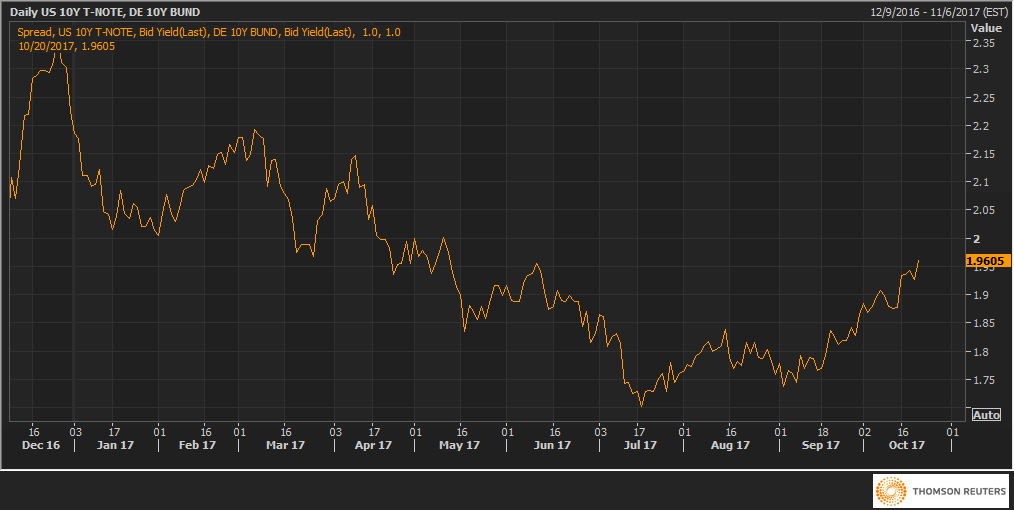
  • The spread currently stands at 196 basis points; the highest since mid-May.

Ahead in the day, the USD may remain well bid on the back of the tax reform news. The Eurozone producer price index data and current account data are unlikely to move EUR pairs in a big way.

Kathy Lien from BK Asset Management writes, " Fed Chair Yellen will speak today, but not until markets close so most of the day will be spent guessing whether she will be more hawkish or dovish. Chances are there will be limited new position taking ahead of her lecture on monetary policy since the financial crisis." 

EUR/USD Technical Levels

The spot was last seen trading around 1.1815 levels. James Chen from Forex.com shares his view on EUR/USD-

"EUR/USD is trading just under its 50-day moving average and between key price levels around the 1.1700 support area to the downside and the 1.1900 resistance area to the upside. The ECB decision next week will help dictate if and in what direction the euro may break this trading range. A likely scenario is that the central bank may advocate a more gradual tapering process over a longer period of time than expected, in part to avoid further euro strengthening. If this is the case, the euro could take a hit and EUR/USD could stumble, especially if Fed-driven dollar support resumes. In this event, a EUR/USD breakdown below 1.1700-area support could pressure the currency pair towards key downside targets around the 1.1600 and 1.1450 support areas."

Author

Omkar Godbole

Omkar Godbole

FXStreet Contributor

Omkar Godbole, editor and analyst, joined FXStreet after four years as a research analyst at several Indian brokerage companies.


More from Omkar Godbole
Share:

Editor's Picks

GBP/USD keeps the vacillating tone near 1.3650

GBP/USD struggles to extend its ongoimg recovery on Monday, this time flirting with the 1.3650 zone. Indeed, Cable trades without clear direction, although it manages well to maintain its business in the upper end of the recent range, challenging multi-week tops despite the decent recovery in the Greenback.

EUR/USD drifts lower to the 1.1670 zone

EUR/USD navigates a tight range at the beginning of the week, hovering around the 1.1670 region amid humble losses. The pair’s decline follows a decent advance in the US Dollar while investors continue to closely follow developments from the US money market.

Gold pushes harder; focus is now on $4,700

Gold keeps its bullish pace well and sound and approaches the $4,700 mark per troy ounce for the first time since early May. The precious metal’s move higher comes despite slight gains in the US Dollar and a modest pullback in US Treasury yields across the curve.

Here's what I learned trading meme coins
I’ve been trading cryptocurrencies for the past seven years, with meme coins becoming one of the most exciting and implacable parts of my experience. I love them because they represent internet culture and community sentiment, and, let’s be honest, extreme speculation. Newly launched meme coins were especially tempting: get in early enough, I thought, and a small bet could turn into a huge return.
Bessent’s presser in focus
Preview: Busy week ahead, with Bessent kicking this off today, with things wrapping up with Warsh at Jackson Hole. For a month that should have been a temporary period of ‘quiet’, we had anything but last week, with the bond market and tariffs front and centre.
$20 billion offered, $2 billion taken: Why Treasury doubled its buyback cap

The US Treasury moved off its own calendar on Wednesday, and that is the part worth sitting with. At 12:32 GMT, the department said it would at least double the size of liquidity support buyback operations in the 10-year to 20-year and 20-year to 30-year sectors, lifting the maximum from $2 billion per operation to at least $4 billion, effective September 9 and running to November 4.















