|

EUR/JPY Price Analysis: Risk of recovery after deep sell-off

  • EUR/JPY finds a floor after its steep sell-off. 
  • The pair forms a Dragonfly Doji and recovers – a bullish close on Friday would add confidence to bulls. 
  • Once the pull back is complete, however, the medium-term downtrend is likely to resume. 

EUR/JPY is at risk of recovering after the steep sell-off of the last two weeks has stalled. The EUR/JPY pair reached a low of 164.83 on Thursday – well below its July 11 peak of 175.43. Since then it has been edging higher as the pair recovers from oversold extremes. 

EUR/JPY Daily Chart 
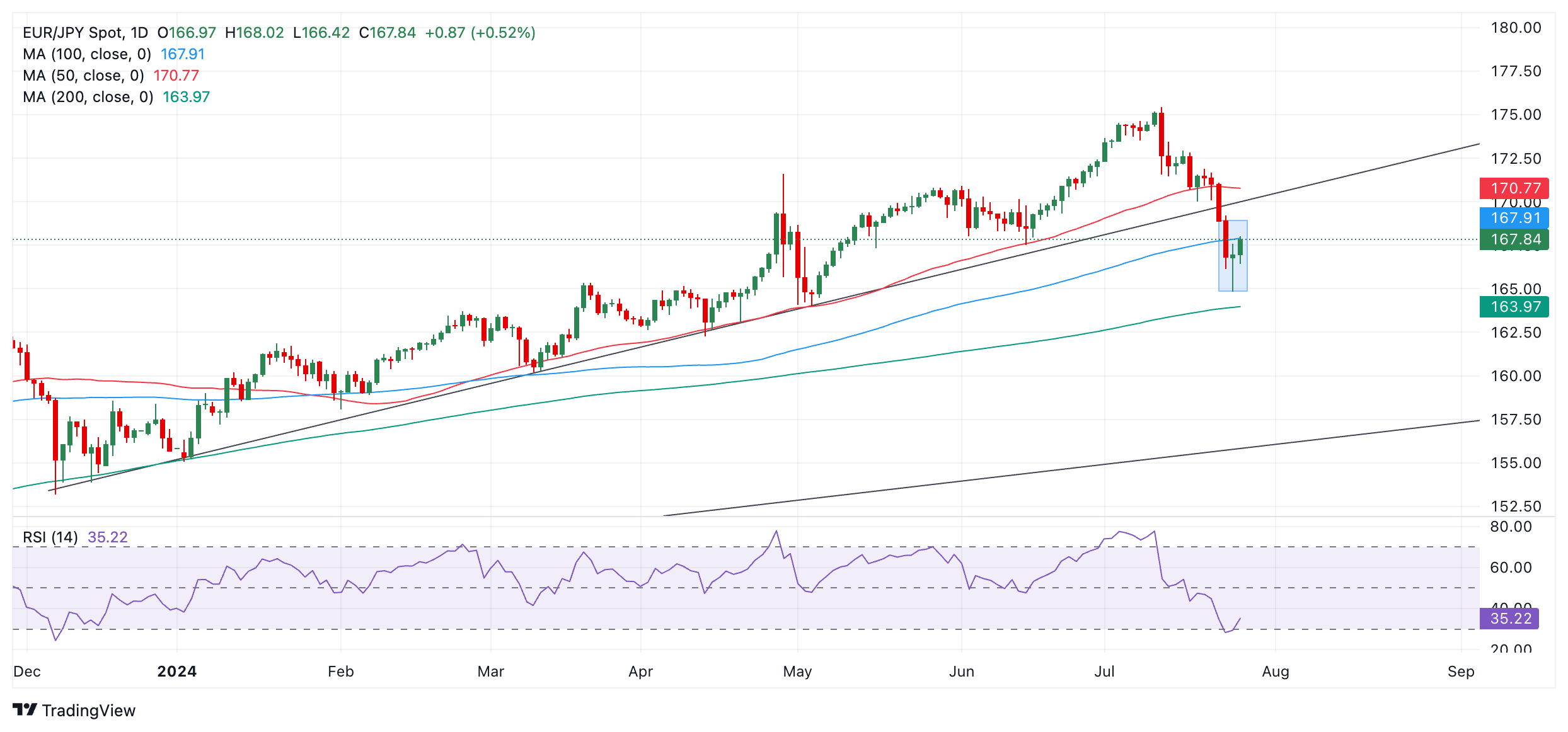


The pair formed a bullish Dragonfly Doji reversal candlestick on Thursday (blue shaded rectangle on chart above) and if it is followed up by a bullish close on Friday it will suggest a correction higher is underway. 

Additionally, the Relative Strength Index (RSI) entered oversold territory (below 30) on Thursday and if it manages to move back above the oversold zone on Friday it will be a signal that price will probably go higher. 

If the pair does recover, however, it is likely to be corrective and eventually run out of steam. This is because both the short and medium-term trends are now probably bearish, which given the old saying “the trend is your friend” suggests the bias is to the downside.  

Once the recovery runs out of energy, price will probably resume its downtrend. The next support level to look out for is the 200-day Simple Moving Average (SMA) at 163.97. A close below that might see EUR/JPY fall to major trendline support at around 157.50. 

The longer-term trend remains intact, however, and there is a chance the pair could make a full recovery back up to the July 11 highs, and possibly go even higher. Whether this happens or not depends on how price action unfolds and how vigorous the recovery is. 

Author

Joaquin Monfort

Joaquin Monfort is a financial writer and analyst with over 10 years experience writing about financial markets and alt data. He holds a degree in Anthropology from London University and a Diploma in Technical analysis.


More from Joaquin Monfort
Share:

Editor's Picks

GBP/USD extends the drop to 1.3360

GBP/USD builds on Monday’s decline and briefly clinches five-day lows near 1.3360 on Tuesday. Cable’s extra pullback follows the better tone in the Greenback as uncertainty in the Middle East prompts investors to adopt a cautious stance. Meanwhile, an apathetic UK labour market report also collaborates with the selling pressure on the British Pound.

EUR/USD stays offered just above 1.1400

EUR/USD keeps the downtrend well in place for yet another day, challenging the 1.1400 contention zone on Tuesday. The continuation of the selling impulse in spot comes amid decent gains in the US Dollar, which continues to find support in the persistent effervescence surrounding the US-Iran crisis.

Middle East crisis intensifies, Gold up

Gold now seems to have embarked on a consolidative phase below the key $4,100 mark per troy ounce in the latter part of Tuesday’s session. Meanwhile, uncertainty surrounding the Middle East conflict and rising expectations for a hawkish Fed policy outlook are expected to limit the precious metal’s bullish momentum in the near term.

XRP rebounds on rising on-chain activity
Ripple (XRP) ticks up and trades around $1.13 at the time of writing on Tuesday. This rebound aligns with a broader recovery in the cryptocurrency market, attributed to reports that mediators between the United States (US) and Iran are seeking a 10-day cessation of strikes to find a way back to the signed Memorandum of Understanding (MoU).
The Iranian war has again risen
The Iranian war has again risen to the top of the economics factor list. There is no end in sight. Intelligence experts say the current level of offense/retaliation will not change minds in Tehran, while in Washington, Trump fears all-out war, which would mean boots on the ground.
US Dollar mid-year outlook: Exceptional currency, exceptional risks?
The US Dollar enters the second half of 2026 in a markedly different position from a year ago. The King currency has recovered, reflecting persistent US inflation, changing expectations for Fed policy, geopolitical tensions and renewed demand for defensive assets.