EUR/GBP declines to year-to-date lows after UK Retail Sales, ECB meeting
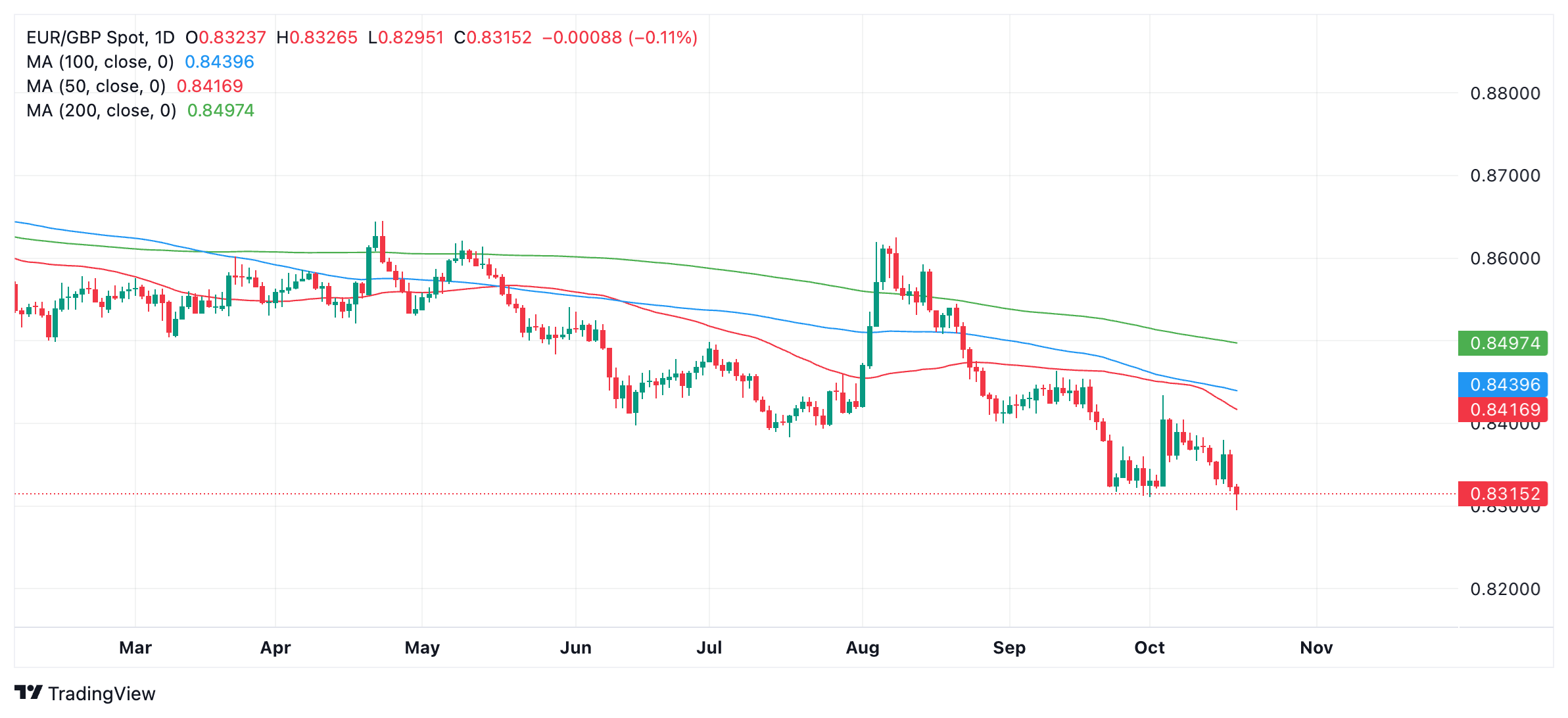
- EUR/GBP falls to a new low for 2024 on Friday after Sterling strengthens following higher-than-expected UK Retail Sales.
- The Euro remains weak after the ECB cuts interest rates at two meetings in a row, accelerating its easing cycle.
- Analysts think diverging monetary policies could push EUR/GBP even lower.

EUR/GBP declines to fresh year-to-date lows of 0.8295 on Friday as the Pound Sterling (GBP) appreciates against the Euro (EUR) following the release of data showing British shoppers spending extravagantly in September.
The lofty data suggests the Bank of England (BoE) will not be in such a hurry to lower interest rates in coming months. Given the BoE’s bank rate stands at 5.00% (one of the highest amongst western central banks) it is likely to continue to attract foreign capital inflows, and, in turn, demand for Sterling.
EUR/GBP Daily Chart
The Euro, meanwhile, remains vulnerable on Friday, on the day after the European Central Bank’s (ECB) decision to cut its interest rates by 25 basis point (bps) (0.25%) bringing the key deposit facility rate down to 3.25%. Although the move was widely telegraphed, it represents a significant turning point in the ECB’s easing cycle. By cutting rates at two consecutive meetings the ECB has signaled a speeding up of its easing cycle, according to analysts, which suggests more frequent cuts ahead. Further, the decision was accompanied by a mildly dovish statement and question-and-answer session by ECB President Christine Lagarde.
“Lagarde confirmed the decision to cut 25 bp yesterday was unanimous and highlighted there was more downside than upside risks to inflation,” said a note by Brown Brothers Harriman (BBH). “Market is now pricing in almost 175 bps of ECB rate cuts over the next twelve months that would see the policy rate bottom near 1.50% vs. 2.00% earlier this week,” it went on.
On Friday, the ECB officials who spoke adopted an unambiguously dovish stance, adding fuel to the flames left by the meeting. ECB member and Banque de France Président Francois Villeroy de Galhau said the direction was clear in his eyes, “we should continue to reduce the restrictive character of our monetary policy in an appropriate manner.” Meanwhile, ECB Governing Council member Boštjan Vasle noted that everything pointed to the process of disinflation being more robust.
EUR/GBP is at risk of extending its downtrend after the UK Retail Sales data, according to BBH. The data surprised to the upside: Retail Sales rose 0.3% MoM, beating expectations of a 0.3% decline, and up on the 0.1% rise of the previous month, and this means the policy paths of the two central banks are diverging sharply.
"GBP firmed up briefly after stronger U.K. retail sales activity reinforced the case for a cautious BOE easing cycle,” said Elias Hadid, Senior Markets Strategist at BBH, “Bottom line: the relative monetary policy trend between the ECB and BOE still favors a lower EUR/GBP,” he concluded.
Not all economists are as confident UK interest rates will remain elevated – at least in the long-term. Alex Kerr, UK Economist at Capital Economics, disagrees with the market about the trajectory of UK rates, saying “We still think the Bank of England will reduce interest rates from 5.00% now to 3.00% in early 2026, rather than to 3.75% as anticipated by investors. But if the Chancellor were to raise investment by more than we expect,” he adds, “rates may not fall quite as fast.”
Author

Joaquin Monfort
FXStreet
Joaquin Monfort is a financial writer and analyst with over 10 years experience writing about financial markets and alt data. He holds a degree in Anthropology from London University and a Diploma in Technical analysis.