EUR/AUD Price Forecast: Bears have the upper hand; positive move could get sold into
- EUR/AUD gains some positive traction, though the bias seems tilted in favor of bearish traders.
- Worries about a fresh US-China trade war could undermine the Aussie and cap any further gains.
- A 'Death Cross' formation supports prospects for the emergence of fresh selling at higher levels.

The EUR/AUD cross attracts some buyers during the Asian session on Tuesday and reverses a part of the previous day's slide, though it lacks bullish conviction. Spot prices currently trade around the 1.6235-1.6240 region, up less than 0.20% for the day as traders now look to German macro data – the final CPI print and ZEW Economic Sentiment.
In the meantime, the Australian Dollar (AUD) continues with its relative underperformance amid worries that US President-elect Donald Trump's protectionist stances could trigger a fresh US-China trade war. This, to a larger extent, overshadows the Reserve Bank of Australia's (RBA) hawkish stance and continues to undermine the China-proxy Aussie, offering some support to the EUR/AUD cross.
Meanwhile, Trump warned before the election that the European Union would have to pay a big price for not buying enough American exports. This, in turn, could strain the Eurozone’s export sector and potentially impact economic growth. Apart from this, a bullish US Dollar (USD) continues to exert some downward pressure on the shared currency and should keep a lid on the EUR/AUD cross.
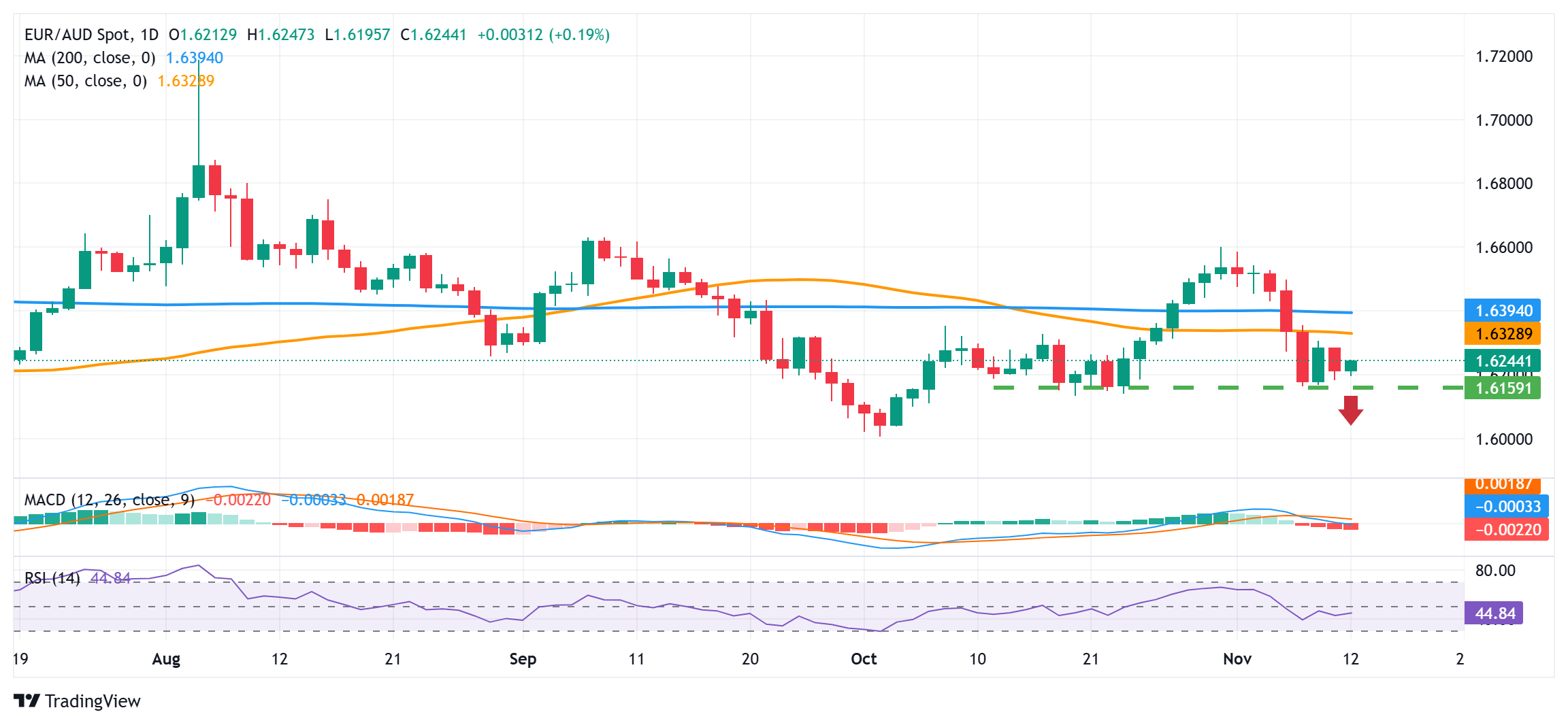
From a technical perspective, the formation of 'Death Cross' – the 50-day Simple Moving Average (SMA) crossing below the 200-day SMA – further warrants caution for bullish traders. Moreover, oscillators on the daily chart have been gaining negative traction and are still away from being in the oversold zone, suggesting that the path of least resistance for the EUR/AUD cross is to the downside.
Hence, any subsequent move-up might continue to attract fresh sellers ahead of the 1.6300 round figure. This, in turn, should cap spot prices near the 50-day SMA, currently pegged near the 1.6325 region. A sustained strength beyond, however, could lift the EUR/AUD cross back towards the 1.6400 mark, or the 200-day SMA, which should now act as a key pivotal point for short-term traders.
On the flip side, the 1.6200 round figure, closely followed by the 1.6180 horizontal zone might continue to protect the immediate downside. A convincing break below will reaffirm the negative bias and make the EUR/AUD cross vulnerable to weaken below the 1.6150-1.6145 support, towards the 1.6110-1.6100 area en route to the 1.6060-1.6050 region and the October low, around the 1.6000 psychological mark.
EUR/AUD daily chart
Australian Dollar FAQs
One of the most significant factors for the Australian Dollar (AUD) is the level of interest rates set by the Reserve Bank of Australia (RBA). Because Australia is a resource-rich country another key driver is the price of its biggest export, Iron Ore. The health of the Chinese economy, its largest trading partner, is a factor, as well as inflation in Australia, its growth rate and Trade Balance. Market sentiment – whether investors are taking on more risky assets (risk-on) or seeking safe-havens (risk-off) – is also a factor, with risk-on positive for AUD.
The Reserve Bank of Australia (RBA) influences the Australian Dollar (AUD) by setting the level of interest rates that Australian banks can lend to each other. This influences the level of interest rates in the economy as a whole. The main goal of the RBA is to maintain a stable inflation rate of 2-3% by adjusting interest rates up or down. Relatively high interest rates compared to other major central banks support the AUD, and the opposite for relatively low. The RBA can also use quantitative easing and tightening to influence credit conditions, with the former AUD-negative and the latter AUD-positive.
China is Australia’s largest trading partner so the health of the Chinese economy is a major influence on the value of the Australian Dollar (AUD). When the Chinese economy is doing well it purchases more raw materials, goods and services from Australia, lifting demand for the AUD, and pushing up its value. The opposite is the case when the Chinese economy is not growing as fast as expected. Positive or negative surprises in Chinese growth data, therefore, often have a direct impact on the Australian Dollar and its pairs.
Iron Ore is Australia’s largest export, accounting for $118 billion a year according to data from 2021, with China as its primary destination. The price of Iron Ore, therefore, can be a driver of the Australian Dollar. Generally, if the price of Iron Ore rises, AUD also goes up, as aggregate demand for the currency increases. The opposite is the case if the price of Iron Ore falls. Higher Iron Ore prices also tend to result in a greater likelihood of a positive Trade Balance for Australia, which is also positive of the AUD.
The Trade Balance, which is the difference between what a country earns from its exports versus what it pays for its imports, is another factor that can influence the value of the Australian Dollar. If Australia produces highly sought after exports, then its currency will gain in value purely from the surplus demand created from foreign buyers seeking to purchase its exports versus what it spends to purchase imports. Therefore, a positive net Trade Balance strengthens the AUD, with the opposite effect if the Trade Balance is negative.
Author

Haresh Menghani
FXStreet
Haresh Menghani is a detail-oriented professional with 10+ years of extensive experience in analysing the global financial markets.