Dow Jones Industrial Average breaches into yet another record high after gaining 300 points on Monday
- The Dow Jones is set to close north of 44,000 for the first time ever as bulls continue to run.
- Equity markets have tilted fully into the buy side after Trump’s decisive election win.
- US CPI inflation print due in the mid-0week as markets eye more Fed rate cuts.

The Dow Jones Industrial Average (DJIA) lurched another 300-plus points higher on Monday, with equities on the climb in an extension of the bull run kicked off after last week’s Trump win at the election polls. Markets are deceptively thin on Monday with most of the US shuttered during the Veteran’s Day holiday. Still, bidders continue to push the Dow Jones into record territory regardless.
Last week saw presidential candidate Donald Trump sweep to a surprise win in the latest US presidential election and another rate trim from the Federal Reserve (Fed). Investors see everything coming up aces, with US jobs data continuing to beat expectations and pulverize previous fears of an economic hard landing scenario.
Later this week brings a fresh update to US Consumer Price Index (CPI) inflation figures. October’s headline CPI is expected to accelerate to 2.6% YoY from the previous period’s 2.4%, with core CPI for the same period forecast to hold steady at 3.3% YoY. Thursday will follow up with US Producer Price Index (PPI) business-level inflation, which is also expected to tick higher to 2.9% YoY in October from 2.8%.
Fed Chair Jerome Powell will also make an appearance on Thursday, where the head of the Fed will participate in a panel discussion hosted by the Fed Bank of Dallas. Audience questions are expected to run the gamut of trying to nail down a hint about the Fed’s plans for another rate cut in December. Investors should also expect a familiar slew of questions about Chair Powell’s intent to ‘step down’ as head of the Fed if incoming president-elect Donald Trump asks for it, something the President’s office has no power or authority to request.
Dow Jones news
Don’t tell the Dow Jones Monday is a holiday; two-thirds of the index’s listed securities are pushing into the green to kick off the new trading week. Salesforce (CRM) surged over 5.5% to $340 per share as the AI bid continues to trickle into companies in the utility tech space, despite a clear path forward on when or even how large-scale data models will generate excess revenue. Honeywell International also rose 2% to $224 per share, tapping into a fresh-two year high.
Dow Jones price forecast
The Dow Jones is firmly back on its bullish ways, tearing into new record high bids and poised for a close north of 44,000 on Monday. The major equity index is now up nearly 20% bottom-to-top in 2024, and has risen an eye-watering 47% since the last time price action touched the 200-day Exponential Moving Average (EMA) near 30,000 in October of 2022.
Traders interested in trying to mount a short position have their work cut out for them; the Dow is on pace to close in record territory for a fifth straight month, leaving a complete lack of technical entry points on the table. Traders carrying long interest might look to pare some bets when the Dow Jones taps 45,000 for the first time, as large round figures tend to create some congestion.
Dow Jones daily chart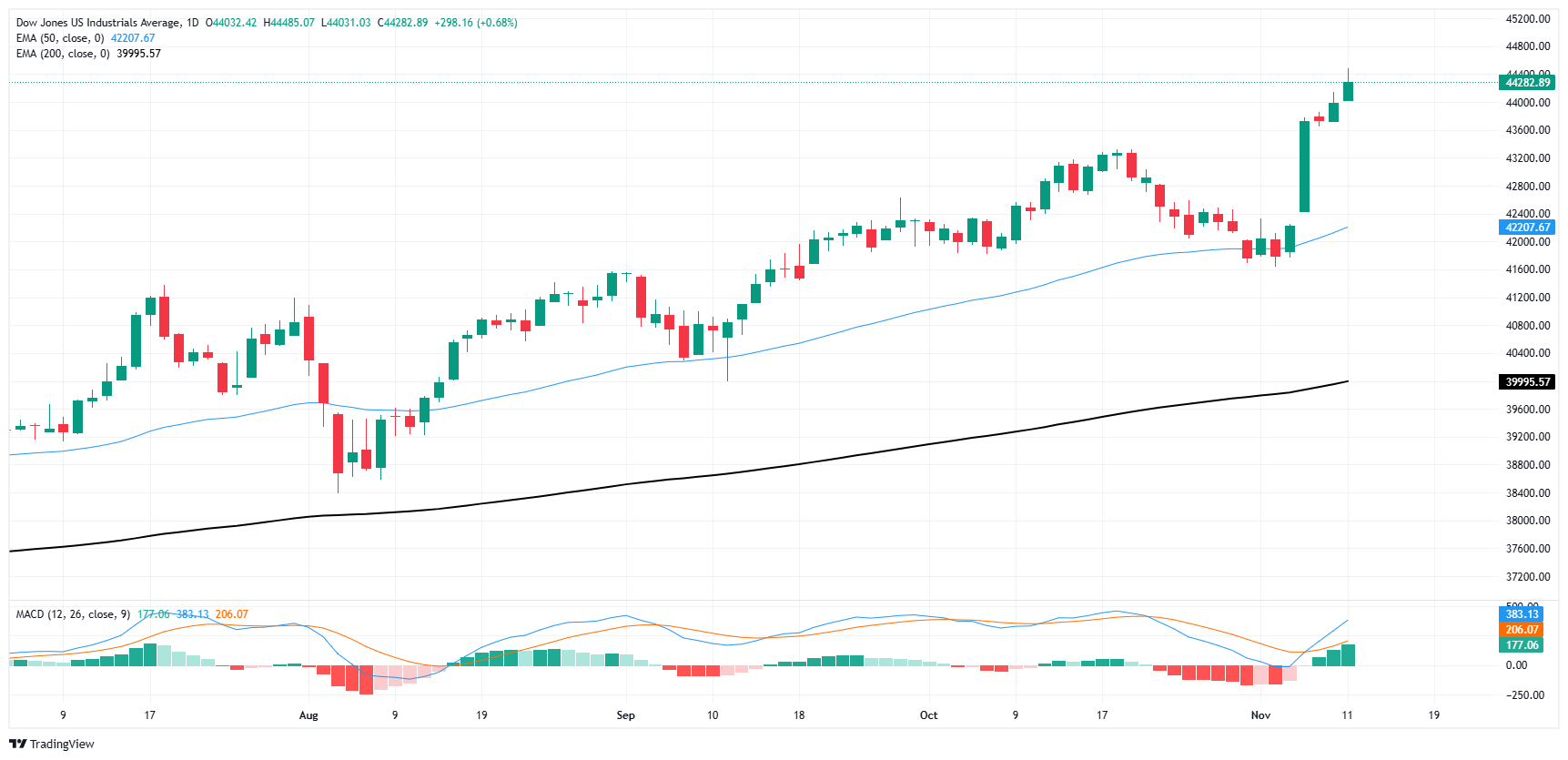
Dow Jones FAQs
The Dow Jones Industrial Average, one of the oldest stock market indices in the world, is compiled of the 30 most traded stocks in the US. The index is price-weighted rather than weighted by capitalization. It is calculated by summing the prices of the constituent stocks and dividing them by a factor, currently 0.152. The index was founded by Charles Dow, who also founded the Wall Street Journal. In later years it has been criticized for not being broadly representative enough because it only tracks 30 conglomerates, unlike broader indices such as the S&P 500.
Many different factors drive the Dow Jones Industrial Average (DJIA). The aggregate performance of the component companies revealed in quarterly company earnings reports is the main one. US and global macroeconomic data also contributes as it impacts on investor sentiment. The level of interest rates, set by the Federal Reserve (Fed), also influences the DJIA as it affects the cost of credit, on which many corporations are heavily reliant. Therefore, inflation can be a major driver as well as other metrics which impact the Fed decisions.
Dow Theory is a method for identifying the primary trend of the stock market developed by Charles Dow. A key step is to compare the direction of the Dow Jones Industrial Average (DJIA) and the Dow Jones Transportation Average (DJTA) and only follow trends where both are moving in the same direction. Volume is a confirmatory criteria. The theory uses elements of peak and trough analysis. Dow’s theory posits three trend phases: accumulation, when smart money starts buying or selling; public participation, when the wider public joins in; and distribution, when the smart money exits.
There are a number of ways to trade the DJIA. One is to use ETFs which allow investors to trade the DJIA as a single security, rather than having to buy shares in all 30 constituent companies. A leading example is the SPDR Dow Jones Industrial Average ETF (DIA). DJIA futures contracts enable traders to speculate on the future value of the index and Options provide the right, but not the obligation, to buy or sell the index at a predetermined price in the future. Mutual funds enable investors to buy a share of a diversified portfolio of DJIA stocks thus providing exposure to the overall index.
Author

Joshua Gibson
FXStreet
Joshua joins the FXStreet team as an Economics and Finance double major from Vancouver Island University with twelve years' experience as an independent trader focusing on technical analysis.
















