Dow Jones Industrial Average climbs to the top of the index pile in thin Monday
- Dow Jones is the clear winner of the major US equity indexes on Monday.
- The Dow Jones is up over three-quarters of one percent to kick off the trading week.
- Key US data data due later in the week as rate cut hopes grip September.

The Dow Jones Industrial Average (DJIA) gained ground on Monday, extending a near-term rebound and on pace to see one of its best single-day performances in June. Treasuries are holding flat and investor sentiment, while mixed, is holding broadly in place as rate cut hopes continue to hold out for a September rate trim.
Fed's Daly: Inflation is not the only risk, but recent inflation readings are more encouraging
Key US data looms ahead later in the week, with an update to annualized US Gross Domestic Product (GDP) for the first quarter on Thursday and a new print of US Personal Consumption Expenditure (PCE) Price Index inflation slated for Friday. Investors will broadly be looking for cooling inflation metrics and slightly soft economic figures to drive the Federal Reserve (Fed) towards a rate cut in September, but both too-good and too-bad figures will spark a dogpile into safe havens.
Dow Jones news
The Dow Jones is broadly higher on Monday, with over two-thirds of the index’s securities seeing green to kick off the new trading week. Salesforce Inc. (CRM) still struggled on the day, backsliding -1.75% and falling to $240.00 per share as the digital management software company struggles to capitalize on the broad-market AI splurge.
Familiar crowd favorites Chevron Corp. (CVX), Amgen Inc. (AMGN), and International Business Machines Corp. (IBM) are all up over 2% on the day as investor appetite bids up the big name houses. Chevron rose above $158.00 per share, with Amgen climbing to $314.81 and IBM testing $176.00 per share.
Dow Jones technical outlook
The Dow Jones tested a fresh five-week high on Monday, clipping into 39,581.81 before cooling off in the back half of the day’s US market session. The index has climbed 4% after hitting a near-term bottom at the 38,000.00 handle.
There is still plenty of ground to cover before bulls can pierce into new all-time highs above the 40,000.00 major handle, but shorts will have an equally hard time pushing back to major long-term technical support at the 200-day Exponential Moving Average (EMA) at 37,462.29.
Dow Jones five minute chart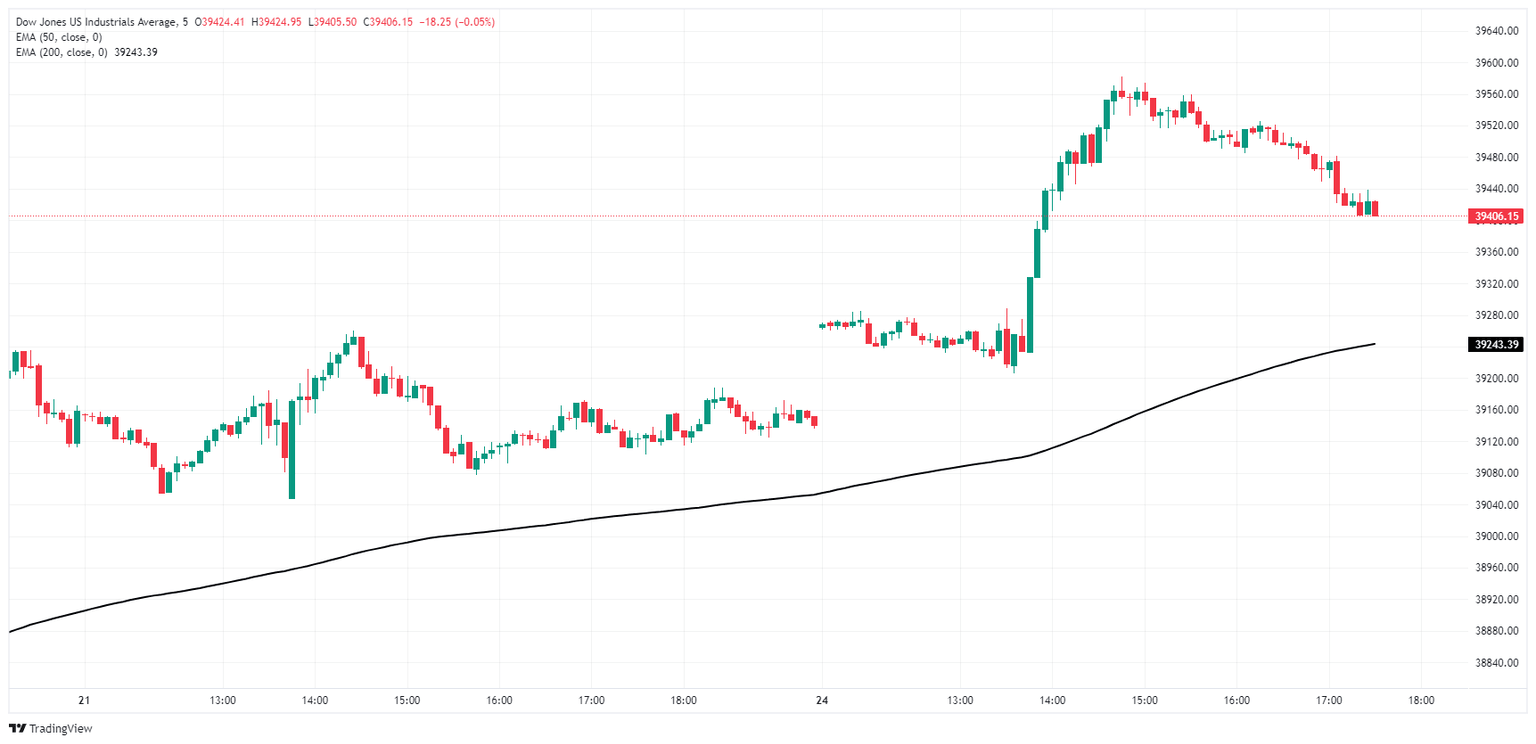
Dow Jones daily chart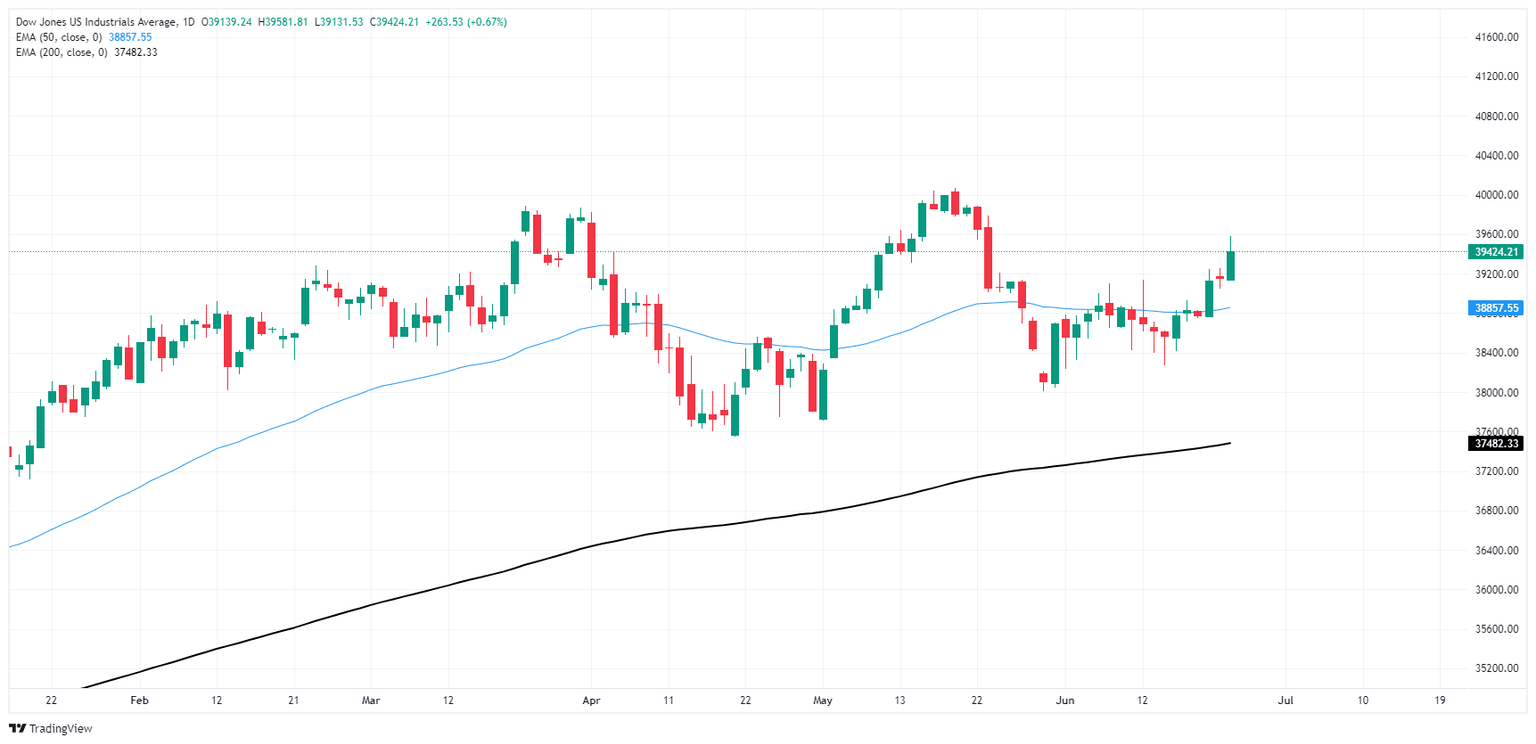
Fed FAQs
Monetary policy in the US is shaped by the Federal Reserve (Fed). The Fed has two mandates: to achieve price stability and foster full employment. Its primary tool to achieve these goals is by adjusting interest rates. When prices are rising too quickly and inflation is above the Fed’s 2% target, it raises interest rates, increasing borrowing costs throughout the economy. This results in a stronger US Dollar (USD) as it makes the US a more attractive place for international investors to park their money. When inflation falls below 2% or the Unemployment Rate is too high, the Fed may lower interest rates to encourage borrowing, which weighs on the Greenback.
The Federal Reserve (Fed) holds eight policy meetings a year, where the Federal Open Market Committee (FOMC) assesses economic conditions and makes monetary policy decisions. The FOMC is attended by twelve Fed officials – the seven members of the Board of Governors, the president of the Federal Reserve Bank of New York, and four of the remaining eleven regional Reserve Bank presidents, who serve one-year terms on a rotating basis.
In extreme situations, the Federal Reserve may resort to a policy named Quantitative Easing (QE). QE is the process by which the Fed substantially increases the flow of credit in a stuck financial system. It is a non-standard policy measure used during crises or when inflation is extremely low. It was the Fed’s weapon of choice during the Great Financial Crisis in 2008. It involves the Fed printing more Dollars and using them to buy high grade bonds from financial institutions. QE usually weakens the US Dollar.
Quantitative tightening (QT) is the reverse process of QE, whereby the Federal Reserve stops buying bonds from financial institutions and does not reinvest the principal from the bonds it holds maturing, to purchase new bonds. It is usually positive for the value of the US Dollar.
Author
Joshua Gibson
FXStreet
Joshua joins the FXStreet team as an Economics and Finance double major from Vancouver Island University with twelve years' experience as an independent trader focusing on technical analysis.