Dow Jones Industrial Average dips as US election, Fed rate cut loom
- Poll volatility keeps Wall Street cautious; VIX rises above 20.
- Nvidia to replace Intel, Sherwin-Williams to replace Dow in DJIA on November 8.
- Factory Orders drop more than expected.

The Dow Jones Industrial Average (DJIA) fell over 0.29% or 100 points in early trading during the North American session on Monday. The financial markets are expected to remain volatile this week as the US presidential election remains a tight race, and swings in the polls on Monday and Tuesday could spur volatility.
Elections in the United States are driving price action in the financial markets. Recent polls suggest that Democrat Vice President Kamala Harris and Republican former President Donald Trump are in a very close race to occupy the White House from 2024 to 2028. Consequently, Wall Street trades in the red, while the CBOE Volatility Index (VIX) rises above 20.00, an indication of increasing jitters.
In the meantime, US Treasury yields along the belly to the long end of the curve post losses, while the Greenback, as measured by the US Dollar Index (DXY), plunges 0.47% down to 103.84.
The US Census Bureau revealed that Factory Orders in September dropped -0.5% MoM, more than estimates of a -0.4% shrinkage but improved compared to August’s -0.8% contraction. The US election and Thursday’s Federal Open Market Committee (FOMC) monetary policy decision overshadowed the data. The FOMC is expected to lower rates by 25 basis points (bps), and it will be followed by a press conference by Federal Reserve (Fed) Chair Jerome Powell.
The CME FedWatch Tool shows odds for a 25 bps rate cut by the Fed reaching 98%. This would leave rates in the 4.50%-4.75% range.
In addition to the above-mentioned events, the US economic docket will be busy with the release of the Balance of Trade, S&P and ISM Services PMIs, Initial Jobless Claims, and the University of Michigan (UoM) Consumer Sentiment.
Dow Jones news
In breaking news, Nvidia (NVDA) will replace Intel (INTC) in the Dow Jones. Index owner S&P writes, this change would “ensure a more representative exposure to the semiconductors industry.” In the same statement, S&P Dow Jones announced that Sherwin Williams (SHW) would replace Dow (DOW) in the materials sector. S&P revealed that the changes would be effective before the opening on Friday, November 8.
After the news broke, NVDA shares rose by 2%, while INTC tumbled over 4%. Shares of SHW jumped over 4% on news.
The Dow Jones stocks leading the pack are Home Depot (HD), which gained 0.50% to $394.55, followed by Boeing (BA), which was up 0.25% at $154.98, and Walmart (WMT), up a minimal 0.17% at $82.33. The main losers amid a dismal session for the DJIA were Intel, which was down 4.33% at $22.20, Dow, which lost 2.75% at $47.63, and UnitedHealth Group (UNH), which was down 1.66% at $558.15.
Dow Jones price forecast
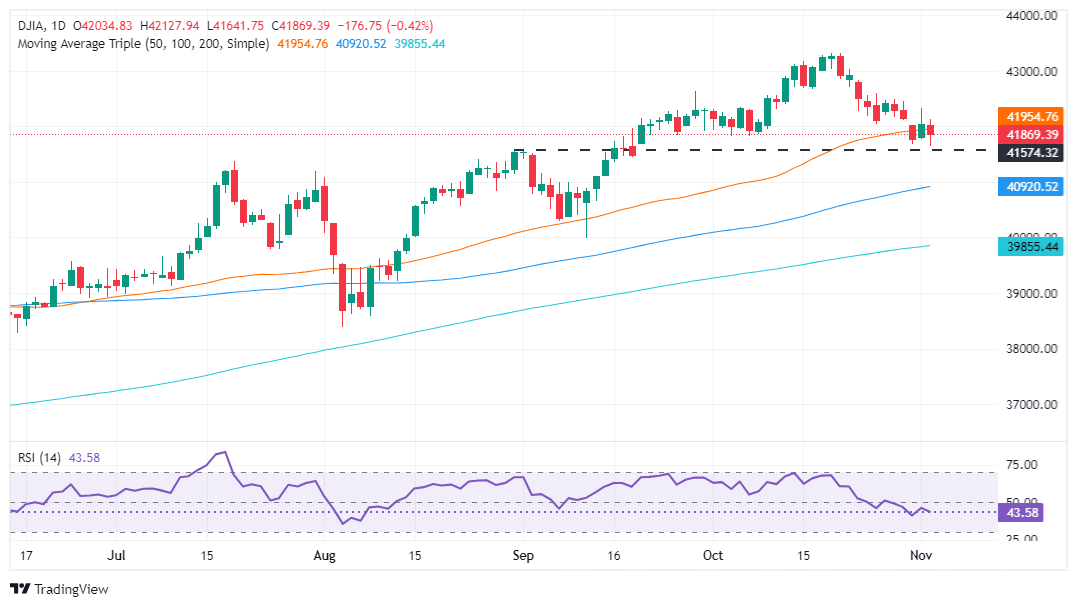
The Dow Jones Industrial Average has fallen below the 42,000 threshold after hitting a two-day peak of 42,328. On its way down, the DJIA surpassed the 50-day Simple Moving Average (SMA) at 41,953, opening the door for further downside.
If the Dow Jones achieves a daily close below 42,000, sellers could push the index toward the August 30 high turned support at 41,574. On further weakness, the next stop would be the September 2 high turned support at 41,564, ahead of the 41,000 area.
If the Dow Jones posts a daily close above 42,000 buyers, it could remain hopeful of challenging the October 30 low, which turned resistance at 42,122. Once cleared, the next stop would be the October 31 high 42,460. On further strength, 42,500 could be reached before testing 43,000.
Oscillators point downward with the Relative Strength Index (RSI) preparing to push deeper into bearish territory but with enough room before turning oversold. Therefore, the DJIA path of least resistance is tilted to the downside.
Dow Jones daily chart
Dow Jones FAQs
The Dow Jones Industrial Average, one of the oldest stock market indices in the world, is compiled of the 30 most traded stocks in the US. The index is price-weighted rather than weighted by capitalization. It is calculated by summing the prices of the constituent stocks and dividing them by a factor, currently 0.152. The index was founded by Charles Dow, who also founded the Wall Street Journal. In later years it has been criticized for not being broadly representative enough because it only tracks 30 conglomerates, unlike broader indices such as the S&P 500.
Many different factors drive the Dow Jones Industrial Average (DJIA). The aggregate performance of the component companies revealed in quarterly company earnings reports is the main one. US and global macroeconomic data also contributes as it impacts on investor sentiment. The level of interest rates, set by the Federal Reserve (Fed), also influences the DJIA as it affects the cost of credit, on which many corporations are heavily reliant. Therefore, inflation can be a major driver as well as other metrics which impact the Fed decisions.
Dow Theory is a method for identifying the primary trend of the stock market developed by Charles Dow. A key step is to compare the direction of the Dow Jones Industrial Average (DJIA) and the Dow Jones Transportation Average (DJTA) and only follow trends where both are moving in the same direction. Volume is a confirmatory criteria. The theory uses elements of peak and trough analysis. Dow’s theory posits three trend phases: accumulation, when smart money starts buying or selling; public participation, when the wider public joins in; and distribution, when the smart money exits.
There are a number of ways to trade the DJIA. One is to use ETFs which allow investors to trade the DJIA as a single security, rather than having to buy shares in all 30 constituent companies. A leading example is the SPDR Dow Jones Industrial Average ETF (DIA). DJIA futures contracts enable traders to speculate on the future value of the index and Options provide the right, but not the obligation, to buy or sell the index at a predetermined price in the future. Mutual funds enable investors to buy a share of a diversified portfolio of DJIA stocks thus providing exposure to the overall index.
Author

Christian Borjon Valencia
FXStreet
Markets analyst, news editor, and trading instructor with over 14 years of experience across FX, commodities, US equity indices, and global macro markets.