Dow Jones falls in higher US yields, hawkish Fed comments
- Dow Jones index is practically flat after a positive opening, following hawkish comments from Fed speakers.
- Strong US employment and manufacturing data has endorsed the Fed's "higher for longer" outlook.
- Broader Dow Jones trend remains negative, on corrective reversal from March highs.

The Dow Jones Industrial Average (DJIA) is practically flat on Thursday's early afternoon session. Wall Street opened with moderate gains as a string of strong corporate earnings boosted risk appetite before some hawkish comments from Federal Reserve's (Fed) Williams and Bostic ruined investors' sentiment, triggering a rebound in US Treasury yields.
New York Federal Reserve (Fed) President John Williams has echoed the words of Chair Jerome Powell by stating that there is no rush to cut rates. Somewhat later Atlanta Fed CEO, Raphael Bostic warned that the path to the 2% inflation will be slow and that the bank will not be able to cut rates before the year-end.
Before that, US Jobless Claims and manufacturing activity figures endorsed the view of strong economic momentum and a tight labour market. On the negative side, Existing Home Sales declined in March, although the median sales price rose by 4.8% from the previous month last year. This adds to evidence of the inflationary CPI trends.
All the main Wall Street indices have dipped into negative territory. The NASDAQ drops 0.4% to 15,622, the S&P 500 loses 0.24% to 5,009 wile the Dow Jones is practically flat at 37,731.
Dow Jones news
The Technologies sector is the worst performer on Thursday, with a 0.87% decline. This sector is followed by the Consumer Discretionary, 0.86% lower.
Communication Services is leading gains, with a 0.86% advance, followed by Financials, up 0.24%.
United Health (UNH) rose 3.5% to $495.91 and is the best performer for the second day in a row, fuelled by the strong quarterly earnings results. Next is American Express (AXP) with a 0.62% gain to $219.03. Intel (INTC) is leading losses with a 2.41% decline to $34.8. Salesforce drops 2.21% to $270.28.
Dow Jones technical outlook
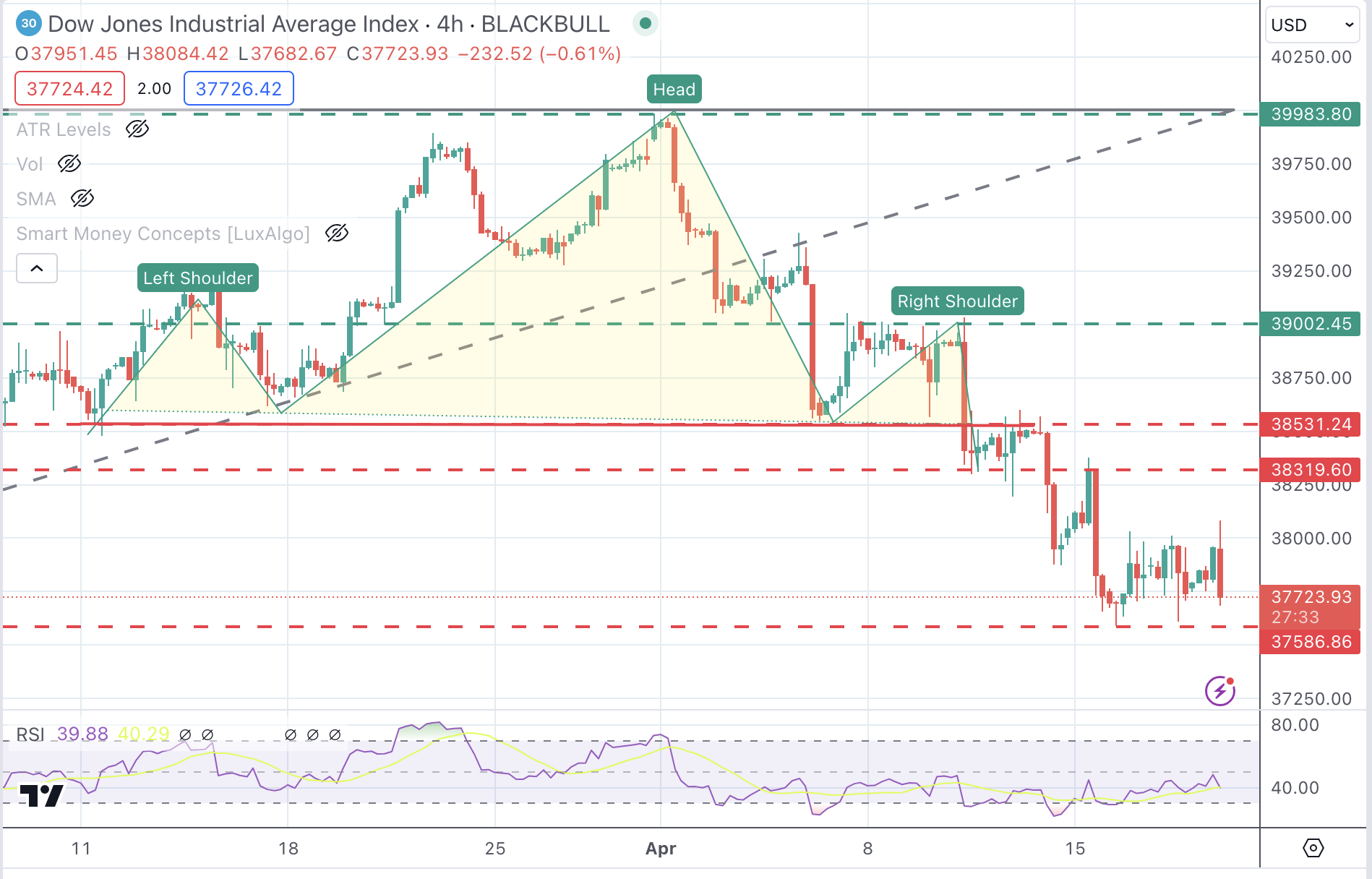
The DJIA is consolidating near recent lows with the broader bearish trend intact. The move below 38,560 has activated a Head & Shoulders pattern that points toward a sharper decline.
Immediate support is 37,586, followed by the measured target of the H&S pattern, which meets the mid-January low and 38.6% Fibonacci retracement at 37,087. A bullish reaction might find resistance at the 38,531 previous support ahead of the 39,000 region (order block).
Dow Jones 4-Hour Chart
Inflation FAQs
Inflation measures the rise in the price of a representative basket of goods and services. Headline inflation is usually expressed as a percentage change on a month-on-month (MoM) and year-on-year (YoY) basis. Core inflation excludes more volatile elements such as food and fuel which can fluctuate because of geopolitical and seasonal factors. Core inflation is the figure economists focus on and is the level targeted by central banks, which are mandated to keep inflation at a manageable level, usually around 2%.
The Consumer Price Index (CPI) measures the change in prices of a basket of goods and services over a period of time. It is usually expressed as a percentage change on a month-on-month (MoM) and year-on-year (YoY) basis. Core CPI is the figure targeted by central banks as it excludes volatile food and fuel inputs. When Core CPI rises above 2% it usually results in higher interest rates and vice versa when it falls below 2%. Since higher interest rates are positive for a currency, higher inflation usually results in a stronger currency. The opposite is true when inflation falls.
Although it may seem counter-intuitive, high inflation in a country pushes up the value of its currency and vice versa for lower inflation. This is because the central bank will normally raise interest rates to combat the higher inflation, which attract more global capital inflows from investors looking for a lucrative place to park their money.
Formerly, Gold was the asset investors turned to in times of high inflation because it preserved its value, and whilst investors will often still buy Gold for its safe-haven properties in times of extreme market turmoil, this is not the case most of the time. This is because when inflation is high, central banks will put up interest rates to combat it. Higher interest rates are negative for Gold because they increase the opportunity-cost of holding Gold vis-a-vis an interest-bearing asset or placing the money in a cash deposit account. On the flipside, lower inflation tends to be positive for Gold as it brings interest rates down, making the bright metal a more viable investment alternative.
Author

Guillermo Alcala
FXStreet
Graduated in Communication Sciences at the Universidad del Pais Vasco and Universiteit van Amsterdam, Guillermo has been working as financial news editor and copywriter in diverse Forex-related firms, like FXStreet and Kantox.

















