Crude Oil rallies to fresh nine-week high on Monday, WTI tests $83
- WTI climbs nearly $3 per barrel amid Monday's Crude Oil surge.
- Crude rising on Middle East geopolitical tensions, fears of cross-border spillover.
- Obscure hopes for rising Crude Oil demand in the future also pressuring barrel bids.

West Texas Intermediate (WTI) US Crude Oil rose sharply on Monday, climbing nearly $2 per barrel, as energy markets found fresh bidding pressure amid ongoing Middle East geopolitical tensions and hopes that unseasonally hot temperatures across the US would bolster demand enough to eat up supply.
The Israel-Palestinian Hamas conflict continues to broil in Gaza, and Crude Oil markets are increasingly concerned that the altercation could spill over borders to drag neighboring countries that are critical to global energy production into the conflict. With Iran backing Palestinian Hamas, concerns are mounting that Israel may step too far in their campaign and cause Tehran to step into matters with military force, destabilizing global Crude Oil supply lines.
Crude Oil markets also hope that an impending increase in domestic US average temperatures will bolster fuel demand for cooling. Investors are expecting that an uptick in demand will help to sop up US Crude Oil production that continues to threaten to swamp out domestic supply lines.
Energy market expectations of future demand increases are running counter to the predictions of financial analysts, who anticipate prices to soften moving forward with one-year price forecasts expected to closely mirror recent price action.
WTI technical outlook
WTI US Crude Oil is accelerating into the high end on Monday, climbing $2 per barrel to kick off the new trading week. WTI pierced near-term technical resistance and broke into fresh nine-week peaks near $83.00. WTI has climbed nearly 15% from June’s early bottom bids near $72.50, gaining ten dollar per barrrel.
WTI is already on pace to close in the green for a fourth consecutive week, but with a long wait to Friday and a US holiday on the cards this week, there is still plenty of room for bulls to flub the bid, and send WTI back into $80.00 per barrel if momentum dried up.
WTI hourly chart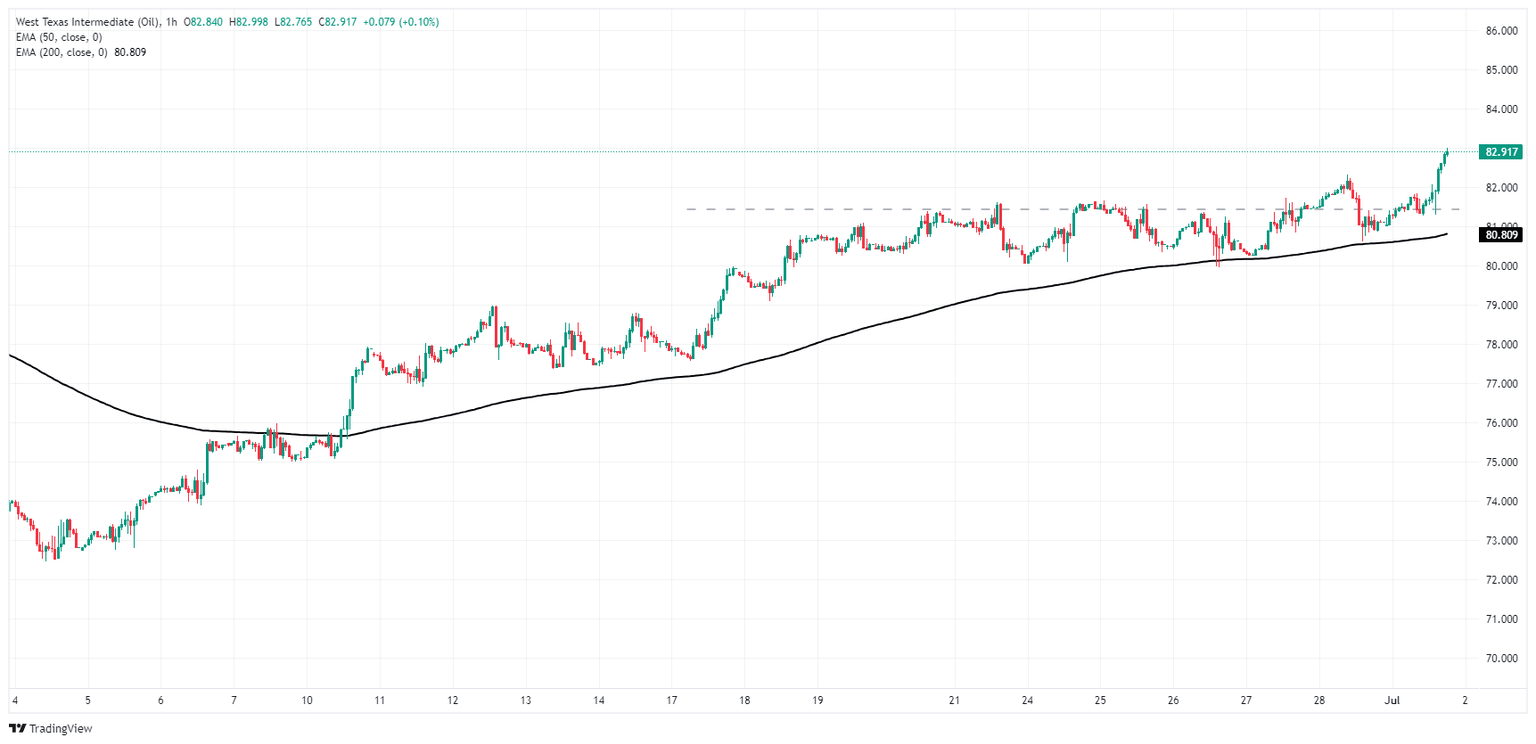
WTI daily chart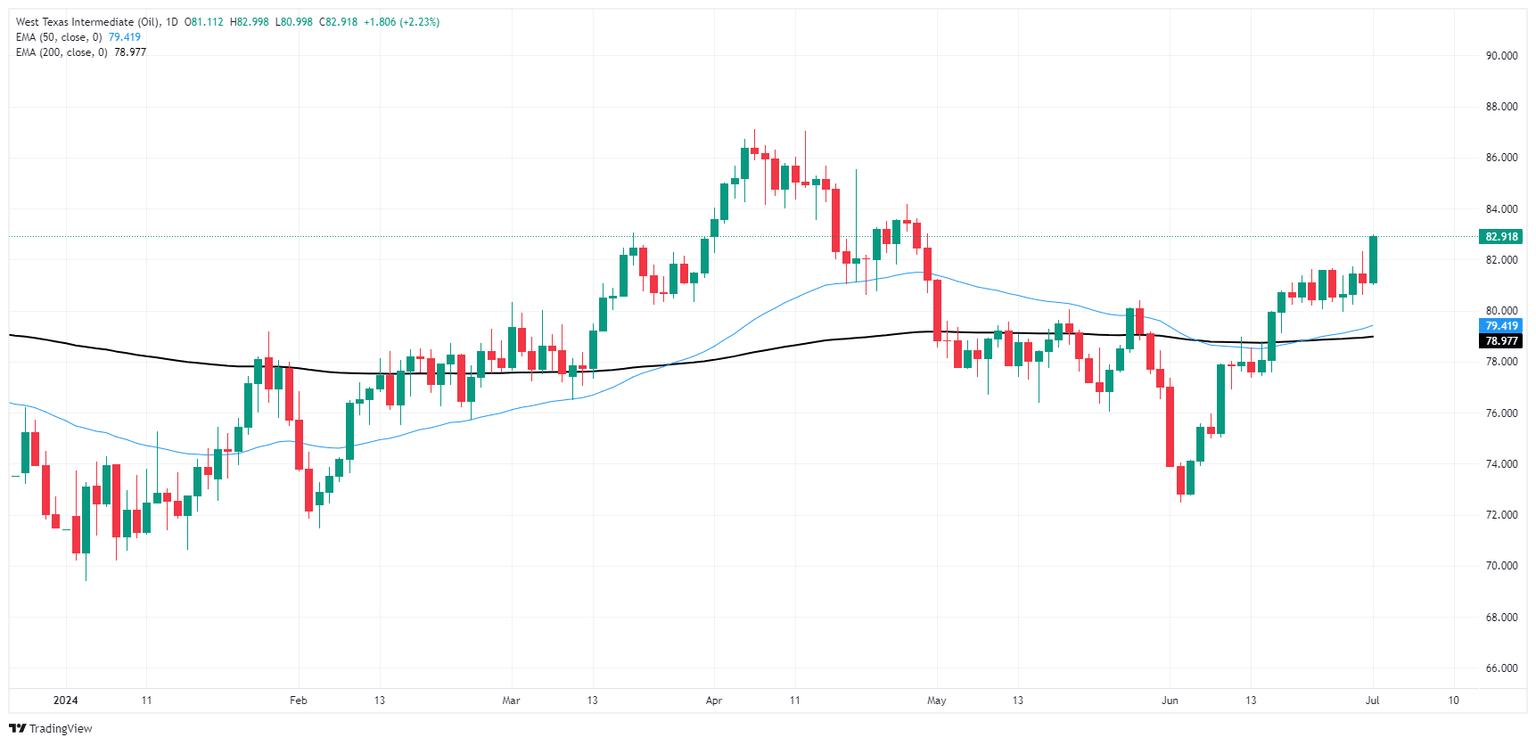
WTI Oil FAQs
WTI Oil is a type of Crude Oil sold on international markets. The WTI stands for West Texas Intermediate, one of three major types including Brent and Dubai Crude. WTI is also referred to as “light” and “sweet” because of its relatively low gravity and sulfur content respectively. It is considered a high quality Oil that is easily refined. It is sourced in the United States and distributed via the Cushing hub, which is considered “The Pipeline Crossroads of the World”. It is a benchmark for the Oil market and WTI price is frequently quoted in the media.
Like all assets, supply and demand are the key drivers of WTI Oil price. As such, global growth can be a driver of increased demand and vice versa for weak global growth. Political instability, wars, and sanctions can disrupt supply and impact prices. The decisions of OPEC, a group of major Oil-producing countries, is another key driver of price. The value of the US Dollar influences the price of WTI Crude Oil, since Oil is predominantly traded in US Dollars, thus a weaker US Dollar can make Oil more affordable and vice versa.
The weekly Oil inventory reports published by the American Petroleum Institute (API) and the Energy Information Agency (EIA) impact the price of WTI Oil. Changes in inventories reflect fluctuating supply and demand. If the data shows a drop in inventories it can indicate increased demand, pushing up Oil price. Higher inventories can reflect increased supply, pushing down prices. API’s report is published every Tuesday and EIA’s the day after. Their results are usually similar, falling within 1% of each other 75% of the time. The EIA data is considered more reliable, since it is a government agency.
OPEC (Organization of the Petroleum Exporting Countries) is a group of 13 Oil-producing nations who collectively decide production quotas for member countries at twice-yearly meetings. Their decisions often impact WTI Oil prices. When OPEC decides to lower quotas, it can tighten supply, pushing up Oil prices. When OPEC increases production, it has the opposite effect. OPEC+ refers to an expanded group that includes ten extra non-OPEC members, the most notable of which is Russia.
Author
Joshua Gibson
FXStreet
Joshua joins the FXStreet team as an Economics and Finance double major from Vancouver Island University with twelve years' experience as an independent trader focusing on technical analysis.