|

China's Caixin/Markit Manufacturing Purchasing Managers' Index (PMI): 52.0 in May

The Caixin/Markit Manufacturing Purchasing Managers' Index (PMI) rose to 52.0 in May.

This was the highest level since December and inching up from April's 51.9.

Reuters reports that ''China's factory activity expanded at the fastest pace this year in May as domestic and export demand picked up, though sharp rises in raw material prices and strains in supply chains crimped some companies' production, a business survey showed on Tuesday.''

Analysts polled by Reuters had expected the index to remain at 51.9.

''New orders rose at the strongest pace so far this year and a gauge for export orders was the highest since November, but the output reading, while still solid, was slightly lower than the previous month,'' Reuters reported. 

"Rapidly rising commodity prices began to disrupt the economy as some enterprises began to hoard goods, while some others suffered raw material shortages. Supply chains were also significantly affected," Wang Zhe, senior economist at Caixin Insight Group, said in comments released alongside the survey's findings.

AUD/USD update

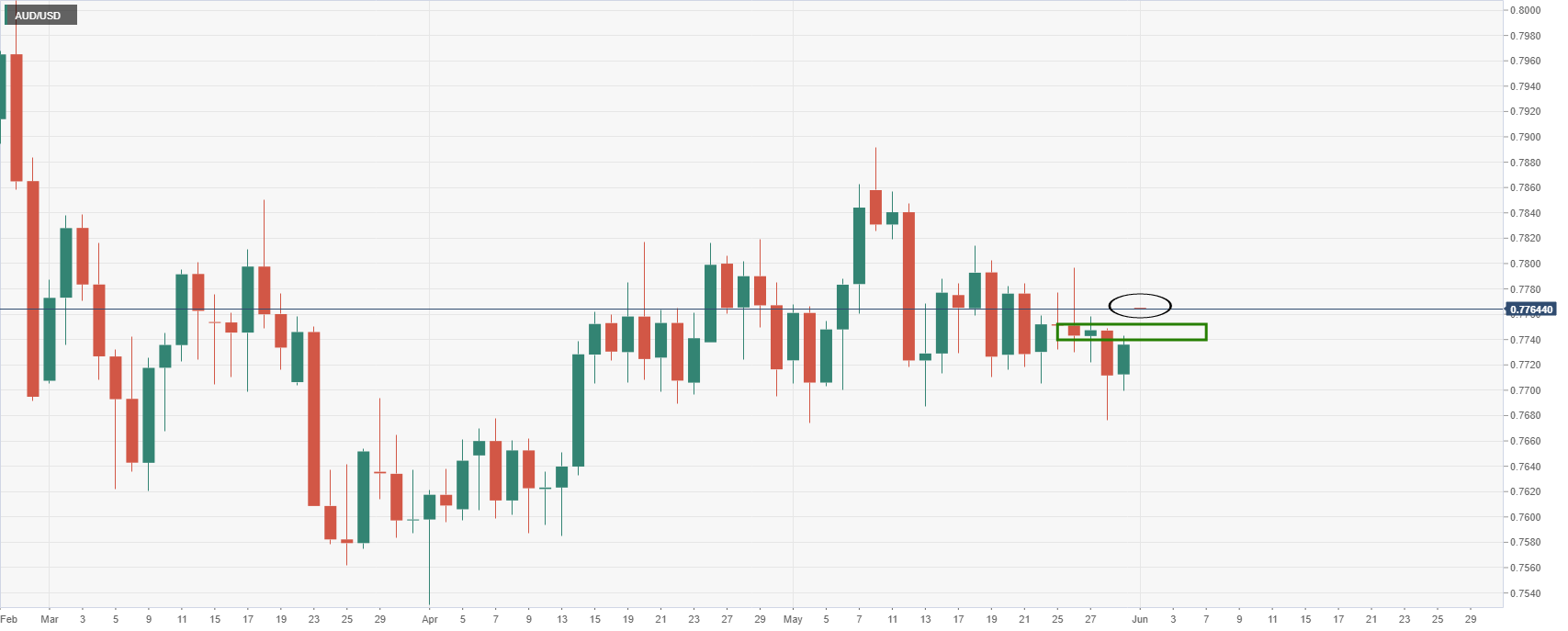
AUD/USD is bid on the day but hardly change don the data.

Traders are more focused on today's Reserve Bank of Australia meeting, although there are no expectations of any changes. 

Importantly, the price has breached a key daily resistance structure that will now be expected to act as support. 
About Caixin China Manufacturing PMI

The Caixin China Manufacturing PMI™, released by Markit Economics, is based on data compiled from monthly replies to questionnaires sent to purchasing executives in over 400 private manufacturing sector companies.

Author

Ross J Burland

Ross J Burland, born in England, UK, is a sportsman at heart. He played Rugby and Judo for his county, Kent and the South East of England Rugby team.


More from Ross J Burland
Share:

Editor's Picks

Japanese Yen gains ground as traders await Fed rate decision

The USD/JPY pair loses ground to near 160.25 during the early European trading hours. Traders prefer to wait on the sidelines ahead of the US Federal Reserve interest rate decision under new Chair Kevin Warsh later on Wednesday.

AUD/USD puts 0.7000 to the test on solid Dollar

In line with the rest of its risk-linked peers, AUD/USD retreats markedly and challenges the key 0.7000 support ahead of the opening bell in Asia. The robust performance of the Greenback hurt the sentiment around the Aussie Dollar, dragging spot lower following the FOMC event.

Gold extends intraday slide towards $4,250

Gold turned negative by the end of Wednesday and trades in the $4,260 price zone. The US Federal Reserve left rates unchanged, but delivered a hawkish message, even though Chair Kevin Warsh refused to provide forward guidance.

Two altcoins to watch as DeFi market cap nears $70B
Decentralized Finance (DeFi) tokens exhibit mixed signals on Wednesday, with Uniswap (UNI) slightly pulling back from an early-week rally to highs around $3.73, while Aster (ASTER) extends its recovery near $0.80. Bitcoin (BTC) holds above $65,000 following a rejection at June highs around $67,000.
The next big AI trade may not be about chips or software
Artificial intelligence has already created some of the biggest winners in modern market history. Chipmakers have surged, data centre construction is booming, and electricity demand forecasts are changing globally.
Why a hawkish RBA is no longer enough to lift the Australian Dollar

The Reserve Bank of Australia delivered more than what markets expected: a hawkish hold that should have supported the Aussie. But markets widely ignored it, focusing instead on slowing economic growth and proving that central bank messaging alone isn’t always enough to drive currencies.












