Canadian Dollar pares losses amid a softer US Dollar
- Canadian Dollar advances favoured by retreating US yields and a softer US Dollar.
- USD/CAD maintains a bid tone despite the Fed’s hawkish stance and lower oil prices.
- Current Canadian Dollar recovery is likely to be short-lived.

The Canadian Dollar (CAD) is trading higher on Wednesday to snap a five-day sell-off that has sent the Loonie 1.7% lower. The US Dollar is losing ground across the board, as US yields retreat from year-to-date highs. This is giving some respite to a battered CAD, which has been struggling under an adverse fundamental background.
In the current background, however, the Canadian Dollar's upside attempts are likely to be short-lived. The “higher for longer” Federal Reserve (Fed) stance, in opposition to the Bank of Canada’s (BoC) dovish outlook, is expected to underpin the US Dollar. Beyond that, the sharp reversal in Oil prices, Canada's main export, is an extra weight for the commodity-linked Loonie.
On Wednesday, the release of the Fed’s beige book and speeches from Fed members Mester and Bowman are the only events worth mentioning. After Tuesday’s speech by Fed Chair Jerome Powell, their impact on the pair is limited.
Daily digest market movers: USD/CAD loses steam at five-month highs
- Canadian Dollar is trading almost 0.4% higher on Wednesday after regaining ground following a five-day sell-off.
- The hawkish Fed stance, confirmed on Wednesday by Fed Chair Powell, and the dovish outlook of the BoC, which is expected to start cutting rates in June, are acting as a headwind for the CAD.
- On Wednesday, Fed Chair Powell warned about the lack of progress on inflation, suggesting that the bank will have to keep rates at restrictive levels for a longer time.
- Bets for a Fed rate cut in July have dropped to 37% from 50% at the beginning of the week. Investors are now pricing in 40 bps of cuts in 2024, down from 150 BP in January.
- EIA Crude Oil stocks have increased by 2.735 million barrels. against expectations of 1.65 million. Incrementally, this is weighing further on Crude prices and also on the CAD.
- On Tuesday, Canadian inflation data showed mixed figures. Headline CPI accelerated to a 2.9% yearly rate from 2.8% in the previous month. The Core CPI eased to 2%, its lowest level in three years.
- These figures endorse the view that the Bank of Canada will be able to cut rates soon, probably in June, and increase negative pressure on the pair.
Canadian Dollar price today
The table below shows the percentage change of Canadian Dollar (CAD) against listed major currencies today. Canadian Dollar was the weakest against the Euro.
| USD | EUR | GBP | CAD | AUD | JPY | NZD | CHF | |
| USD | -0.46% | -0.14% | -0.31% | -0.39% | -0.24% | -0.41% | -0.25% | |
| EUR | 0.46% | 0.31% | 0.15% | 0.07% | 0.20% | 0.03% | 0.19% | |
| GBP | 0.15% | -0.32% | -0.16% | -0.22% | -0.11% | -0.28% | -0.10% | |
| CAD | 0.31% | -0.15% | 0.18% | -0.07% | 0.06% | -0.12% | 0.06% | |
| AUD | 0.37% | -0.08% | 0.24% | 0.07% | 0.13% | -0.04% | 0.14% | |
| JPY | 0.25% | -0.22% | 0.10% | -0.05% | -0.16% | -0.19% | 0.01% | |
| NZD | 0.44% | -0.05% | 0.27% | 0.10% | 0.05% | 0.18% | 0.17% | |
| CHF | 0.25% | -0.21% | 0.11% | -0.06% | -0.13% | -0.01% | -0.18% |
The heat map shows percentage changes of major currencies against each other. The base currency is picked from the left column, while the quote currency is picked from the top row. For example, if you pick the Euro from the left column and move along the horizontal line to the Japanese Yen, the percentage change displayed in the box will represent EUR (base)/JPY (quote).
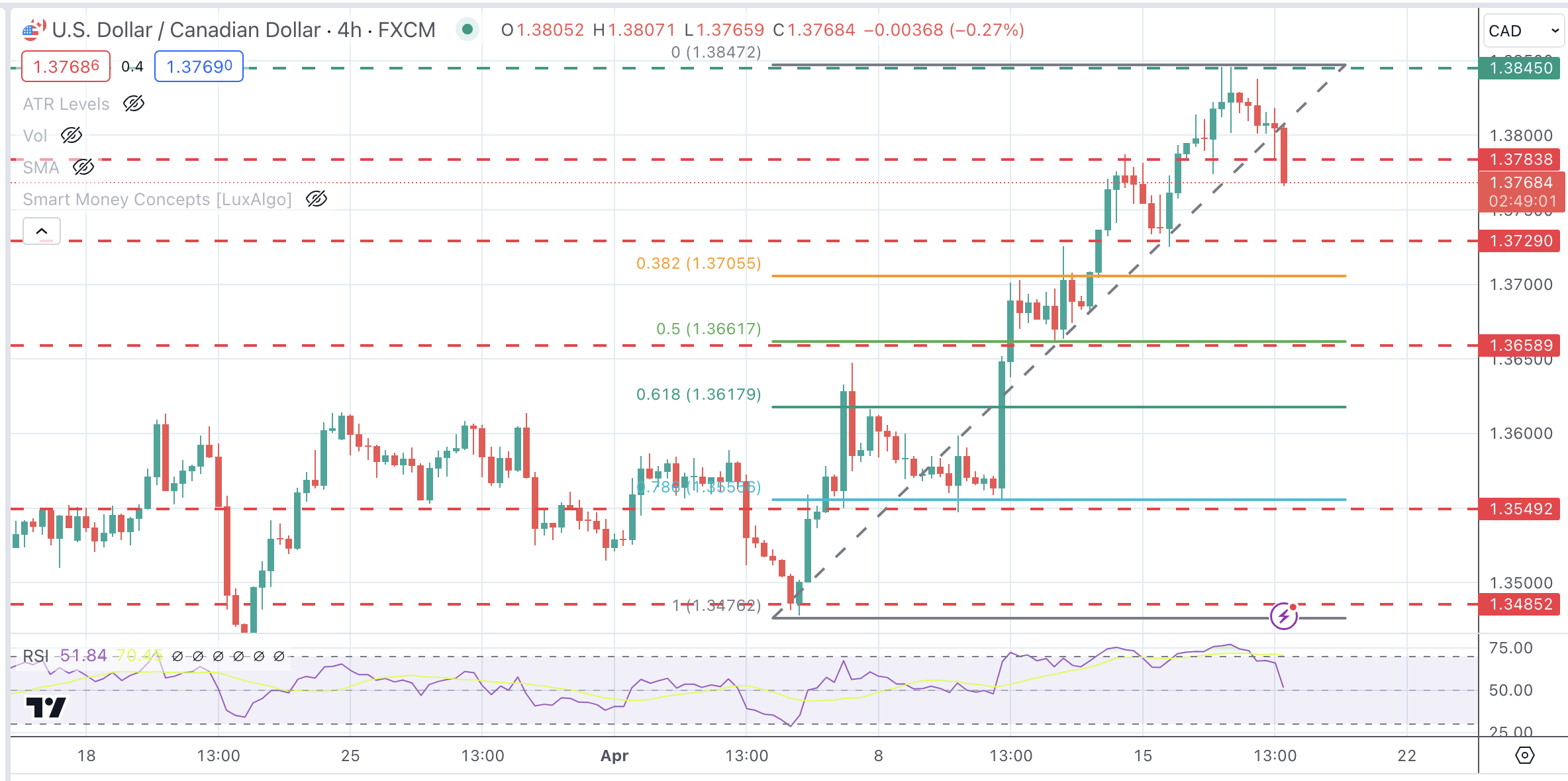
Technical analysis: USD/CAD is gathering bearish traction below 1.3775
The broader US Dollar trend remains intact, although the pair is under an increasing bullish momentum, which suggests a deeper correction from five-month highs.
Bears have pierced the 1.3775-85 support area and might extend the current pullback towards the intra-week low at 1.3728. Further down, the 38.2% Fibonacci retracement level of April’s rally at 1.3705 is a common target for corrections. On the upside, the immediate resistance is at 1.3845. Further up, the next target would be November 2023 high at 1.3900.
USD/CAD 4-Hour Chart
Canadian Dollar FAQs
The key factors driving the Canadian Dollar (CAD) are the level of interest rates set by the Bank of Canada (BoC), the price of Oil, Canada’s largest export, the health of its economy, inflation and the Trade Balance, which is the difference between the value of Canada’s exports versus its imports. Other factors include market sentiment – whether investors are taking on more risky assets (risk-on) or seeking safe-havens (risk-off) – with risk-on being CAD-positive. As its largest trading partner, the health of the US economy is also a key factor influencing the Canadian Dollar.
The Bank of Canada (BoC) has a significant influence on the Canadian Dollar by setting the level of interest rates that banks can lend to one another. This influences the level of interest rates for everyone. The main goal of the BoC is to maintain inflation at 1-3% by adjusting interest rates up or down. Relatively higher interest rates tend to be positive for the CAD. The Bank of Canada can also use quantitative easing and tightening to influence credit conditions, with the former CAD-negative and the latter CAD-positive.
The price of Oil is a key factor impacting the value of the Canadian Dollar. Petroleum is Canada’s biggest export, so Oil price tends to have an immediate impact on the CAD value. Generally, if Oil price rises CAD also goes up, as aggregate demand for the currency increases. The opposite is the case if the price of Oil falls. Higher Oil prices also tend to result in a greater likelihood of a positive Trade Balance, which is also supportive of the CAD.
While inflation had always traditionally been thought of as a negative factor for a currency since it lowers the value of money, the opposite has actually been the case in modern times with the relaxation of cross-border capital controls. Higher inflation tends to lead central banks to put up interest rates which attracts more capital inflows from global investors seeking a lucrative place to keep their money. This increases demand for the local currency, which in Canada’s case is the Canadian Dollar.
Macroeconomic data releases gauge the health of the economy and can have an impact on the Canadian Dollar. Indicators such as GDP, Manufacturing and Services PMIs, employment, and consumer sentiment surveys can all influence the direction of the CAD. A strong economy is good for the Canadian Dollar. Not only does it attract more foreign investment but it may encourage the Bank of Canada to put up interest rates, leading to a stronger currency. If economic data is weak, however, the CAD is likely to fall.
Author

Guillermo Alcala
FXStreet
Graduated in Communication Sciences at the Universidad del Pais Vasco and Universiteit van Amsterdam, Guillermo has been working as financial news editor and copywriter in diverse Forex-related firms, like FXStreet and Kantox.