Canadian Dollar pares losses on Thursday but trims weight against Greenback
- Canadian Dollar grapples with recovering US Dollar.
- Canada remains absent from the economic calendar on Thursday.
- CAD traders looking ahead to next Tuesday’s Canadian CPI inflation.

The Canadian Dollar (CAD) is broadly higher on Thursday, gaining ground across the board but still struggling under the weight of the US Dollar (USD) as the Greenback recovers from the previous day’s plunge. Mid-tier data had a limited impact, and Fedspeak is expected to dominate the headlines.
Canada delivered no economic data on Thursday and is expected to remain absent or strictly low-tier until next week’s Consumer Price Index (CPI) inflation release slated for next Tuesday. US data carried few surprises, with housing starts and new unemployment claims missing forecasts, but only by slim margins.
Daily market movers: Canadian Dollar battles Greenback as US data, Fedspeak dominate
- US Initial Jobless Claims eased to 222K for the week ended May 10, stepping back from the previous week’s 232K (revised from 231K) but still undershot the 220K forecast.
- US Housing Starts in April rose to 1.36 million MoM, above the previous 1.287 million (revised from 1.321 million) but below the forecast of 1.48 million.
- Talking points from Fed policymakers to dominate the financial news cycle until higher-impact data approaches.
- Federal Reserve Bank of Cleveland President Loretta J. Mester on Thursday:
- I welcome recent CPI data as a sign of cooling inflation.
- It will still take longer to gain confidence that inflation is moving toward 2%.
- Risks to inflation side of Fed’s mandate have increased.
- A strong economy means Fed is risking little to hold policy in place.
Canadian Dollar PRICE Today
The table below shows the percentage change of Canadian Dollar (CAD) against listed major currencies today. Canadian Dollar was the strongest against the Swiss Franc.
| USD | EUR | GBP | JPY | CAD | AUD | NZD | CHF | |
|---|---|---|---|---|---|---|---|---|
| USD | 0.18% | 0.13% | 0.34% | 0.12% | 0.26% | 0.06% | 0.44% | |
| EUR | -0.18% | -0.04% | 0.17% | -0.05% | 0.08% | -0.09% | 0.26% | |
| GBP | -0.13% | 0.04% | 0.22% | 0.00% | 0.13% | -0.05% | 0.30% | |
| JPY | -0.34% | -0.17% | -0.22% | -0.22% | -0.08% | -0.30% | 0.11% | |
| CAD | -0.12% | 0.05% | -0.00% | 0.22% | 0.14% | -0.06% | 0.32% | |
| AUD | -0.26% | -0.08% | -0.13% | 0.08% | -0.14% | -0.20% | 0.21% | |
| NZD | -0.06% | 0.09% | 0.05% | 0.30% | 0.06% | 0.20% | 0.37% | |
| CHF | -0.44% | -0.26% | -0.30% | -0.11% | -0.32% | -0.21% | -0.37% |
The heat map shows percentage changes of major currencies against each other. The base currency is picked from the left column, while the quote currency is picked from the top row. For example, if you pick the Canadian Dollar from the left column and move along the horizontal line to the US Dollar, the percentage change displayed in the box will represent CAD (base)/USD (quote).
Technical analysis: Canadian Dollar finds thin gains, but Greenback weighs
The Canadian Dollar (CAD) is broadly higher on Thursday but still struggling to make meaningful gains against the US Dollar. The CAD is up over half a percent against the Japanese Yen (JPY) and a third of a percent against the Swiss Franc (CHF). On the low side, the Canadian Dollar is weaker by about a tenth of a percent against the USD.
USD/CAD continues to churn near the 1.3600 handle as technicals swamp the pair near a familiar demand zone from 1.3660. The pair remains on the low side of the 200-hour Exponential Moving Average (EMA) at 1.3664. The Canadian Dollar tested a four-week high against the US Dollar on Thursday, dragging the USD/CAD pair down to 1.3590 before USD bids recovered into positive territory.
Despite slim topside gains for the Greenback, USD/CAD is battling near-term bearishness, trading south of the 50-day EMA at 1.3637. The pair is down -1.7% from the last swing high above 1.3840.
USD/CAD hourly chart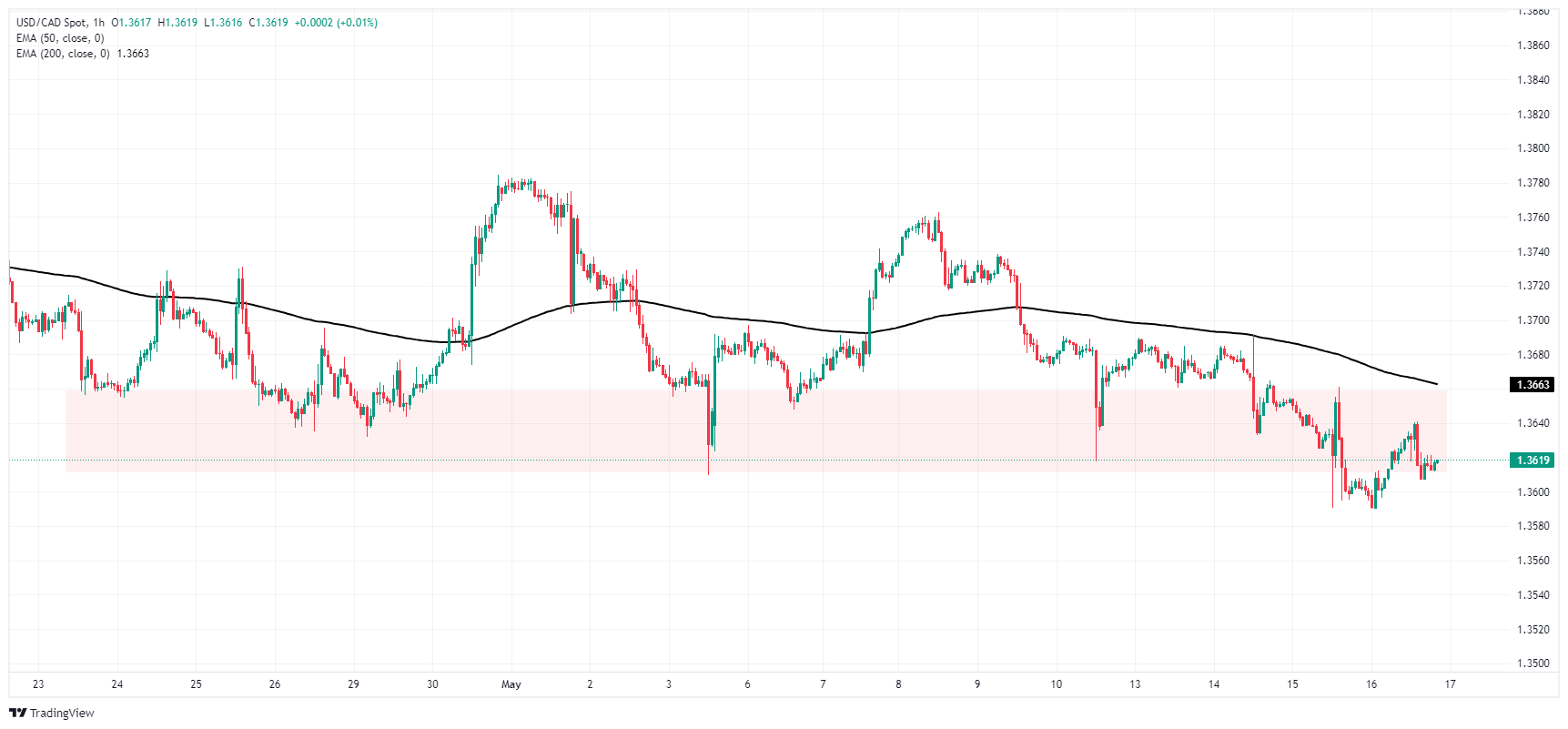
USD/CAD daily chart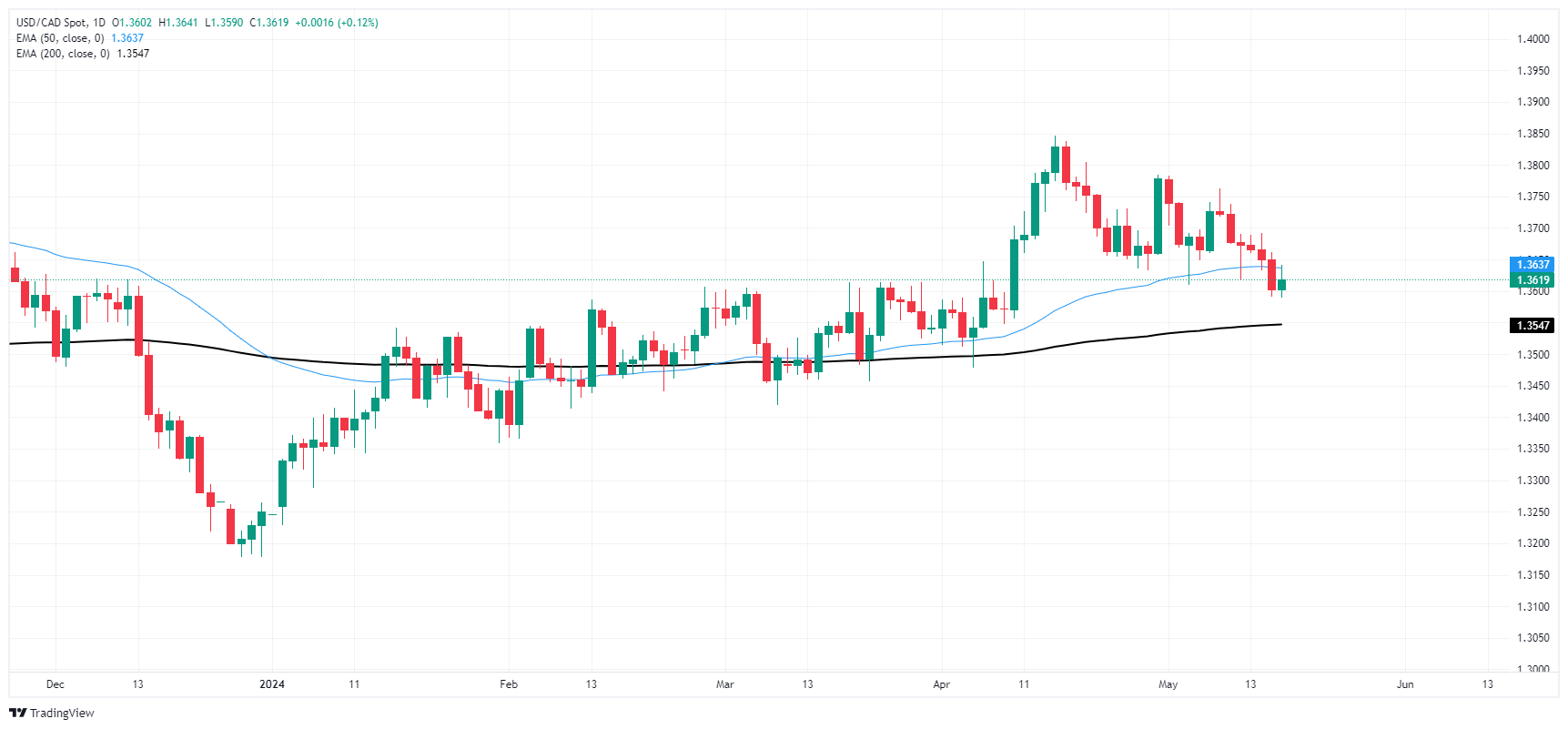
Fed FAQs
Monetary policy in the US is shaped by the Federal Reserve (Fed). The Fed has two mandates: to achieve price stability and foster full employment. Its primary tool to achieve these goals is by adjusting interest rates. When prices are rising too quickly and inflation is above the Fed’s 2% target, it raises interest rates, increasing borrowing costs throughout the economy. This results in a stronger US Dollar (USD) as it makes the US a more attractive place for international investors to park their money. When inflation falls below 2% or the Unemployment Rate is too high, the Fed may lower interest rates to encourage borrowing, which weighs on the Greenback.
The Federal Reserve (Fed) holds eight policy meetings a year, where the Federal Open Market Committee (FOMC) assesses economic conditions and makes monetary policy decisions. The FOMC is attended by twelve Fed officials – the seven members of the Board of Governors, the president of the Federal Reserve Bank of New York, and four of the remaining eleven regional Reserve Bank presidents, who serve one-year terms on a rotating basis.
In extreme situations, the Federal Reserve may resort to a policy named Quantitative Easing (QE). QE is the process by which the Fed substantially increases the flow of credit in a stuck financial system. It is a non-standard policy measure used during crises or when inflation is extremely low. It was the Fed’s weapon of choice during the Great Financial Crisis in 2008. It involves the Fed printing more Dollars and using them to buy high grade bonds from financial institutions. QE usually weakens the US Dollar.
Quantitative tightening (QT) is the reverse process of QE, whereby the Federal Reserve stops buying bonds from financial institutions and does not reinvest the principal from the bonds it holds maturing, to purchase new bonds. It is usually positive for the value of the US Dollar.
Author

Joshua Gibson
FXStreet
Joshua joins the FXStreet team as an Economics and Finance double major from Vancouver Island University with twelve years' experience as an independent trader focusing on technical analysis.