|

Breaking: Gold surges and breaches $2,000/oz

The price of gold has just hit $2,000 in fast markets at the open of the week. 
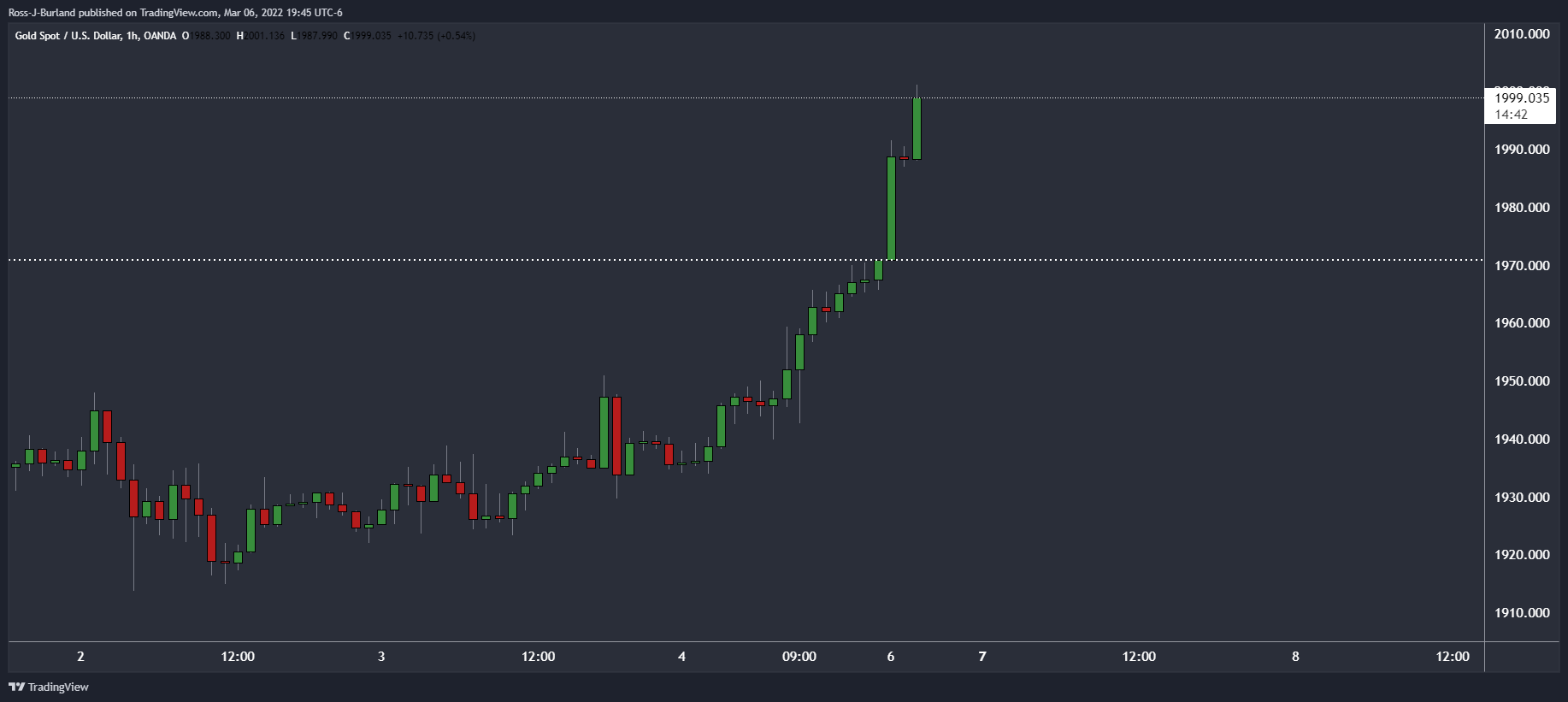
The driver is oil and fears of global stagflation. Oil has surged 10% on Monday with the risk of the US and European ban on Russian products. There are also delays in Iranian talks. Brent was quoted $12.73 higher at $130.84, while US crude rose $9.92 to $125.60.

At the time of writing, it is being reported that US House Speaker Nancy Pelosi is exploring legislation that would ban Russian oil imports. This was a theme that roiled markets at the open. More on this here:

Pelosi said last Thursday that she supports banning Russian oil imports to the US. Biden has been reluctant to curb Russian oil shipments to the US or slap on energy sanctions with prices already hitting the pockets of US citizens. However, the sanction has already been backed by wide numbers of Republicans and an increasing number of Democrats.

Commodity prices in general are having their strongest start to any year since 1915. Among the many movers last week, nickel rose 19%, aluminium 15%, zinc 12%, and copper 8%, while wheat futures surged 60% and corn 15%.

This makes this week's US Consumer Price Index a key event for markets whereby an annual growth at 7.9%, and the core measure at 6.4% is feared ahead of the European Central Bank meeting this week and the Federal Reserve next week. The divergence between the two banks is fuelling the bid for the greenback which is competing with the price of gold as they both take to the moon. 

Author

FXStreet Team

Composed of a group of economic journalists and FX experts, the FXStreet content team produces and oversees all content published on FXStreet. It provides a purely journalistic approach to the Forex market.


More from FXStreet Team
Share:

Editor's Picks

AUD/USD sticks to neutral bias above 0.7100 amid cautious markets

AUD/USD holds steady above 0.7100 in the Asian session on Monday as the US Dollar stalls its modest pullback from the highest level since late July amid persistent geopolitical uncertainties. The PBOC status quo on Loan Prime Rates also weighs on the Aussie. However, bets on another RBA rate hike continue to underpin the Australian Dollar ahead of the Trump-Xi Summit.

USD/JPY eases below 157.00 amid looming intervention risks

USD/JPY is easing back below 157.00 in Asia on Monday, undermined by modest Japanese Yen strength amid looming intervention risks after Friday's BoJ rate check. A Japanese holiday also keeps traders on edge amid escalating geopolitical tensions between Russia and Ukraine and in the Middle East. As a result, the US Dollar pauses its pullback, limiting the pair's downside.

Gold: Sellers test $4,350 on renewed USD upside

Gold kicks off the new week on a weaker note following Friday's failure near the $4,400 mark. The commodity currently trades near the $4,350 level as traders await further developments surrounding the Middle East crisis and their implications for inflation. This would influence interest rate expectations and, in turn, drive the non-yielding bullion.

Dogecoin extends gains as ETF inflows return and momentum improves

Dogecoin extends its recovery, trading above $0.088 after gaining nearly 6% last week. The bullish price outlook is supported by the return of institutional demand through DOGE spot Exchange Traded Funds. Meanwhile, improving momentum indicators and signs of whale accumulation suggest a positive outlook for the dog-themed meme coin.

Economics week ahead

This week is light on the domestic data front, with focus on Thursday's new home sales report. We expect sales to partially recover in August, rising 2.6% to a 623K pace after a sharp decline in July. Higher mortgage rates continue to weigh on affordability and demand, though builder incentives remained in place and conditions did not worsen materially during the month.

BoJ Recap: Not as hawkish as expected

The Bank of Japan (BoJ) raised its short-term interest-rate target to 1.25% from 1.00% in a 7-2 vote, marking another step in the normalisation of monetary policy and widely matching what everyone has been expecting for weeks.