Breaking: Australia Employment Report: Upbeat details for December recall AUD/USD buyers

Australian Bureau of Statistics (ABS) released the latest employment figures for December month as follows:
- Employment Change 64.8K (Reuters poll: 30.0K), prior 366.1K.
- Unemployment rate +4.2 pct, s/adj (Reuters poll: +4.5%), prior +4.6%.
- Full Time Employment 41.5K versus +128.3k prior.
- Participation Rate matched +66.1 pct s/adj prior figures (Reuters poll: +66.2 pct).
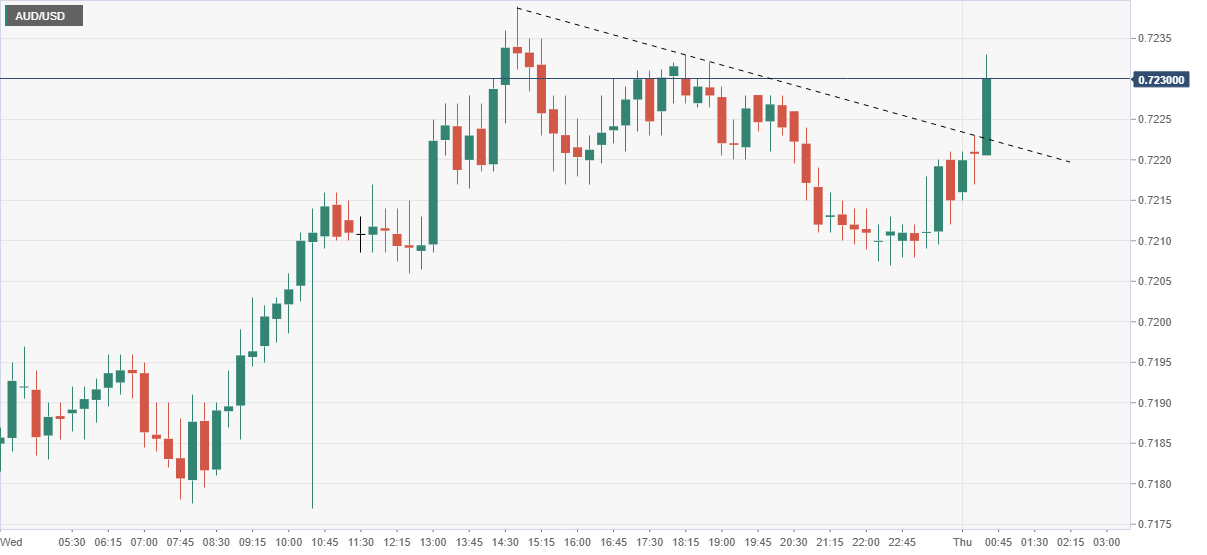
Following the data, AUD/USD refreshes intraday top to 0.7230 while breaking the immediate resistance line on the 15-minute chart.
AUD/USD: 15-minute chart
AUD/USD: Daily chart
-637782359810170182.png)
On the daily basis, the quote extends bounce off the seven-week-old support line, suggesting further advances towards the 100-SMA level of 0.7280. However, any further upside will be challenged by the monthly peak of 0.7315.
Alternatively, pullback moves remain elusive beyond the stated support line of 0.7177. Adding to the downside filter is the monthly ascending trend line, near 0.7155.
Key notes
AUD/USD retreats towards 0.7200 ahead of Aussie employment, PBOC
AUD/USD rises towards 0.7250 on strong Australia jobs report but yields test bulls
About the Employment Change
The Employment Change released by the Australian Bureau of Statistics is a measure of the change in the number of employed people in Australia. Generally speaking, a rise in this indicator has positive implications for consumer spending which stimulates economic growth. Therefore, a high reading is seen as positive (or bullish) for the AUD, while a low reading is seen as negative (or bearish).
About the Unemployment Rate
The Unemployment Rate released by the Australian Bureau of Statistics is the number of unemployed workers divided by the total civilian labour force. If the rate hikes indicate a lack of expansion within the Australian labour market. As a result, a rise leads to weaken the Australian economy. A decrease of the figure is seen as positive (or bullish) for the AUD, while an increase is seen as negative (or bearish).
Author

FXStreet Team
FXStreet
Composed of a group of economic journalists and FX experts, the FXStreet content team produces and oversees all content published on FXStreet. It provides a purely journalistic approach to the Forex market.