Australian Dollar rises due to risk-on mood, focus shift to US Initial Jobless Claims
- The AUD/USD pair edges higher following remarks from former RBA Governor Bernie Fraser.
- Fraser criticized the RBA board for being overly focused on inflation at the expense of the job market.
- Australia’s Consumer Inflation Expectations eased to 4.4% in September, down slightly from August's four-month high of 4.5%.


The AUD/USD pair gains ground following soft Consumer Inflation Expectations from Australia released on Thursday. Additionally, the former Reserve Bank of Australia (RBA) Governor Bernie Fraser criticized the current RBA Board for being overly focused on inflation at the expense of the job market. Fraser suggested that the Board should lower the cash rate, warning of "recessionary risks" that could have severe consequences for employment.
The Australian Dollar (AUD) gained support against the US Dollar (USD) as improved risk sentiment followed the release of the US inflation report on Wednesday. August’s US Consumer Price Index (CPI) data showed that headline inflation dropped to a three-year low, although core inflation exceeded expectations. This development has heightened the likelihood that the Federal Reserve (Fed) will begin its easing cycle with a 25-basis points interest rate cut in September. Investors shift their focus on the US Producer Price Index (PPI) and Initial Jobless Claims data scheduled for Thursday for further insights.
On Wednesday, Sarah Hunter, the Reserve Bank of Australia's (RBA) Assistant Governor for Economics, remarked that high interest rates are suppressing demand, which is expected to lead to a mild economic downturn. Hunter also pointed out that the labor market remains tight relative to full employment levels, with employment growth projected to continue, though slower than population growth, according to Reuters.
Daily Digest Market Movers: Australian Dollar holds ground due to improved risk sentiment
- According to the CME FedWatch Tool, markets are fully anticipating at least a 25 basis point (bps) rate cut by the Federal Reserve at its September meeting. The likelihood of a 50 bps rate cut has sharply decreased to 15.0%, down from 44.0% a week ago.
- Australia’s Consumer Inflation Expectations eased to 4.4% in September, down slightly from August's four-month high of 4.5%. This decline highlights the central bank's efforts to strike a balance between bringing inflation down within a reasonable timeframe and maintaining gains in the labor market.
- The US Consumer Price Index dipped to 2.5% year-on-year in August, from the previous reading of 2.9%. The index has fallen short of the expected 2.6% reading. Meanwhile, headline CPI stood at 0.2% MoM.
- US core CPI ex Food & Energy, remained unchanged at 3.2% YoY. On a monthly basis, core CPI rose to 0.3% from the previous 0.2% reading.
- The first US presidential debate between former President Donald Trump and Democratic nominee Kamala Harris in Pennsylvania was won by Harris, according to a CNN poll. The debate began with a critical focus on the economy, inflation, and economic policies.
- Morgan Stanley's Chief China Economist, Robin Xing, stated that China is undoubtedly experiencing deflation, likely in the second stage of the process. Xing noted that Japan's experience suggests that the longer deflation persists, the greater the need for China to implement significant stimulus measures to overcome the debt-deflation challenge, per Business Standard.
- Australia's Westpac Consumer Confidence fell by 0.5% month-on-month in September, swinging from a 2.8% gain in August.
- China's Trade Balance reported a trade surplus of CNY 649.34 billion for August, increasing from the previous reading of CNY 601.90 billion. Meanwhile, China's Exports (CNY) increased by 8.4% year-on-year, following the previous rise of 6.5%.
Technical Analysis: Australian Dollar moves above 0.6650; next barrier at the nine-day EMA
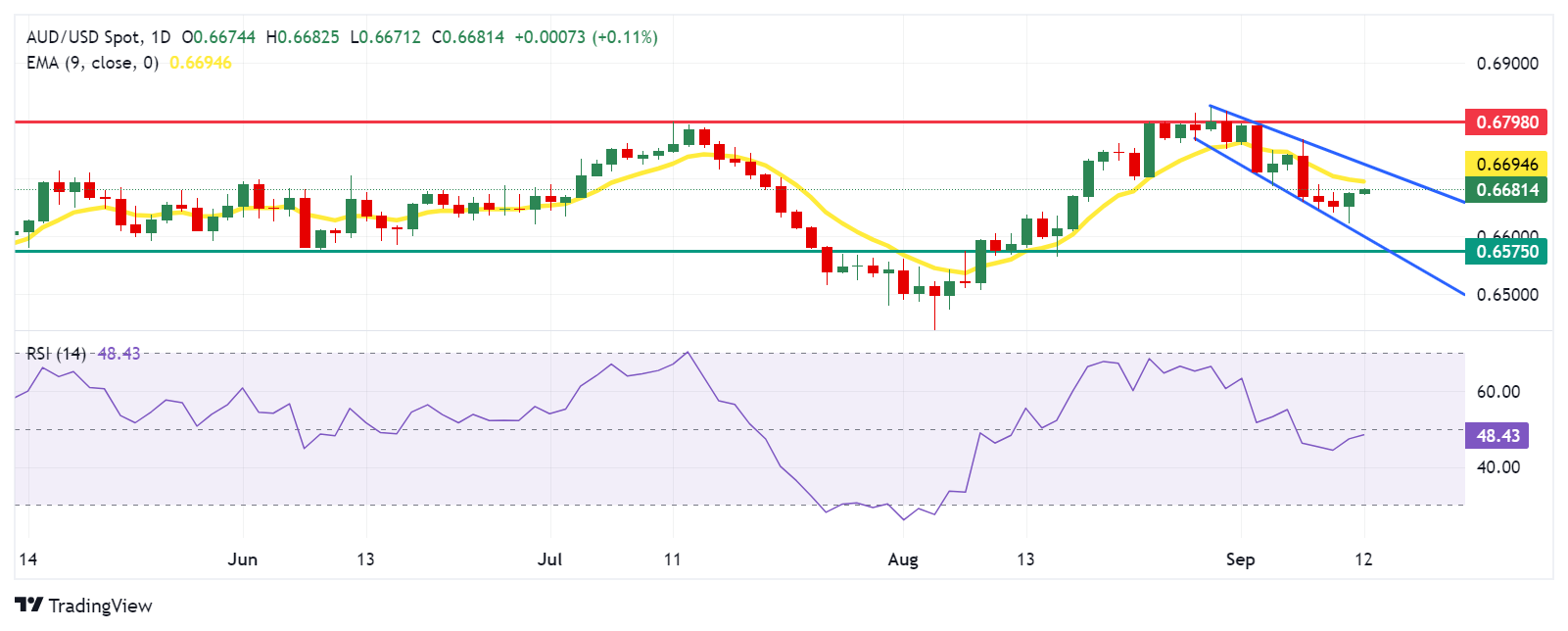
The AUD/USD pair trades near 0.6680 on Thursday, with technical analysis of the daily chart indicating that it remains within a descending channel, signaling a bearish bias. The 14-day Relative Strength Index (RSI) remains below the 50 level, confirming the ongoing bearish trend.
On the downside, the AUD/USD pair could target the lower boundary of the descending channel around 0.6600. A break below this level may strengthen the bearish outlook, potentially driving the pair toward the throwback support zone near 0.6575.
On the upside, the AUD/USD pair may face resistance around the nine-day Exponential Moving Average (EMA) at 0.6694, followed by the upper boundary of the descending channel near 0.6720. A break above this upper boundary could diminish the bearish bias, potentially opening the door for the pair to retest its seven-month high of 0.6798, last seen on July 11.
AUD/USD: Daily Chart
Australian Dollar PRICE Today
The table below shows the percentage change of Australian Dollar (AUD) against listed major currencies today. Australian Dollar was the strongest against the Japanese Yen.
| USD | EUR | GBP | JPY | CAD | AUD | NZD | CHF | |
|---|---|---|---|---|---|---|---|---|
| USD | -0.04% | -0.04% | 0.24% | -0.05% | -0.24% | -0.25% | 0.11% | |
| EUR | 0.04% | 0.01% | 0.30% | 0.01% | -0.20% | -0.21% | 0.14% | |
| GBP | 0.04% | -0.01% | 0.00% | 0.01% | -0.20% | -0.21% | 0.14% | |
| JPY | -0.24% | -0.30% | 0.00% | -0.28% | -0.49% | -0.53% | -0.14% | |
| CAD | 0.05% | -0.01% | -0.01% | 0.28% | -0.20% | -0.23% | 0.13% | |
| AUD | 0.24% | 0.20% | 0.20% | 0.49% | 0.20% | -0.01% | 0.33% | |
| NZD | 0.25% | 0.21% | 0.21% | 0.53% | 0.23% | 0.00% | 0.36% | |
| CHF | -0.11% | -0.14% | -0.14% | 0.14% | -0.13% | -0.33% | -0.36% |
The heat map shows percentage changes of major currencies against each other. The base currency is picked from the left column, while the quote currency is picked from the top row. For example, if you pick the Australian Dollar from the left column and move along the horizontal line to the US Dollar, the percentage change displayed in the box will represent AUD (base)/USD (quote).
Interest rates FAQs
Interest rates are charged by financial institutions on loans to borrowers and are paid as interest to savers and depositors. They are influenced by base lending rates, which are set by central banks in response to changes in the economy. Central banks normally have a mandate to ensure price stability, which in most cases means targeting a core inflation rate of around 2%. If inflation falls below target the central bank may cut base lending rates, with a view to stimulating lending and boosting the economy. If inflation rises substantially above 2% it normally results in the central bank raising base lending rates in an attempt to lower inflation.
Higher interest rates generally help strengthen a country’s currency as they make it a more attractive place for global investors to park their money.
Higher interest rates overall weigh on the price of Gold because they increase the opportunity cost of holding Gold instead of investing in an interest-bearing asset or placing cash in the bank. If interest rates are high that usually pushes up the price of the US Dollar (USD), and since Gold is priced in Dollars, this has the effect of lowering the price of Gold.
The Fed funds rate is the overnight rate at which US banks lend to each other. It is the oft-quoted headline rate set by the Federal Reserve at its FOMC meetings. It is set as a range, for example 4.75%-5.00%, though the upper limit (in that case 5.00%) is the quoted figure. Market expectations for future Fed funds rate are tracked by the CME FedWatch tool, which shapes how many financial markets behave in anticipation of future Federal Reserve monetary policy decisions.
Author
Akhtar Faruqui
FXStreet
Akhtar Faruqui is a Forex Analyst based in New Delhi, India. With a keen eye for market trends and a passion for dissecting complex financial dynamics, he is dedicated to delivering accurate and insightful Forex news and analysis.

















