Australian Dollar remains subdued due to risk-off mood, awaits US Nonfarm Payrolls
- The Australian Dollar halted its two-day winning streak despite the hawkish RBA outlook.
- RBA Governor Michele Bullock stated that it is too early to consider rate cuts.
- The US Dollar extends its decline following the dovish Fedspeak.


The Australian Dollar (AUD) halts its two days of gains against the US Dollar (USD) as traders adopt caution ahead of the release of US Nonfarm Payrolls (NFP). This data may offer more cues on the potential size of an expected rate cut by the Federal Reserve (Fed) this month.
The Aussie Dollar received support from the positive Trade Balance data released on Thursday. Additionally, the Reserve Bank of Australia (RBA) Governor Michele Bullock spoke at "The Anika Foundation" in Sydney on "The Costs of High Inflation," stating that it is too early to consider rate cuts. Currently, the board does not anticipate being able to reduce rates in the near term.
The US Dollar extends its decline following the dovish comments from the Fed officials. However, the positive key economic data might have limited the downside of the Greenback. US ISM Services PMI rose to 51.5 in August from 51.4 in July, above the market expectation of 51.1.
Chicago Fed President Austan Goolsbee said on Friday that the longer-run trend of the labor market and inflation data justify the Fed easing interest-rate policy soon and then steadily over the next year. FXStreet’s FedTracker, which gauges the tone of Fed officials’ speeches on a dovish-to-hawkish scale from 0 to 10 using a custom AI model, rated Goolsbee’s words as neutral with a score of 3.8.
Daily Digest Market Movers: Australian Dollar depreciates ahead of US Nonfarm Payrolls
- ADP Employment Change showed on Thursday that private-sector employment increased by 99,000 in August, following July’s increase of 111,000 and below the estimate of 145,000. Meanwhile, the weekly US Initial Jobless Claims rose to 227,000 for the week ending August 30, compared to the previous reading of 232,000 and below the initial consensus of 230,000.
- Australia’s trade surplus widened to 6,009 million MoM in July, exceeding the expected 5,150 million and 5,589 million in the previous reading.
- Atlanta Federal Reserve President Raphael Bostic said on Wednesday that the Fed is in a favorable position but added that they must not maintain a restrictive policy stance for too long, per Reuters. FXStreet’s FedTracker, which gauges the tone of Fed officials’ speeches on a dovish-to-hawkish scale from 0 to 10 using a custom AI model, rated Bostic’s words as neutral with a score of 4.6.
- US JOLTS Job Openings dropped to 7.673 million in July, down from 7.910 million in June, marking the lowest level since January 2021 and falling short of market expectations of 8.10 million.
- Bank of America (BoA) has revised its economic growth forecast for China, lowering its 2024 projection to 4.8% from the previous 5.0%. For 2025, the forecast is adjusted to 4.5% growth, while the 2026 outlook remains unchanged at 4.5%.
- Australia’s Gross Domestic Product (GDP) posted a 0.2% reading QoQ for the second quarter, up from the previous quarter’s 0.1% but falling short of the expected 0.3% readings.
- The Judo Bank Composite PMI climbed to 51.7 in August, up from 51.4 in July, signaling the fastest expansion in three months. This growth was primarily fueled by a rise in services activity, with the Services PMI reaching 52.5 in August, up from 52.2 in July, marking the seventh consecutive month of growth in the services sector.
- The US ISM Manufacturing PMI inched up to 47.2 in August from 46.8 in July, falling short of market expectations of 47.5. This marks the 21st contraction in US factory activity over the past 22 months.
Technical Analysis: Australian Dollar holds position above 50-day EMA near 0.6700
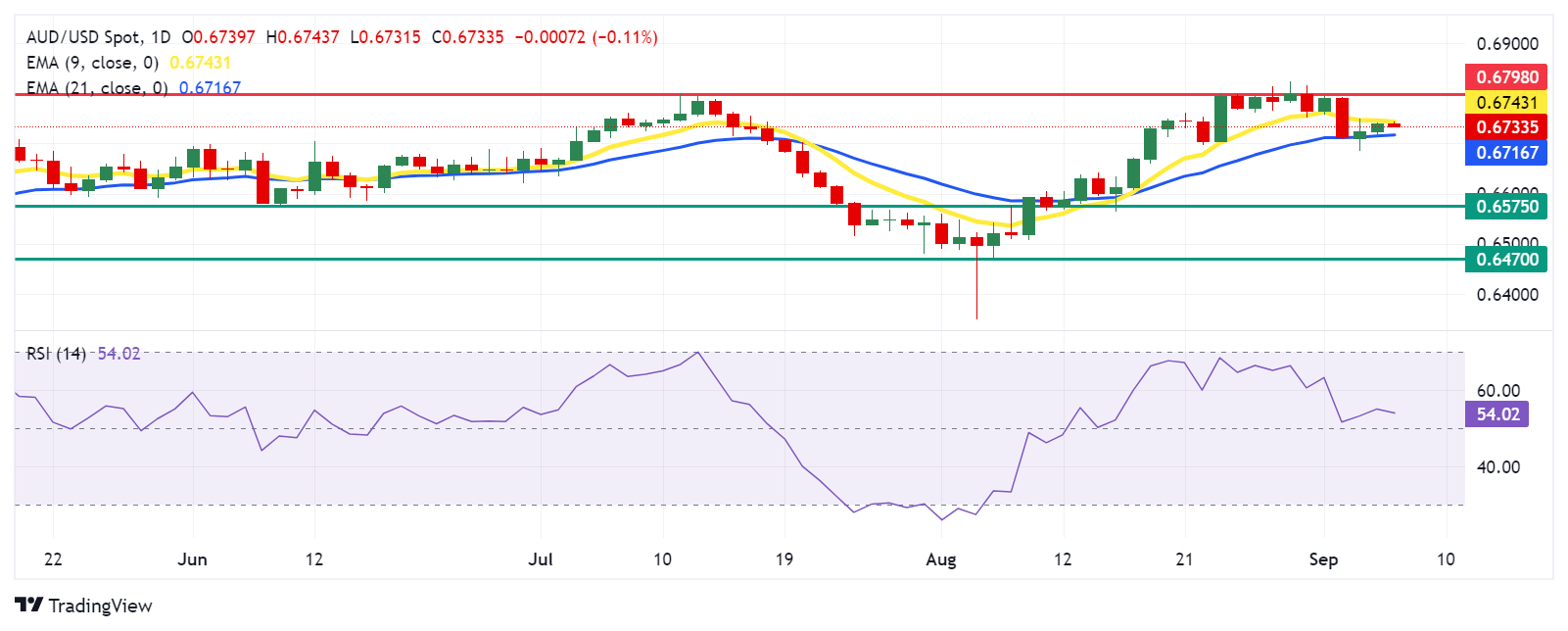
The Australian Dollar is trading around 0.6740 on Friday. On the daily chart, the AUD/USD pair is positioned below the nine-day Exponential Moving Average (EMA), indicating a short-term bearish trend. However, the 14-day Relative Strength Index (RSI) is slightly above 50, hinting at a possible bullish inclination. A drop below the 50 level on the RSI could confirm a bearish shift.
On the downside, the AUD/USD pair could test immediate support around the 50-day EMA at 0.6716 level. A break below this level could reinforce the bearish bias and lead the pair to navigate the region around the throwback level near 0.6575, with a deeper decline potentially aiming for the lower support around 0.6470.
Regarding resistance, the AUD/USD pair is testing the nine-day EMA at 0.6743. A break above this level could open the door for a potential retest of the seven-month high at 0.6798.
AUD/USD: Daily Chart
Australian Dollar PRICE Today
The table below shows the percentage change of Australian Dollar (AUD) against listed major currencies today. Australian Dollar was the weakest against the Japanese Yen.
| USD | EUR | GBP | JPY | CAD | AUD | NZD | CHF | |
|---|---|---|---|---|---|---|---|---|
| USD | -0.05% | 0.01% | -0.51% | -0.03% | 0.20% | 0.20% | -0.17% | |
| EUR | 0.05% | 0.07% | -0.46% | 0.00% | 0.26% | 0.23% | -0.13% | |
| GBP | -0.01% | -0.07% | -0.53% | -0.05% | 0.20% | 0.18% | -0.19% | |
| JPY | 0.51% | 0.46% | 0.53% | 0.50% | 0.74% | 0.71% | 0.34% | |
| CAD | 0.03% | -0.00% | 0.05% | -0.50% | 0.23% | 0.23% | -0.15% | |
| AUD | -0.20% | -0.26% | -0.20% | -0.74% | -0.23% | -0.03% | -0.40% | |
| NZD | -0.20% | -0.23% | -0.18% | -0.71% | -0.23% | 0.03% | -0.37% | |
| CHF | 0.17% | 0.13% | 0.19% | -0.34% | 0.15% | 0.40% | 0.37% |
The heat map shows percentage changes of major currencies against each other. The base currency is picked from the left column, while the quote currency is picked from the top row. For example, if you pick the Australian Dollar from the left column and move along the horizontal line to the US Dollar, the percentage change displayed in the box will represent AUD (base)/USD (quote).
Economic Indicator
Nonfarm Payrolls
The Nonfarm Payrolls release presents the number of new jobs created in the US during the previous month in all non-agricultural businesses; it is released by the US Bureau of Labor Statistics (BLS). The monthly changes in payrolls can be extremely volatile. The number is also subject to strong reviews, which can also trigger volatility in the Forex board. Generally speaking, a high reading is seen as bullish for the US Dollar (USD), while a low reading is seen as bearish, although previous months' reviews and the Unemployment Rate are as relevant as the headline figure. The market's reaction, therefore, depends on how the market assesses all the data contained in the BLS report as a whole.
Read more.Next release: Fri Sep 06, 2024 12:30
Frequency: Monthly
Consensus: 160K
Previous: 114K
Source: US Bureau of Labor Statistics
America’s monthly jobs report is considered the most important economic indicator for forex traders. Released on the first Friday following the reported month, the change in the number of positions is closely correlated with the overall performance of the economy and is monitored by policymakers. Full employment is one of the Federal Reserve’s mandates and it considers developments in the labor market when setting its policies, thus impacting currencies. Despite several leading indicators shaping estimates, Nonfarm Payrolls tend to surprise markets and trigger substantial volatility. Actual figures beating the consensus tend to be USD bullish.
Author
Akhtar Faruqui
FXStreet
Akhtar Faruqui is a Forex Analyst based in New Delhi, India. With a keen eye for market trends and a passion for dissecting complex financial dynamics, he is dedicated to delivering accurate and insightful Forex news and analysis.