Australian Dollar improves due to commodities prices rebound, US PCE inflation eyed
- The Australian Dollar improves on price recovery of commodities like coal and copper.
- PBOC’s unexpected lending rate cuts lead to higher commodities prices.
- The US Dollar may appreciate as recent US economic data have reduced the Fed’s rate cut expectations for September.


The Australian Dollar (AUD) halts its nine-day losing streak against the US Dollar (USD) on Friday, following unexpected cuts to key lending rates by the People's Bank of China (PBoC). This move enhances the outlook for the major metals consumer, leading to higher prices for commodities such as coal and copper. Given Australia’s role as a net exporter of energy and metals, its currency is notably responsive to changes in commodity prices.
The Aussie Dollar also receives support from the hawkish sentiment surrounding the Reserve Bank of Australia’s (RBA) policy stance. The RBA is anticipated to postpone easing its policy tightening, unlike other major central banks, due to ongoing inflationary pressures and a tight labor market.
The AUD/USD pair gains ground on the weaker US Dollar. However, the Greenback may limit its downside as stronger US economic data have reduced some rate cut expectations for September. On Friday, attention will be on the release of the Personal Consumption Expenditures (PCE) Price Index for June.
According to CME Group’s FedWatch Tool, markets now indicate an 88.6% probability of a 25-basis point rate cut at the September Fed meeting, down from 94.0% a week earlier.
Daily Digest Market Movers: Australian Dollar improves due to improved commodities prices
- Bank of America suggests that robust economic growth in the United States enables the Federal Open Market Committee (FOMC) to "afford to wait" before implementing any adjustments. The BofA notes that the economy "remains strong" and maintains its expectation for the Fed to begin rate cuts in December.
- On Thursday, the US GDP grew at an annualized rate of 2.8%, adjusted for seasonality and inflation, up from the previous reading of 1.4% and surpassing forecasts of 2%. Additionally, Initial Jobless Claims fell to 235K in the week ending July 19, compared to the previous reading of 243K and the expected 238K.
- The S&P Global US Services PMI increased to a reading of 56.0 in July, the highest in 28 months, up from a 55.3 reading in June and exceeding market expectations of 55.3. Meanwhile, the Composite PMI rose to 55.0 from the previous 54.8 reading, marking the highest reading since April 2022 and indicating sustained growth over the past 18 months.
- Concerns about the weak Chinese economy were heightened by an unexpected rate cut from the People's Bank of China (PBoC) on Monday. The People’s Bank of China (PBOC), cut the one-year Medium-term Lending Facility (MLF) rate from 2.50% to 2.30% on Thursday. Additionally, the Bank of China, one of the world's largest banks, announced a 10-20 basis points cut in time deposit rates. Any change in the Chinese economy could impact the Australian markets as both countries are close trade partners.
- Australia's Judo Bank Manufacturing PMI improved to 47.4 in July from 47.2 in June. Meanwhile, the Services PMI dropped to 50.8 in July from 51.2 in June. The Composite PMI also declined, falling to 50.2 in July from 50.7 in June.
- Last week, Reuters cited Sean Langcake, head of macroeconomic forecasting for Oxford Economics Australia, saying, "The current pace of employment growth suggests demand is resilient and cost pressures will remain. We think the RBA will stay the course and keep rates on hold, but August is certainly a live meeting."
Technical Analysis: Australian Dollar edges higher to near 0.6550
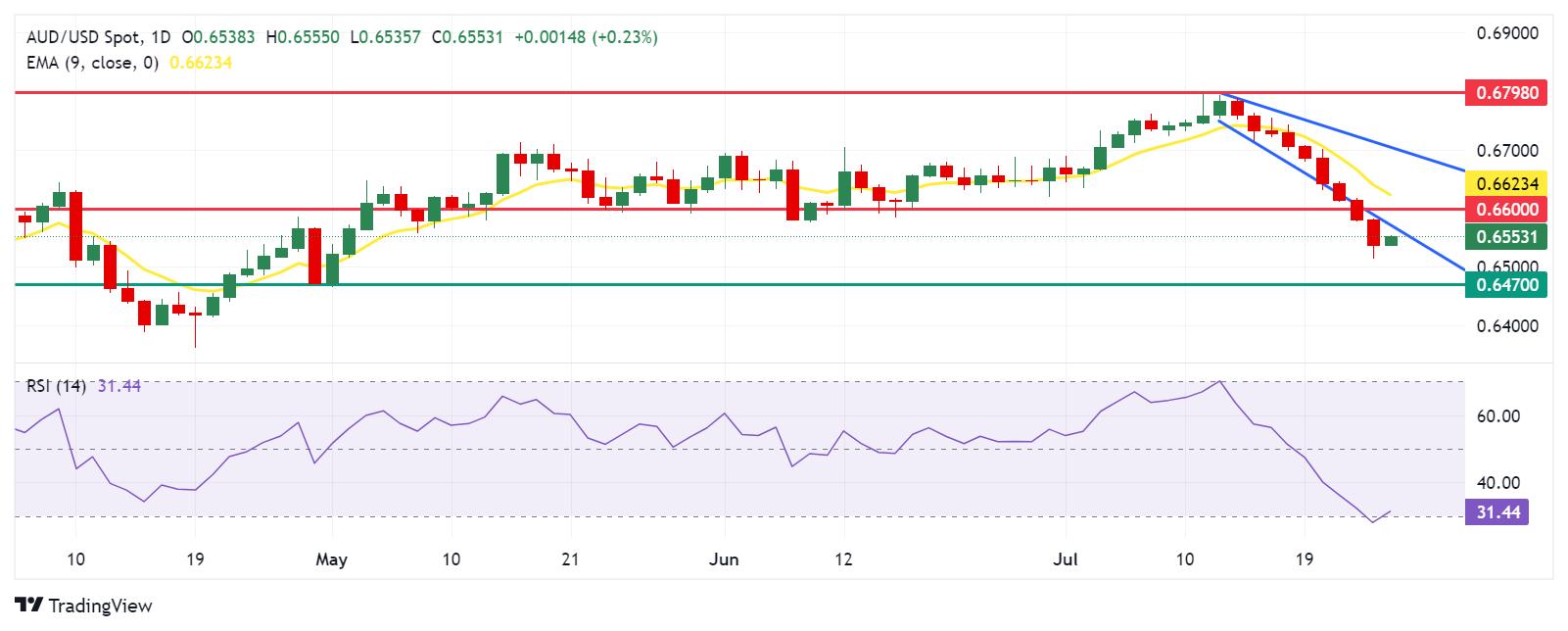
The Australian Dollar trades around 0.6550 on Friday. The daily chart analysis shows that the AUD/USD pair has fallen below the descending channel, indicating a strengthening bearish bias. The 14-day Relative Strength Index (RSI) is slightly above the 30 level, suggesting the currency pair is oversold and may be due for a potential correction soon.
Support for the AUD/USD pair could be found around the psychological level of 0.6500, with further support at 0.6470.
On the upside, key resistance lies at the lower boundary of the descending channel at 0.6570, followed by the psychological level of 0.6600. If the AUD/USD pair returns to the descending channel, it may weaken the bearish bias and support testing the nine-day Exponential Moving Average (EMA) at 0.6623. A break above this level could lead the pair to test the upper boundary of the descending channel around 0.6715, with a potential aim for a six-month high of 0.6798.
AUD/USD: Daily Chart
Australian Dollar PRICE Today
The table below shows the percentage change of Australian Dollar (AUD) against listed major currencies today. Australian Dollar was the strongest against the US Dollar.
| USD | EUR | GBP | JPY | CAD | AUD | NZD | CHF | |
|---|---|---|---|---|---|---|---|---|
| USD | -0.12% | -0.09% | -0.15% | -0.10% | -0.26% | -0.09% | -0.05% | |
| EUR | 0.12% | 0.02% | -0.05% | 0.03% | -0.15% | 0.06% | 0.08% | |
| GBP | 0.09% | -0.02% | -0.08% | 0.01% | -0.17% | 0.03% | 0.04% | |
| JPY | 0.15% | 0.05% | 0.08% | 0.06% | -0.08% | 0.09% | 0.12% | |
| CAD | 0.10% | -0.03% | -0.01% | -0.06% | -0.17% | 0.01% | 0.03% | |
| AUD | 0.26% | 0.15% | 0.17% | 0.08% | 0.17% | 0.20% | 0.23% | |
| NZD | 0.09% | -0.06% | -0.03% | -0.09% | -0.01% | -0.20% | 0.01% | |
| CHF | 0.05% | -0.08% | -0.04% | -0.12% | -0.03% | -0.23% | -0.01% |
The heat map shows percentage changes of major currencies against each other. The base currency is picked from the left column, while the quote currency is picked from the top row. For example, if you pick the Australian Dollar from the left column and move along the horizontal line to the US Dollar, the percentage change displayed in the box will represent AUD (base)/USD (quote).
Economic Indicator
Core Personal Consumption Expenditures - Price Index (MoM)
The Core Personal Consumption Expenditures (PCE), released by the US Bureau of Economic Analysis on a monthly basis, measures the changes in the prices of goods and services purchased by consumers in the United States (US). The PCE Price Index is also the Federal Reserve’s (Fed) preferred gauge of inflation. The MoM figure compares the prices of goods in the reference month to the previous month.The core reading excludes the so-called more volatile food and energy components to give a more accurate measurement of price pressures. Generally, a high reading is bullish for the US Dollar (USD), while a low reading is bearish.
Read more.Next release: Fri Jul 26, 2024 12:30
Frequency: Monthly
Consensus: 0.1%
Previous: 0.1%
Source: US Bureau of Economic Analysis
After publishing the GDP report, the US Bureau of Economic Analysis releases the Personal Consumption Expenditures (PCE) Price Index data alongside the monthly changes in Personal Spending and Personal Income. FOMC policymakers use the annual Core PCE Price Index, which excludes volatile food and energy prices, as their primary gauge of inflation. A stronger-than-expected reading could help the USD outperform its rivals as it would hint at a possible hawkish shift in the Fed’s forward guidance and vice versa.
Author
Akhtar Faruqui
FXStreet
Akhtar Faruqui is a Forex Analyst based in New Delhi, India. With a keen eye for market trends and a passion for dissecting complex financial dynamics, he is dedicated to delivering accurate and insightful Forex news and analysis.