Australian Dollar hovers above a major level amid a subdued US Dollar, focus on US PMI
- Australian Dollar continues its winning streak after the positive Services PMI on Thursday.
- Australia’s ASX 200 extends losses on weak sentiment due to expectations of prolonged higher borrowing costs.
- FOMC Minutes reflect caution regarding interest rate cuts that could potentially delay the start of an easing cycle.
- US Dollar faces challenges as US Treasury yields retrace recent gains.
- Investors await S&P US PMI data, weekly Initial Jobless Claims, and Existing Home Sales on Thursday.

The Australian Dollar (AUD) extends its winning streak on Thursday that began on February 14. This positive momentum was fueled by encouraging preliminary Australian Purchasing Managers Index (PMI) data. The data indicated a notable return to growth in private sector activity in February, marking the end of a five-month downturn, particularly driven by robust expansion in the services sector. However, the manufacturing sector encountered difficulties due to increased interest rates, leading to the most significant decline in output since May 2020.
Australian Dollar (AUD) could face hurdles stemming from softer Aussie money markets, as the S&P/ASX 200 Index registers its third consecutive decline amidst subdued sentiment. The recent release of the Federal Open Market Committee (FOMC) Minutes, expressing caution regarding interest rate cuts, might postpone the onset of an easing cycle. Additionally, the Reserve Bank of Australia's (RBA) meeting minutes earlier this week shifted market sentiment towards the probability of no imminent rate cuts.
The US Dollar Index (DXY) encountered downward pressure despite the rise in US Treasury yields on Wednesday following the cautious tone expressed in the FOMC Minutes regarding the pace of interest rate reductions. The Meeting Minutes highlighted the necessity for further evidence of disinflation to alleviate concerns about upside risks. Presently, futures in funds indicate that approximately 70% of the market anticipates a rate cut by the Fed's June meeting. According to the CME FedWatch Tool, there's now a 52.2% probability assigned by the market for the initiation of easing to commence in June.
Daily Digest Market Movers: Australian Dollar strengthens on improved Services PMI
- Judo Bank Australia Composite PMI increased to 51.8 in February from the previous reading of 49, indicating the first month of expansion in the Australian private sector after a five-month period of contraction.
- Judo Bank Australia Services PMI rose to 52.8 from the previous reading of 49.1. Manufacturing PMI fell to 47.7 from 50.1 prior due to a significant drop in new orders.
- Australian Wage Price Index (QoQ) grew by 0.9% in the fourth quarter as expected, lower than the previous rise of 1.3%. The index rose by 4.2% year-over-year, surpassing the market expectation to be unchanged at 4.1%.
- Westpac Leading Index (MoM) declined by 0.1% in January against the previous reading of flat 0.0%.
- The ANZ-Roy Morgan Consumer Confidence improved to 82.8 this week from 82.6 prior. Remarkably, the index has now spent a record 55 consecutive weeks below the mark of 85.
- RBA’s Meeting Minutes revealed that the Board deliberated on the possibility of raising rates by 25 basis points (bps) or keeping rates unchanged. While recent data indicated that inflation would return to target within a reasonable timeframe, it was acknowledged that this process would "take some time." Consequently, the board agreed that it was prudent not to rule out another rate hike.
- S&P's analysis of the FOMC minutes suggests that inflation is expected to continue cooling in the upcoming months, despite the ongoing uneven disinflationary trends. They maintain their outlook for monetary policy in 2024, anticipating no changes. S&P predicts that the Federal Reserve will likely reduce its policy rate by 25 basis points at its June meeting, with further cuts totaling 75 basis points by the end of the year.
- Richmond Federal Reserve Bank President Thomas Barkin told Reuters that the United States still has "ways to go" to achieve a soft landing. He highlighted the overall positive trajectory of US data concerning inflation and employment. However, Barkin noted that recent figures on the Producer Price Index (PPI) and Consumer Price Index (CPI) have been less favorable, indicating a reliance on disinflation from goods. He suggested that the US is nearing the end of its inflation challenge, with the pressing question being the duration until resolution.
Technical Analysis: Australian Dollar maintains its position above the major support of 0.6550
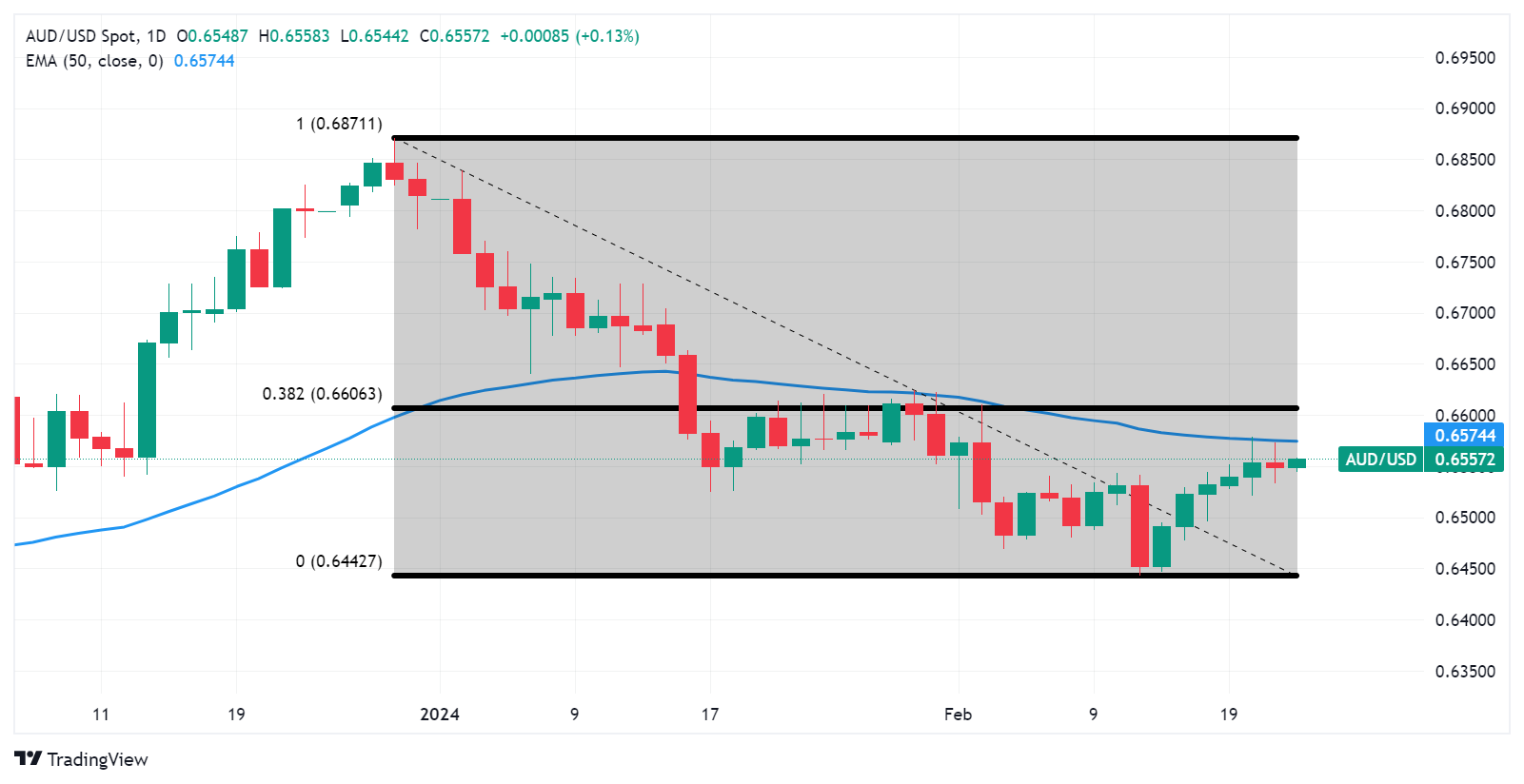
The Australian Dollar traded around the major level at 0.6560 on Thursday, which is positioned above the immediate support level of 0.6550. A break below this major level could retest the weekly low at 0.6521 followed by the psychological support level of 0.6500. On the upside, the AUD/USD pair could face a key resistance area around the 50-day Exponential Moving Average (EMA) at 0.6574 and the three-week high at 0.6579. A break above this region could lead the AUD/USD pair to approach the resistance zone around the psychological level of 0.6600 and 38.2% Fibonacci retracement level of 0.6606.
AUD/USD: Daily Chart
Australian Dollar price today
The table below shows the percentage change of Australian Dollar (AUD) against listed major currencies today. Australian Dollar was the strongest against the US Dollar.
| USD | EUR | GBP | CAD | AUD | JPY | NZD | CHF | |
| USD | -0.13% | -0.07% | -0.14% | -0.11% | -0.06% | -0.27% | -0.14% | |
| EUR | 0.12% | 0.05% | -0.04% | 0.01% | 0.07% | -0.13% | -0.01% | |
| GBP | 0.06% | -0.06% | -0.08% | -0.05% | 0.00% | -0.18% | -0.07% | |
| CAD | 0.13% | 0.03% | 0.09% | 0.05% | 0.10% | -0.09% | 0.02% | |
| AUD | 0.11% | -0.01% | 0.05% | -0.04% | 0.06% | -0.14% | -0.03% | |
| JPY | 0.06% | -0.07% | -0.03% | -0.10% | -0.09% | -0.21% | -0.06% | |
| NZD | 0.26% | 0.12% | 0.18% | 0.09% | 0.13% | 0.19% | 0.12% | |
| CHF | 0.14% | -0.01% | 0.07% | -0.02% | 0.02% | 0.08% | -0.11% |
The heat map shows percentage changes of major currencies against each other. The base currency is picked from the left column, while the quote currency is picked from the top row. For example, if you pick the Euro from the left column and move along the horizontal line to the Japanese Yen, the percentage change displayed in the box will represent EUR (base)/JPY (quote).
US Interest rates FAQs
What are interest rates?
Interest rates are charged by financial institutions on loans to borrowers and are paid as interest to savers and depositors. They are influenced by base lending rates, which are set by central banks in response to changes in the economy. Central banks normally have a mandate to ensure price stability, which in most cases means targeting a core inflation rate of around 2%.
If inflation falls below target the central bank may cut base lending rates, with a view to stimulating lending and boosting the economy. If inflation rises substantially above 2% it normally results in the central bank raising base lending rates in an attempt to lower inflation.
How do interest rates impact currencies?
Higher interest rates generally help strengthen a country’s currency as they make it a more attractive place for global investors to park their money.
How do interest rates influence the price of Gold?
Higher interest rates overall weigh on the price of Gold because they increase the opportunity cost of holding Gold instead of investing in an interest-bearing asset or placing cash in the bank.
If interest rates are high that usually pushes up the price of the US Dollar (USD), and since Gold is priced in Dollars, this has the effect of lowering the price of Gold.
What is the Fed Funds rate?
The Fed funds rate is the overnight rate at which US banks lend to each other. It is the oft-quoted headline rate set by the Federal Reserve at its FOMC meetings. It is set as a range, for example 4.75%-5.00%, though the upper limit (in that case 5.00%) is the quoted figure.
Market expectations for future Fed funds rate are tracked by the CME FedWatch tool, which shapes how many financial markets behave in anticipation of future Federal Reserve monetary policy decisions.
Author

Akhtar Faruqui
FXStreet
Akhtar Faruqui is a Forex Analyst based in New Delhi, India. With a keen eye for market trends and a passion for dissecting complex financial dynamics, he is dedicated to delivering accurate and insightful Forex news and analysis.