Australian Dollar remains weak as US Dollar steadies ahead of PMI release
- The Australian Dollar continues to lose ground due to the stark decline in prices of Iron Ore.
- Australia's Composite PMI declined to 50.2 in July from 50.7 in June, marking the slowest growth in six months.
- The US Dollar may be under pressure due to rising bets on a Fed rate cut in September.

The Australian Dollar (AUD) continues its losing streak for the eighth consecutive day following the release of mixed data from Australia's Judo Bank Purchasing Managers Index (PMI) on Wednesday. Moreover, sluggish economic activity in China has put additional selling pressure on the AUD. Concerns about the weak Chinese economy were heightened by an unexpected rate cut from the People's Bank of China (PBoC) on Monday.
Additionally, the weak outlook for the Chinese economy has caused a decline in Iron Ore prices, further pressuring the Australian Dollar. Iron ore prices depreciate toward $108.00, hitting its lowest level in three weeks. This decline is particularly impactful for Australia, the largest exporter of this precious metal.
The US Dollar (USD) may struggle due to rising bets on a Federal Reserve (Fed) rate cut in September, which could limit the downside of the AUD/USD pair. Traders await the data release of the Global Purchasing Managers Index (PMI) on Wednesday to gain fresh insights into the economic conditions of the United States (US).
According to CME Group’s FedWatch Tool, markets now indicate a 93.6% probability of a 25-basis point rate cut at the September Fed meeting, up from 88.5% a day earlier.
Daily Digest Market Movers: Australian Dollar depreciates due to China’s growing concerns
- Australia's Judo Bank Manufacturing PMI improved to 47.4 in July from 47.2 in June. Meanwhile, the Services PMI dropped to 50.8 in July from 51.2 in June. The Composite PMI also declined, falling to 50.2 in July from 50.7 in June.
- Media reports say that Vice President Kamala Harris has just passed 1,976 Democratic delegates to secure the party's presidential nomination. Harris is now the Democratic Party’s Presumptive Nominee for November’s Presidential Election.
- "The interest rate cuts by the People's Bank of China (PBoC) and the outcomes of the Third Plenum are too modest to convince market participants that a significant acceleration in the Chinese economy is in prospect," said Joseph Capurso, head of international economics at the Commonwealth Bank of Australia.
- The People’s Bank of China (PBoC) has cut one- and five-year loan prime rates by ten basis points to 3.35% and 3.85%, respectively. Any change in the Chinese economy could impact the Australian markets as both countries are close trade partners.
- Federal Reserve Bank of New York President John Williams stated on Friday that the long-term trends that caused declines in neutral interest rates before the pandemic continue to prevail. Williams noted, "My own Holston-Laubach-Williams estimates for r-star in the United States, Canada, and the Euro area are about the same level as they were before the pandemic," according to Bloomberg.
- Reuters cited Sean Langcake, head of macroeconomic forecasting for Oxford Economics Australia, saying, "The current pace of employment growth suggests demand is resilient and cost pressures will remain. We think the RBA will stay the course and keep rates on hold, but August is certainly a live meeting."
- Fed Chair Powell stated last week that the three US inflation readings from this year "add somewhat to confidence" that inflation is on track to meet the Fed’s target sustainably, suggesting that a shift to interest rate cuts may be imminent.
Technical Analysis: Australian Dollar falls to near 0.6600
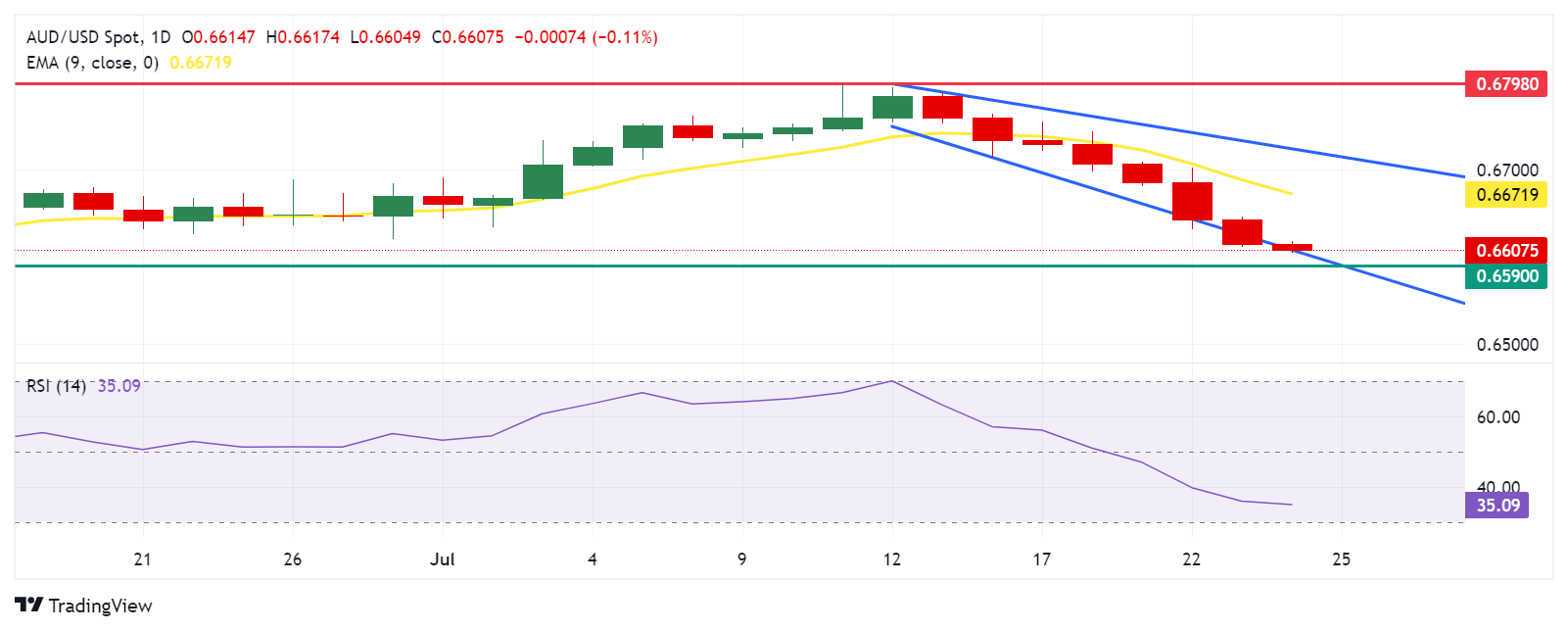
The Australian Dollar trades around 0.6610 on Wednesday. The daily chart analysis shows that the AUD/USD pair is depreciating within a descending channel, indicating a bearish bias. The 14-day Relative Strength Index (RSI) is below the level of 50, confirming a bearish trend.
The AUD/USD pair tests the lower boundary of the descending channel near the psychological level of 0.6600. A decline below this level could push the pair toward the throwback support around 0.6590.
On the upside, key resistance is at the nine-day Exponential Moving Average (EMA) at 0.6671, followed by the psychological level of 0.6700. A breakthrough above this level could lead the AUD/USD pair to test the upper boundary of the descending channel around 0.6722, and then aim for a six-month high of 0.6798.
AUD/USD: Daily Chart
Australian Dollar PRICE Today
The table below shows the percentage change of Australian Dollar (AUD) against listed major currencies today. Australian Dollar was the weakest against the Japanese Yen.
| USD | EUR | GBP | JPY | CAD | AUD | NZD | CHF | |
|---|---|---|---|---|---|---|---|---|
| USD | 0.01% | 0.10% | -0.60% | 0.04% | 0.29% | 0.50% | -0.02% | |
| EUR | -0.01% | 0.08% | -0.65% | 0.03% | 0.29% | 0.51% | -0.04% | |
| GBP | -0.10% | -0.08% | -0.72% | -0.06% | 0.20% | 0.41% | -0.13% | |
| JPY | 0.60% | 0.65% | 0.72% | 0.68% | 0.92% | 1.11% | 0.59% | |
| CAD | -0.04% | -0.03% | 0.06% | -0.68% | 0.25% | 0.46% | -0.08% | |
| AUD | -0.29% | -0.29% | -0.20% | -0.92% | -0.25% | 0.19% | -0.33% | |
| NZD | -0.50% | -0.51% | -0.41% | -1.11% | -0.46% | -0.19% | -0.52% | |
| CHF | 0.02% | 0.04% | 0.13% | -0.59% | 0.08% | 0.33% | 0.52% |
The heat map shows percentage changes of major currencies against each other. The base currency is picked from the left column, while the quote currency is picked from the top row. For example, if you pick the Australian Dollar from the left column and move along the horizontal line to the US Dollar, the percentage change displayed in the box will represent AUD (base)/USD (quote).
Australian Dollar FAQs
One of the most significant factors for the Australian Dollar (AUD) is the level of interest rates set by the Reserve Bank of Australia (RBA). Because Australia is a resource-rich country another key driver is the price of its biggest export, Iron Ore. The health of the Chinese economy, its largest trading partner, is a factor, as well as inflation in Australia, its growth rate and Trade Balance. Market sentiment – whether investors are taking on more risky assets (risk-on) or seeking safe-havens (risk-off) – is also a factor, with risk-on positive for AUD.
The Reserve Bank of Australia (RBA) influences the Australian Dollar (AUD) by setting the level of interest rates that Australian banks can lend to each other. This influences the level of interest rates in the economy as a whole. The main goal of the RBA is to maintain a stable inflation rate of 2-3% by adjusting interest rates up or down. Relatively high interest rates compared to other major central banks support the AUD, and the opposite for relatively low. The RBA can also use quantitative easing and tightening to influence credit conditions, with the former AUD-negative and the latter AUD-positive.
China is Australia’s largest trading partner so the health of the Chinese economy is a major influence on the value of the Australian Dollar (AUD). When the Chinese economy is doing well it purchases more raw materials, goods and services from Australia, lifting demand for the AUD, and pushing up its value. The opposite is the case when the Chinese economy is not growing as fast as expected. Positive or negative surprises in Chinese growth data, therefore, often have a direct impact on the Australian Dollar and its pairs.
Iron Ore is Australia’s largest export, accounting for $118 billion a year according to data from 2021, with China as its primary destination. The price of Iron Ore, therefore, can be a driver of the Australian Dollar. Generally, if the price of Iron Ore rises, AUD also goes up, as aggregate demand for the currency increases. The opposite is the case if the price of Iron Ore falls. Higher Iron Ore prices also tend to result in a greater likelihood of a positive Trade Balance for Australia, which is also positive of the AUD.
The Trade Balance, which is the difference between what a country earns from its exports versus what it pays for its imports, is another factor that can influence the value of the Australian Dollar. If Australia produces highly sought after exports, then its currency will gain in value purely from the surplus demand created from foreign buyers seeking to purchase its exports versus what it spends to purchase imports. Therefore, a positive net Trade Balance strengthens the AUD, with the opposite effect if the Trade Balance is negative.
Author
Akhtar Faruqui
FXStreet
Akhtar Faruqui is a Forex Analyst based in New Delhi, India. With a keen eye for market trends and a passion for dissecting complex financial dynamics, he is dedicated to delivering accurate and insightful Forex news and analysis.

















