Aussie Dollar dips on geopolitical strain as market await US jobs data
- The Australian Dollar losses steam after failing to hold gains above 0.6900.
- Geopolitical tensions between Israel and Iran spur safe-haven demand for the US Dollar.
- US unemployment claims rising above estimates, and strong ISM Services PMI data reduces chances of further aggressive Fed rate cuts.

The Australian Dollar (AUD) loses more than 0.50% against the US Dollar on Thursday, dropping after hitting a daily high of 0.6888 amid concerns that the Israel-Iran war could broaden in the Middle East. This spurred flows toward the Greenback, which briefly topped 102.00 via the US Dollar Index (DXY), but mixed US data capped its gains. The AUD/USD trades at 0.6844.
A risk-off impulse is weighing on the Aussie Dollar. Discussions between the US and Israel continued on how to retaliate against Iran. A headline that US President Joe Biden discussed with Israel a possible attack on Iran’s oil facilities dented appetite for riskier assets like the AUD.
Data revealed by the US Department of Labor showed that the number of people filing for unemployment benefits increased above estimates. Meanwhile, business activity data in the services sectors, revealed by the Institute for Supply Management (ISM) exceeded estimates in September, portraying a robust economy, which could erase the chances for a further 50 basis points (bps) of rate cuts by the Federal Reserve (Fed).
In the meantime, the Balance of Trade in Australia printed a surplus in August, which exceeded estimates of A$5.5 billion, came at A$5.64 billion, up from July’s A$5.636 billion.
Besides that, Australia’s Judo Bank Services Purchasing Managers Index (PMI) decelerates from 52.5 to 50.5 in September. This could refrain the Reserve Bank of Australia (RBA) from adopting a hawkish stance amid concerns that the economy is cooling.
Ahead in the calendar, the Australian economic docket will feature Home Loans and Investment Lending for Homes in August.
Daily digest market movers: Australian Dollar tumbles on risk aversion ahead of US NFP
- US Initial Jobless Claims for the week ending September 28 increased from 219K to 225K, surpassing the estimate of 220K.
- The ISM Services PMI for September expanded from 51.5 to 54.9, while Factory Orders for August declined by -0.2%, missing the 0% estimate and down from the previous month's 4.9% increase.
- US Nonfarm Payrolls, due on Friday, are expected to show 140K jobs added in September, slightly below the 142K jobs in August, with the Unemployment Rate projected to remain unchanged.
- Market participants have placed the odds of a 25 bps rate cut at 66.7%, while the chances of a larger 50 bps cut have decreased to 33.3%, according to the CME FedWatch Tool.
- China’s business activity has deteriorated, which has led to increased stimulus from the People’s Bank of China (PBoC) and the Politburo.
- To stimulate the economy, the PBoC cut loan rates, reduced bank reserve capital requirements and even lowered property down payments. If China’s economy continues to print deflationary readings, it could miss its Gross Domestic Product (GDP) 5% goal for 2024.
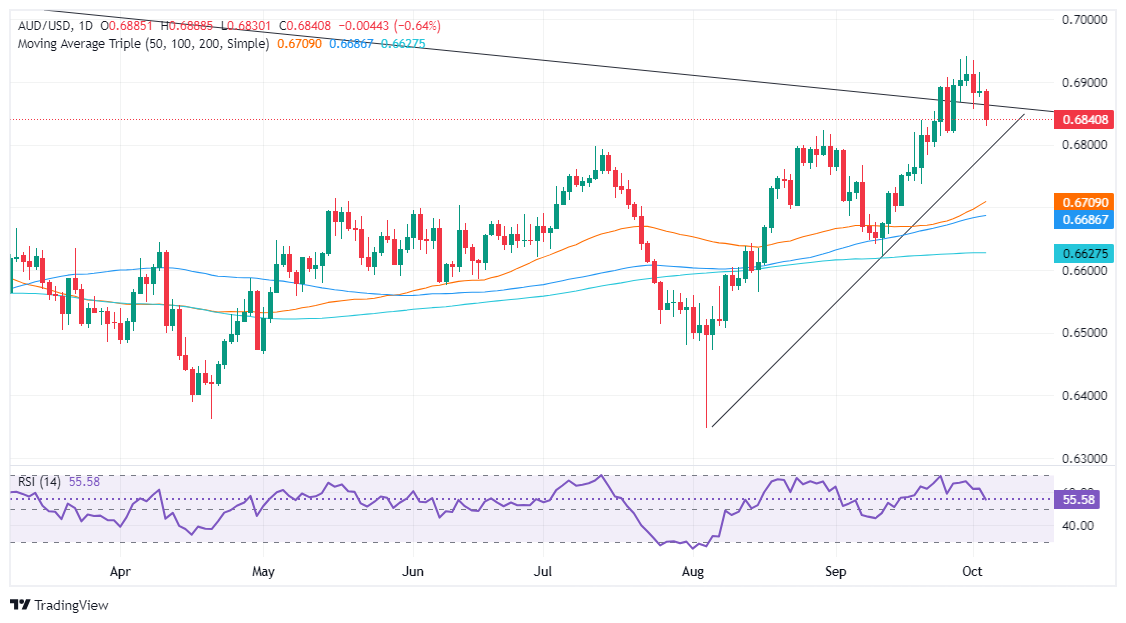
Technical outlook: Australian Dollar extends its losses below 0.6850
The AUD/USD remains upwardly biased, but in the short-term the Aussie could test lower prices. The ongoing pullback broke the first support level at 0.6871, exacerbating a drop toward the 0.6800 figure.
From a momentum standpoint, the Relative Strength Index (RSI) is mixed, remaining in bullish territory. However, the RSI is falling almost vertically toward its neutral line. Hence, further AUD/USD downside is seen.
Once AUD/USD cleared the October 1, 2024 low of 0.6856, that has opened the door to challenge the 0.6800 figure. Once surpassed, the next stop would be the 50-day Simple Moving Average (SMA) at 0.6707.
Conversely, if AUD/USD aims higher and closes above 0.6900, look for a retest of the year-to-date high of 0.6934.
Australian Dollar FAQs
One of the most significant factors for the Australian Dollar (AUD) is the level of interest rates set by the Reserve Bank of Australia (RBA). Because Australia is a resource-rich country another key driver is the price of its biggest export, Iron Ore. The health of the Chinese economy, its largest trading partner, is a factor, as well as inflation in Australia, its growth rate and Trade Balance. Market sentiment – whether investors are taking on more risky assets (risk-on) or seeking safe-havens (risk-off) – is also a factor, with risk-on positive for AUD.
The Reserve Bank of Australia (RBA) influences the Australian Dollar (AUD) by setting the level of interest rates that Australian banks can lend to each other. This influences the level of interest rates in the economy as a whole. The main goal of the RBA is to maintain a stable inflation rate of 2-3% by adjusting interest rates up or down. Relatively high interest rates compared to other major central banks support the AUD, and the opposite for relatively low. The RBA can also use quantitative easing and tightening to influence credit conditions, with the former AUD-negative and the latter AUD-positive.
China is Australia’s largest trading partner so the health of the Chinese economy is a major influence on the value of the Australian Dollar (AUD). When the Chinese economy is doing well it purchases more raw materials, goods and services from Australia, lifting demand for the AUD, and pushing up its value. The opposite is the case when the Chinese economy is not growing as fast as expected. Positive or negative surprises in Chinese growth data, therefore, often have a direct impact on the Australian Dollar and its pairs.
Iron Ore is Australia’s largest export, accounting for $118 billion a year according to data from 2021, with China as its primary destination. The price of Iron Ore, therefore, can be a driver of the Australian Dollar. Generally, if the price of Iron Ore rises, AUD also goes up, as aggregate demand for the currency increases. The opposite is the case if the price of Iron Ore falls. Higher Iron Ore prices also tend to result in a greater likelihood of a positive Trade Balance for Australia, which is also positive of the AUD.
The Trade Balance, which is the difference between what a country earns from its exports versus what it pays for its imports, is another factor that can influence the value of the Australian Dollar. If Australia produces highly sought after exports, then its currency will gain in value purely from the surplus demand created from foreign buyers seeking to purchase its exports versus what it spends to purchase imports. Therefore, a positive net Trade Balance strengthens the AUD, with the opposite effect if the Trade Balance is negative.
Author

Christian Borjon Valencia
FXStreet
Markets analyst, news editor, and trading instructor with over 14 years of experience across FX, commodities, US equity indices, and global macro markets.