Australian Dollar remains tepid as US Dollar appreciates ahead of US CPI
- The Australian Dollar depreciates as US Dollar continues to strengthen amid optimism around the Trump trades.
- Australia's Wage Price Index increased by 3.5% YoY in Q3, down from a 4.1% rise in Q2.
- The US Consumer Price Index data release will be eyed in the North American session.

The Australian Dollar (AUD) extends its losses against the US Dollar (USD) for the fourth successive day on Wednesday. The AUD/USD pair remains subdued after the release of the weaker-than-expected Australia’s Wage Price Index data. Additionally, the downward movement of the pair is bolstered by the optimism around the Trump trades.
Australia's Prime Minister Anthony Albanese shared in a radio interview on Wednesday that he discussed trade with US President-elect Donald Trump during a phone call last week. Albanese informed Trump that the United States holds a trade surplus with Australia and emphasized that it is in Washington's best interest to "trade fairly" with its ally. Meanwhile, the defense minister underscored Australia's significant investment in security.
The Reserve Bank of Australia (RBA) Governor Michele Bullock reaffirmed a hawkish stance after the interest rate hold last week, emphasizing the need for restrictive monetary policy amid ongoing inflation risks and a strong labor market. The hawkish sentiment surrounding the RBA might have restrained the downside of the Australian Dollar.
The US Dollar strengthened as analysts noted that if Trump’s fiscal policies are enacted, they could increase investment, spending, and labor demand, potentially heightening inflation risks. This scenario might lead the Federal Reserve (Fed) to consider a more restrictive monetary policy stance.
Traders are now focused on the upcoming US inflation data release on Wednesday for further guidance on future US policy. The headline Consumer Price Index (CPI) is expected to show a 2.6% year-over-year increase for October, with the core CPI anticipated to rise by 3.3%.
Australian Dollar receives downward pressure from Trump's potential tariff on China imports
- Australia's Wage Price Index rose by 3.5% year-over-year in the third quarter, down from a 4.1% increase in the previous quarter and below expectations of a 3.6% gain. This marks the slowest wage growth since Q4 2022.
- Minneapolis Fed President Neel Kashkari stated on Tuesday that the central bank remains confident in its prolonged fight against transitory inflation but noted that it’s too early to declare complete victory. Kashkari also mentioned that the Fed would hold off on modeling the economic impact of Trump’s policies until there is more clarity on their specifics.
- Australia's Westpac Consumer Confidence index rose by 5.3% to reach 94.6 points in November, marking its second consecutive month of improvement and the highest level in two and a half years. However, the index has remained below 100 for nearly three years, reflecting that pessimists still outnumber optimists.
- Matthew Hassan, Senior Economist at Westpac, noted "Consumers are feeling less pressure on their family finances, are no longer worried about further interest rate rises, and are increasingly confident in the economic outlook."
- Bloomberg News reported early Tuesday that Chinese regulators are planning to cut taxes on home purchases. According to the report, authorities are working on a proposal that would allow major cities to lower the deed tax for buyers to as low as 1%, down from the current maximum rate of 3%.
- China's latest stimulus measures fell short of investor expectations, further dampening demand prospects for Australia’s largest trading partner and weighing on the Australian Dollar. China announced a 10 trillion Yuan debt package on Friday designed to alleviate local government financing pressures and support struggling economic growth. However, the package stopped short of implementing direct economic stimulus measures.
- Morgan Stanley divides the Trump administration's macroeconomic policies into three key areas: tariffs, immigration, and fiscal measures. The report predicts that tariff policies will be prioritized, with an anticipated immediate imposition of 10% tariffs globally and 60% tariffs specifically on China.
- On Thursday, Federal Reserve Chair Jerome Powell stated he doesn’t anticipate Trump’s potential return to the White House impacting the Fed’s near-term policy decisions. “We don’t guess, speculate, and we don’t assume what future government policy choices will be,” Powell noted after the bank decided to lower interest rates by 25 basis points to a range of 4.50%-4.75%, as expected.
Australian Dollar falls toward three-month lows near 0.6500
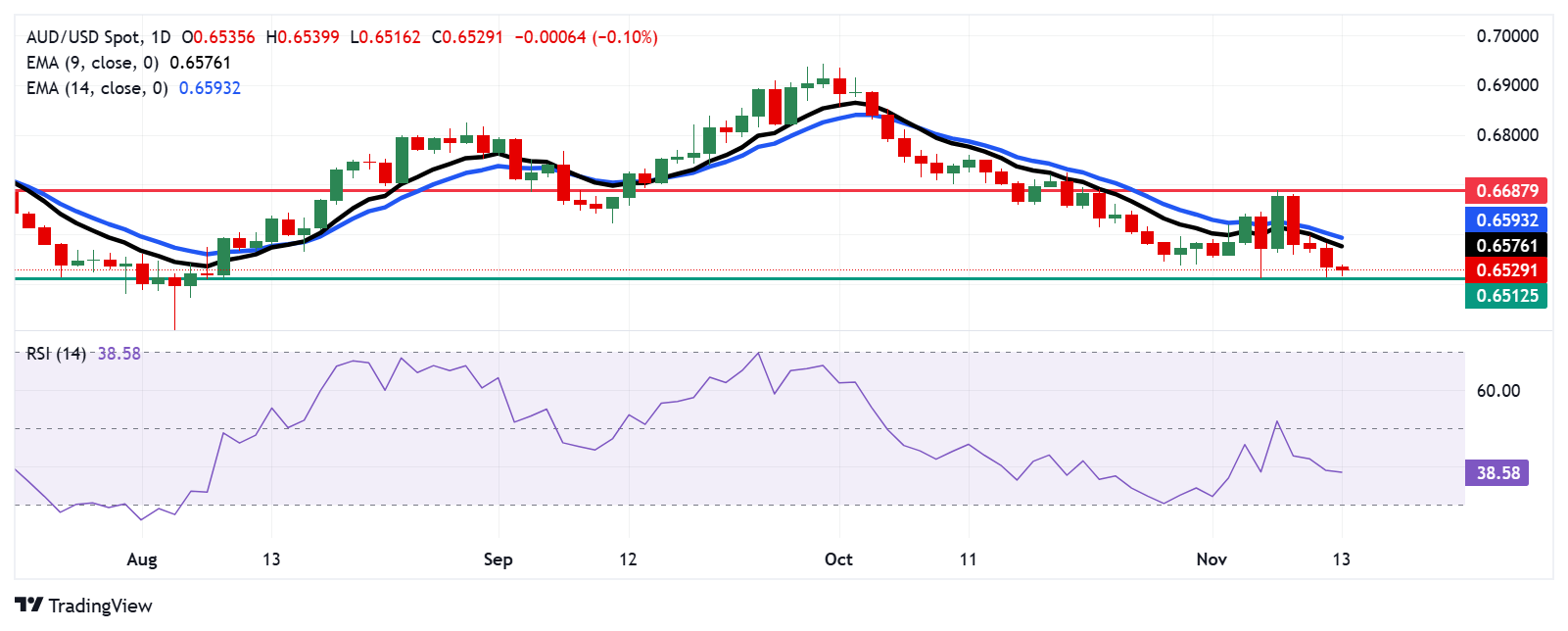
AUD/USD trades near 0.6530 on Wednesday. The daily chart analysis indicates short-term downward pressure, as the pair stays below the nine-day Exponential Moving Average (EMA). Additionally, the 14-day Relative Strength Index (RSI) remains under the 50 level, further supporting a bearish outlook.
In terms of support, the AUD/USD pair is testing its three-month low of 0.6512, reached on November 6, with further psychological support at 0.6500.
On the upside, resistance appears at the nine-day EMA at 0.6576, followed by the 14-day EMA at 0.6593. A break above these EMAs could propel the AUD/USD pair toward its three-week high of 0.6687, with the next psychological target at 0.6700.
AUD/USD: Daily Chart
Economic Indicator
Consumer Price Index (YoY)
Inflationary or deflationary tendencies are measured by periodically summing the prices of a basket of representative goods and services and presenting the data as The Consumer Price Index (CPI). CPI data is compiled on a monthly basis and released by the US Department of Labor Statistics. The YoY reading compares the prices of goods in the reference month to the same month a year earlier.The CPI is a key indicator to measure inflation and changes in purchasing trends. Generally speaking, a high reading is seen as bullish for the US Dollar (USD), while a low reading is seen as bearish.
Read more.Next release: Wed Nov 13, 2024 13:30
Frequency: Monthly
Consensus: 2.6%
Previous: 2.4%
Source: US Bureau of Labor Statistics
The US Federal Reserve has a dual mandate of maintaining price stability and maximum employment. According to such mandate, inflation should be at around 2% YoY and has become the weakest pillar of the central bank’s directive ever since the world suffered a pandemic, which extends to these days. Price pressures keep rising amid supply-chain issues and bottlenecks, with the Consumer Price Index (CPI) hanging at multi-decade highs. The Fed has already taken measures to tame inflation and is expected to maintain an aggressive stance in the foreseeable future.
Inflation FAQs
Inflation measures the rise in the price of a representative basket of goods and services. Headline inflation is usually expressed as a percentage change on a month-on-month (MoM) and year-on-year (YoY) basis. Core inflation excludes more volatile elements such as food and fuel which can fluctuate because of geopolitical and seasonal factors. Core inflation is the figure economists focus on and is the level targeted by central banks, which are mandated to keep inflation at a manageable level, usually around 2%.
The Consumer Price Index (CPI) measures the change in prices of a basket of goods and services over a period of time. It is usually expressed as a percentage change on a month-on-month (MoM) and year-on-year (YoY) basis. Core CPI is the figure targeted by central banks as it excludes volatile food and fuel inputs. When Core CPI rises above 2% it usually results in higher interest rates and vice versa when it falls below 2%. Since higher interest rates are positive for a currency, higher inflation usually results in a stronger currency. The opposite is true when inflation falls.
Although it may seem counter-intuitive, high inflation in a country pushes up the value of its currency and vice versa for lower inflation. This is because the central bank will normally raise interest rates to combat the higher inflation, which attract more global capital inflows from investors looking for a lucrative place to park their money.
Formerly, Gold was the asset investors turned to in times of high inflation because it preserved its value, and whilst investors will often still buy Gold for its safe-haven properties in times of extreme market turmoil, this is not the case most of the time. This is because when inflation is high, central banks will put up interest rates to combat it. Higher interest rates are negative for Gold because they increase the opportunity-cost of holding Gold vis-a-vis an interest-bearing asset or placing the money in a cash deposit account. On the flipside, lower inflation tends to be positive for Gold as it brings interest rates down, making the bright metal a more viable investment alternative.
Author

Akhtar Faruqui
FXStreet
Akhtar Faruqui is a Forex Analyst based in New Delhi, India. With a keen eye for market trends and a passion for dissecting complex financial dynamics, he is dedicated to delivering accurate and insightful Forex news and analysis.