|

Aussie GDP: Misses the mark QoQ and AUD under some pressure

Australia's Gross Domestic Product data for the second quarter has been released as follows:

Australian GDP SA (QoQ) Q2: 0.9% (est 1.0%; prev 0.8%) - GDP (YoY) Q2: 3.6% (est 3.4%; prev 3.3%)

This is a slight weight to the Aussie that is trying to make a fresh low for the day:
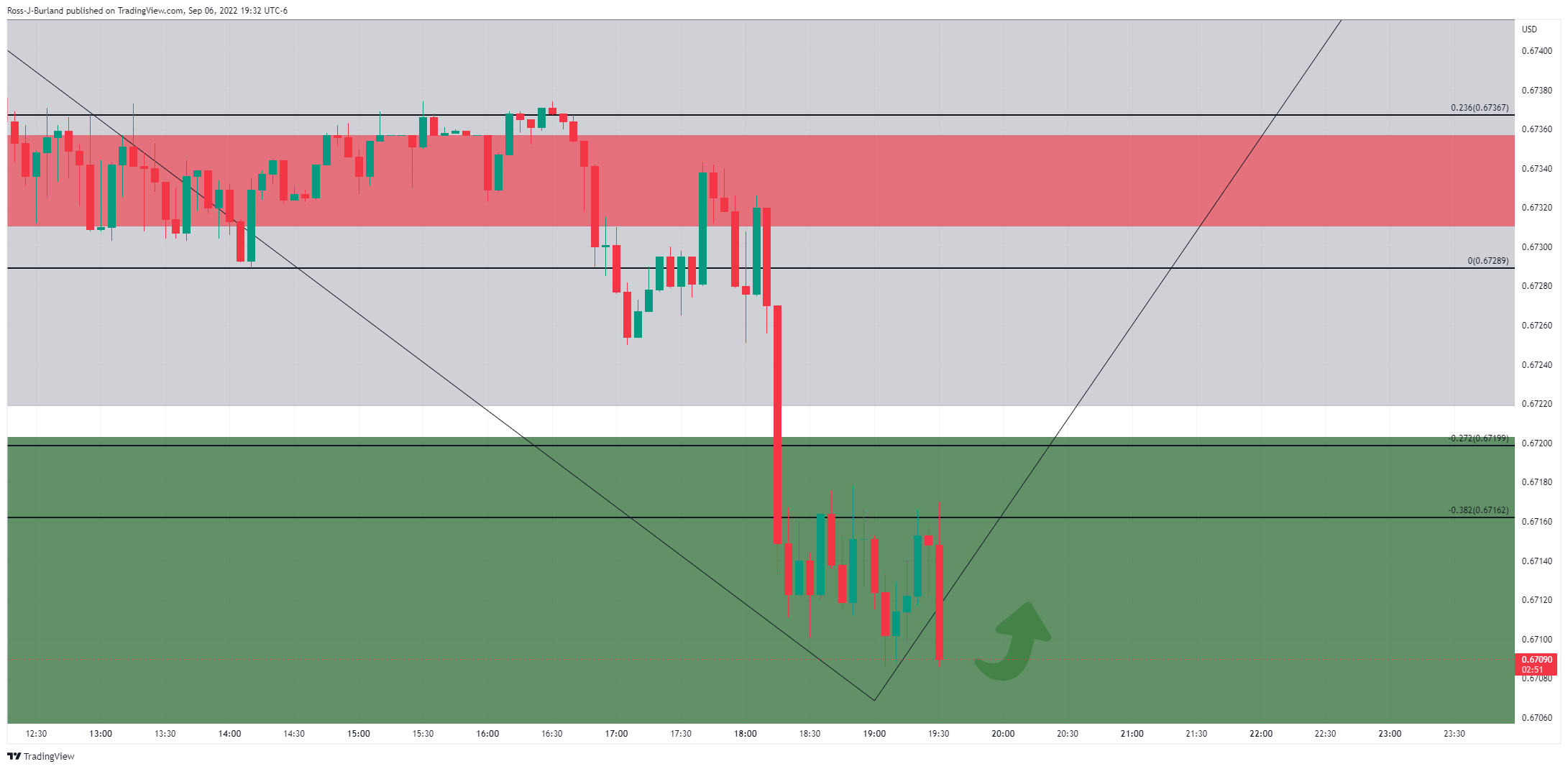
We have resistance around 0.6735 as the price currently takes on the -38.2% extension of the prior bearish impulse. Above the resistance, eyes will be on the 0.6775 area around the Wall Street opening highs. 

Prior to the release, it was explained that analysts at ANZ bank explained that ''from a policy perspective it will be the inflation indicators in the GDP report that are key. The RBA’s preferred measure of wider labor costs – non-farm average earnings per hour – looks to have grown at an annual pace of just over 4% in the June quarter.''

Despite the miss in the quarterly headline, this leaves a bullish bias on the charts for the data given that labor costs are clearly trending higher.

The analysts at ANZ Bank also note that ''household consumption deflator and broader GDP deflator also look to have risen strongly, suggesting still-intense inflationary pressures.''

About Aussie GDP

The Australian Bureau of Statistics (ABS) releases the Gross Domestic Product (GDP) on a quarterly basis. It is published about 65 days after the quarter ends. The indicator is closely watched, as it paints an important picture of the economy. A strong labour market, rising wages and rising private capital expenditure data are critical for the country’s improved economic performance, which in turn impacts the Reserve Bank of Australia’s (RBA) monetary policy decision and the Australian dollar. Actual figures beating estimates is considered AUD bullish, as it could prompt the RBA to tighten its monetary policy.

Author

Ross J Burland

Ross J Burland, born in England, UK, is a sportsman at heart. He played Rugby and Judo for his county, Kent and the South East of England Rugby team.


More from Ross J Burland
Share:

Editor's Picks

EUR/USD holds above 1.1800 after German sentiment data

EUR/USD stays in positive territory above 1.1800 on Monday after the data from Germany highlighted a modest improvement in business sentiment in February. Meanwhile, the US Dollar stays under pressure amid growing unceratinty surrounding the US trade regime, allowing the pair to hold its ground.

GBP/USD rises toward 1.3550 as tariff confusion slams USD

GBP/USD extends the advance toward 1.3550 on Monday. The US Dollar faces intense selling pressure as tariff uncertainty lingers following US President Trump's latest announcement. Traders will take more cues from the broader market sentiment and central bank talks. 

Gold climbs above $5,100 on broad USD weakness

Gold sticks to its bullish bias near the monthly above $5,100 on Monday. Renewed trade-war fears, along with rising geopolitical tensions in the Middle East, turn out to be key factors that underpin the safe-haven precious metal and validate the constructive outlook.

Cardano braces for impact as US tariff storm brews

Cardano is down 4% at press time on Monday, entering its third consecutive day of decline. Bearish bias in Cardano’s derivatives market positional buildup aligns with rising pressure on the broader cryptocurrencymarket amid US President Donald Trump's reassessment of global tariffs and domestic conflict with the US Supreme Court. 

Supreme Court nixes tariffs, Trump teases 15% global tariff

On February 20th, the Supreme Court ruled that Trump’s global tariffs under IEEPA authority were unconstitutional, effectively nullifying the framework. However, the relief was short-lived. Within hours, Trump floated a 15% blanket tariff under an alternative legal authority.

Top Crypto Losers: Zcash, Pump.fun, and LayerZero extended losses as Bitcoin loses $65,000

The cryptocurrency market starts the week in panic mode, with altcoins Zcash, Pump.fun, and LayerZero. Bitcoin falls below $65,000 as the US President Donald Trump regroups amid renewed trade policy risks.