AUDUSD subdued after Federal Reserve official’s commentary, as RBA minutes loom
- Federal Reserve policymakers are committed to tackling inflation in the United States, bolstering the US Dollar.
- Australia’s Consumer Confidence improved, Aussie Dollar traders eye RBA minutes.
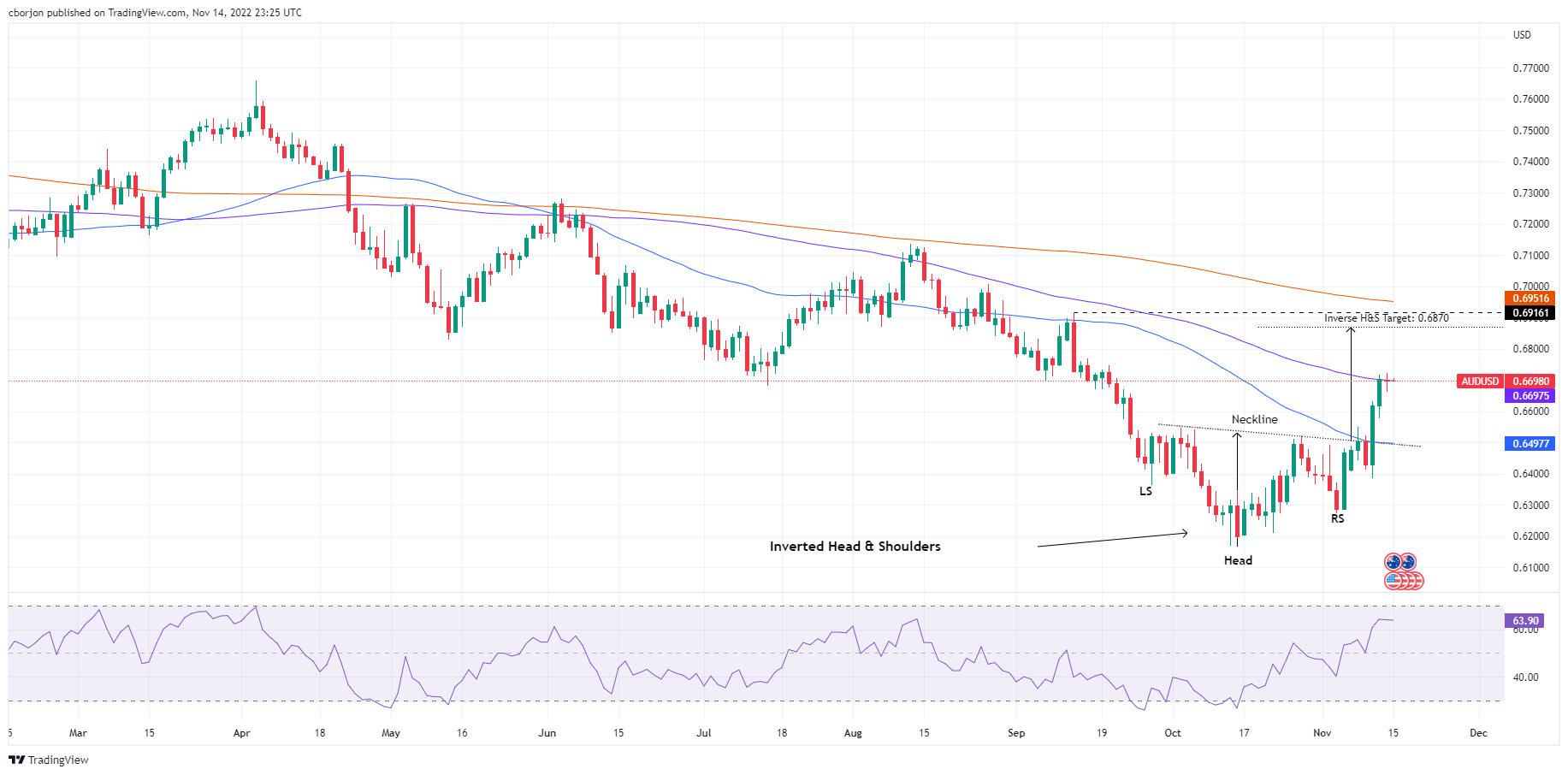
- AUDUSD Price Analysis: The inverted head-and-shoulders pattern remains in play, targets 0.6870.

The Australian Dollar (AUD) is almost flat as the North American session winds down after two Fed officials emphasized the Federal Reserve’s (Fed) commitment to tackle inflation at around 7.7% YoY, bolstering the US Dollar (USD). However, both policymakers acknowledged that it would be “appropriate” to slow the pace of interest-rate increases, spurring a risk-on impulse. Nevertheless, sentiment shifted sour. At the time of writing, the AUDUSD is trading at 0.6700.
Fed officials compromised to bring inflation to Fed’s target
Wall Street finished Monday’s session in the red. Fed Vice-Chair Lael Brainard said that the Federal Reserve might slow the pace of interest-rate increases and said she favors a 50 bps hike in December. Brainard added that the Central Bank would not pause or ease monetary conditions, adding that “we have additional work to do.” Earlier, Fed Governor Christopher Waller echoed Brainard’s comments and commented that the Fed could moderate the size of interest-rate increases to 50 bps at their December meeting or the one after that. Although it was a hawkish statement, and the USD was bolstered, the AUD clung to its last week’s gains, as shown by the AUDUSD hitting a daily low at 0.6663 before challenging the 0.6700 figure.
Data-wise, the United States (US) calendar featured the New York Fed inflation expectations, with one and three-year horizons expanding by 5.9% and 3.1%, from 5.4% and 2.9%, respectively. The jump in inflation expectations is attributed to high gasoline prices.
Australia’s Consumer Confidence improved, but the AUDUSD remains subdued
Aside from this, Australia’s economic docket features the ANZ-Roy Morgan Consumer Confidence, which rose 2.7% after declining 10.4% over the previous six weeks. Delving into the report, Weekly Inflation expectations dropped 0.3% though they remained elevated at around 6.5%. Traders did not react to the data, as the AUDUSD was in choppy trading as the Asian session began.
RBA’s monetary policy minutes eyed
The Reserve Bank of Australia’s (RBA) November monetary policy meeting minutes would be revealed after the Central Bank lifted the Overnight Cash Rate (OCR) 25 bps to 2.85%. Some analysts expect that the RBA will return to a faster pace of tightening after September’s inflation report increased by 7.3%. However, the RBA upgraded its inflation forecast, and now they see inflation at around 8%.
AUDUSD Price Analysis: Technical outlook
The AUDUSD remains neutral-to-upward biased. It should be noted that an inverted head-and-shoulders remains in play, though the Aussie Dollar is struggling to reclaim the 100-day Exponential Moving Average (EMA) at 0.6697. Once the latter is cleared, the uptrend towards the inverted head-and-shoulders pattern target at 0.6870 is on the cards, but critical resistance levels need to be surpassed, like the 0.6800 figure.
Author

Christian Borjon Valencia
FXStreet
Markets analyst, news editor, and trading instructor with over 14 years of experience across FX, commodities, US equity indices, and global macro markets.

















