|

AUD/USD stays firm amid mixed US economic data

  • AUD/USD edges up to 0.6539 after US producer inflation hints at easing pressures.
  • US Jobless Claims drop, indicating a resilient labor market despite mixed economic signs.
  • Federal Reserve officials express concerns over inflation trends, influencing market expectations about the timing and extent of future rate cuts.

The Australian Dollar recovered some territory against the US Dollar yet fell shy of reclaiming key technical resistance levels after Thursday’s US inflation data capped the Greenback's advance. As the Asian session begins, the AUD/USD trades at 0.6539, up by a minimal 0.02% at the time of writing.

AUD/USD shows a slight recovery after US PPI data underperforms expectations

On Thursday, the US Department of Labor revealed March’s Producer Price Index (PPI) with figures registering a 0.2% MoM increase, which is below the anticipated 0.3%. Similarly, the core PPI, which excludes volatile food and energy prices, also recorded a 0.2% increase, falling short of both estimates and the previous month's figure.

Annually based figures showed the PPI increasing by 2.1%, less than expected but up from February's 1.6%. Meanwhile, the core PPI over the same period stood at 2.4%, exceeding both forecasts and the figure from the prior month.

Other data revealed that the number of Americans filing for unemployment benefits fell, as Initial Jobless Claims for the week ending April 6 dipped from 222K to 211K, below estimates of 215K.

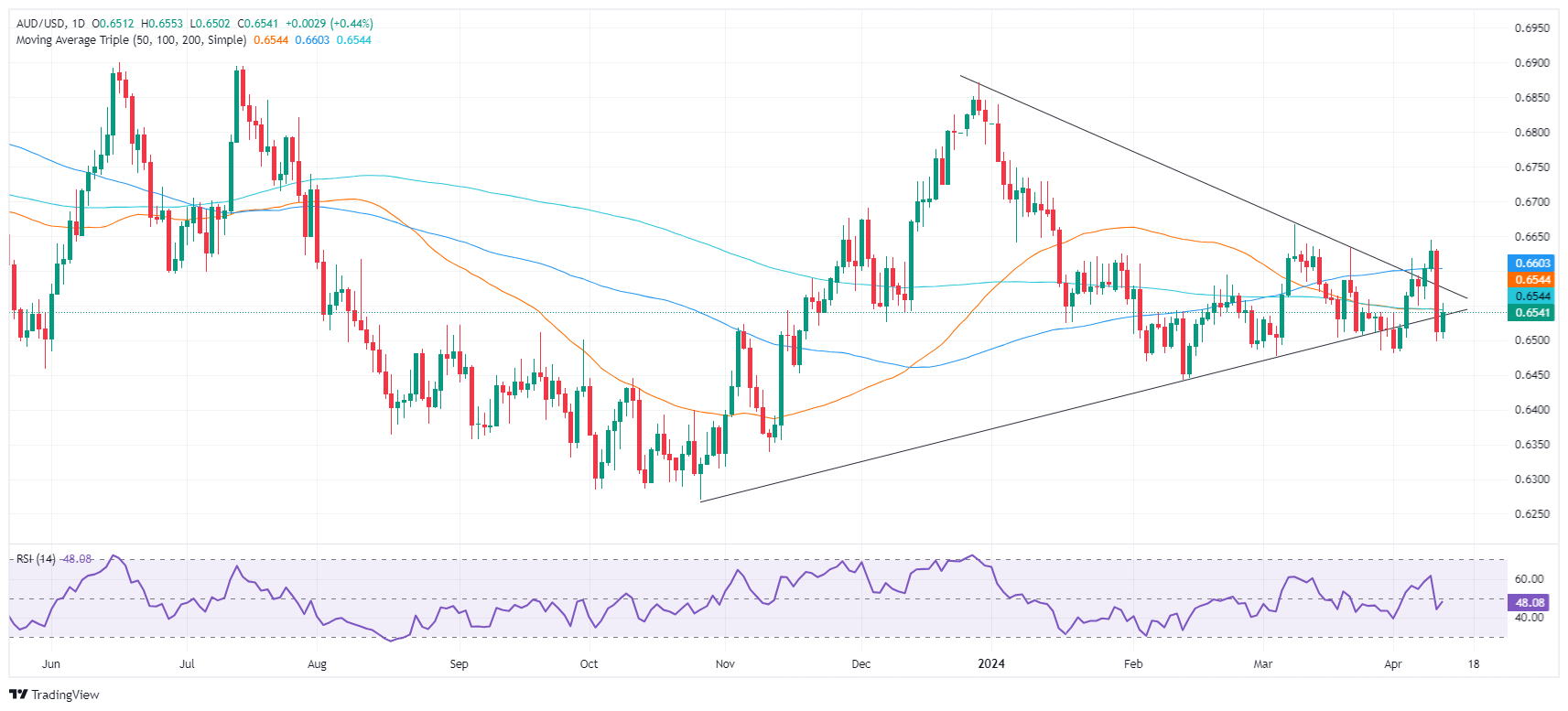
Given Thursday’s economic data's mixed outlook, AUD/USD traders booked profits following Wednesday’s plunge of 1.75%, which dragged spot prices to a fresh weekly low of 0.6498.

Elsewhere, Federal Reserve officials remain in a wait-and-see mode, led by New York Fed President John Williams, who commented that recent inflation data is disappointing. Richmond Fed Thomas Barkin added that “inflation data raise the question if we are seeing a shift.” Finally, Boston Fed Susan Collins added that she still sees rate cuts in 2024, though they could be fewer than projected.

In that regard, futures traders of Federal funds rates (FFR) are projecting that the Fed would ease policy twice, as shown by data from the Chicago Board of Trade (CBOT). The December 2024 contract depicts traders expect the FFR to end at 4.97%.

AUD/USD Price Analysis: Technical outlook

From a technical perspective, the AUD/USD tilted slightly bearish after cracking the confluence of the 50 and 200-day moving averages (DMAs) at 0.6541. If buyers conquer that level, the next resistance will be 0.6600. However, failure to do so will drive the exchange rate below 0.6500, opening the door to test April’s 1 low of 0.6483, ahead of the February 13 low of 0.6442.
AUD/USD

Overview
Today last price0.654
Today Daily Change0.0028
Today Daily Change %0.43
Today daily open0.6512
 
Trends
Daily SMA200.6551
Daily SMA500.6544
Daily SMA1000.6603
Daily SMA2000.6544
 
Levels
Previous Daily High0.6631
Previous Daily Low0.6499
Previous Weekly High0.6619
Previous Weekly Low0.6481
Previous Monthly High0.6667
Previous Monthly Low0.6478
Daily Fibonacci 38.2%0.6549
Daily Fibonacci 61.8%0.6581
Daily Pivot Point S10.6464
Daily Pivot Point S20.6415
Daily Pivot Point S30.6331
Daily Pivot Point R10.6596
Daily Pivot Point R20.668
Daily Pivot Point R30.6729

Author

Christian Borjon Valencia

Markets analyst, news editor, and trading instructor with over 14 years of experience across FX, commodities, US equity indices, and global macro markets.


More from Christian Borjon Valencia
Share:

Editor's Picks

AUD/USD finds some support near mid-0.7100s as USD bulls await US CPI

AUD/USD steadies above mid-0.7100s during the Asian session on Friday, stalling the previous day's heavy losses to an over one-week low. The August PPI report reaffirmed Fed rate-hike bets and boosted the US Dollar on Thursday, which weighed heavily on the currency pair. However, hawkish RBA expectations limited losses for the Aussie as USD bulls now await the release of consumer inflation figures before placing fresh bets.

USD/JPY holds steady around mid-154.00s; looks to US CPI for fresh impetus

USD/JPY preserves the previous day's recovery gains and consolidates around mid-154.00s during the Asian session on Friday as US Dollar bulls opt to wait for the release of the latest US consumer inflation figures. Meanwhile, the August US PPI report, released on Thursday, bolstered Fed rate-hike bets and acts as a tailwind for the buck. However, a more hawkish BoJ repricing might continue to underpin the Japanese Yen and cap the currency pair.

Gold hangs near one-week low, above $4,300 as focus shifts to US CPI

Gold languishes near its lowest level in over a week during the Asian session on Friday as rising Fed rate hike bets, bolstered by US PPI, underpin the US Dollar. Traders now look to the US CPI report for more cues about the Fed's policy path amid inflation risks stemming from higher energy prices due to the Middle East conflict. The outlook will drive the USD and influence the non-yielding bullion.

Bitcoin holds steady on positive ETF flows despite short-term holders cashing in

Bitcoin's exchange-traded funds (ETF) demand regime has notably shifted, with 30-day net inflows reaching $21.9 billion, according to a Thursday post by CryptoQuant. The data suggests that the average Bitcoin held through spot ETFs is now in profit, with the realized price of the ETF cohort standing at roughly $72,000 to $73,000.

ECB recap: A hawkish hike despite downside growth risks
The European Central Bank (ECB) increased the Deposit Facility Rate to 2.50%, the Refinancing Rate to 2.65% and the Marginal Lending Facility to 2.90%, effective from September 16. The decision was accompanied by a clear warning that the outlook remains highly uncertain, with risks tilted to the upside for inflation and to the downside for growth.
Venezuela’s 65-billion-barrel Oil deal could reshape America’s inflation fight
The United States (US) has secured unprecedented access to part of Venezuela’s vast Oil reserves. The timing is particularly significant as the war with Iran is disrupting Middle Eastern supplies, keeping energy prices elevated and reviving concerns about inflation.