|

AUD/USD Price Analysis: Attempts Descending Triangle breakout near 0.6600

  • AUD/USD extends its winning streak on weak US Dollar.
  • The US Dollar weakens as poor US ISM Services PMI dampens the economic outlook.
  • Surging global commodity prices strengthen the Australian Dollar.

The AUD/USD pair extends its winning spell for the third trading session on Thursday. The Aussie asset rallies to the round-level resistance of 0.6600 as the US Dollar weakens due to the unexpected decline in the United States Services PMI data for March, reported by the Institute of Supply Management (ISM) on Wednesday.

The US Dollar Index (DXY), which tracks the US Dollar’s value against six major currencies, extends its downside to 104.00. The US ISM reported that the Services PMI missed expectations, dropping to 51.4 from expectations of 52.7 and the former reading of 52.6. Subindexes such as New Orders and Prices Paid also eased sharply, impacting the US economic outlook.

Going forward, investors will focus on the US Nonfarm Payrolls (NFP) data for March, which will be published on Friday. The labor market data will influence market expectations for Fed rate cuts, which are currently expected in the June meeting.

Meanwhile, the Australian Dollar strengthens as global commodity prices witness a sharp upside. Growing expectations for China’s economic recovery due to reviving domestic demand have also boosted demand for the Australian Dollar.

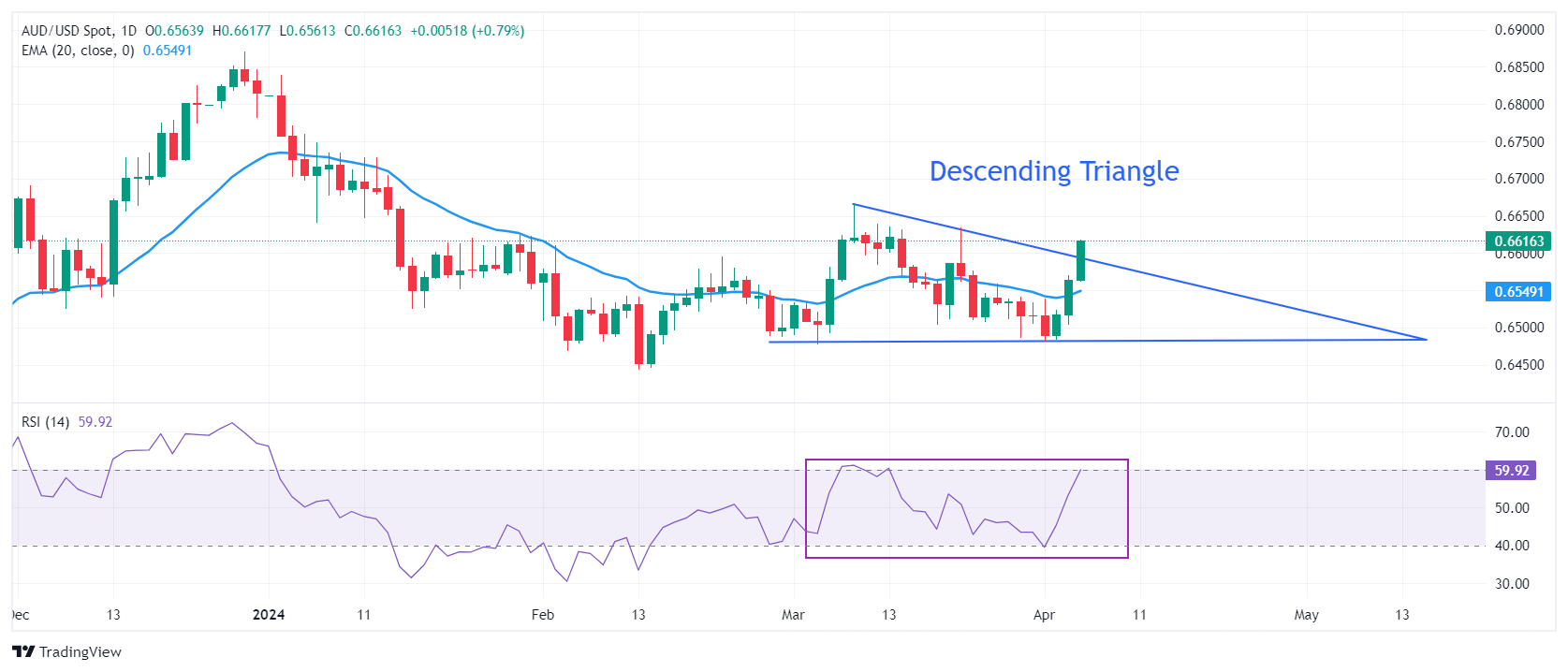
AUD/USD attempts to deliver a breakout of the Descending Triangle chart pattern formed on a daily timeframe. The downward-sloping border of the aforementioned pattern is placed from March 8 high at 0.6667 while horizontal support is plotted from March 5 low at 0.6477. The chart pattern exhibits a sharp volatility contraction and a breakout can happen in any direction.

The Aussie asset sustains above the 20-day Exponential Moving Average (EMA) trading near 0.6550, suggesting upbeat demand for the Australian Dollar.

The 14-period Relative Strength Index (RSI) rebounds to 60.00. A bullish momentum would trigger if the RSI manages to climb above the aforementioned level.

More upside would appear if the asset breaks above March 21 high at 0.6635. This will drive the asset toward March 8 high at 0.6667, followed by the round-level resistance of 0.6700.

On the flip side, investors might build fresh shorts below March 28 low at 0.6485. Profits on shorts would be booked near February 13 low around 0.6440 and the round-level support of 0.6400.

AUD/USD daily chart
AUD/USD

Overview
Today last price0.6616
Today Daily Change0.0052
Today Daily Change %0.79
Today daily open0.6564
 
Trends
Daily SMA200.656
Daily SMA500.6545
Daily SMA1000.6601
Daily SMA2000.6546
 
Levels
Previous Daily High0.657
Previous Daily Low0.6503
Previous Weekly High0.6559
Previous Weekly Low0.6486
Previous Monthly High0.6667
Previous Monthly Low0.6478
Daily Fibonacci 38.2%0.6544
Daily Fibonacci 61.8%0.6529
Daily Pivot Point S10.6522
Daily Pivot Point S20.6479
Daily Pivot Point S30.6455
Daily Pivot Point R10.6588
Daily Pivot Point R20.6612
Daily Pivot Point R30.6655

Author

Sagar Dua

Sagar Dua

FXStreet

Sagar Dua is associated with the financial markets from his college days. Along with pursuing post-graduation in Commerce in 2014, he started his markets training with chart analysis.


More from Sagar Dua
Share:

Editor's Picks

AUD/USD breaks below 0.7000 ahead of inflation data

AUD/USD has accelerated its downward trend on Tuesday, breaching below the key 0.7000 yardstick ahead of the opening bell in Asia on Wednesday. Indeed, spot has retreated for the second day in a row despite the hawkish hike by the RBA early on Tuesday and in response to the continuation of the move higher in the Greenback. Looking ahead, all the attention will be on the release of Australia’s inflation data on Wednesday.

USD/JPY consolidates near 157.50 as a bullish USD counters intervention risks

USD/JPY struggles to capitalize on the overnight bounce from a one-week low, consolidating around 157.50 in the Asian session on Tuesday. Trump's concerns about the Japanese Yen's weakness fueled speculation about another US-Japan joint intervention. This, along with the hawkish BoJ, underpins the JPY and caps the currency pair. Meanwhile, rising Fed rate-hike bets and oil-driven inflation fears continue to push US bond yields to multi-year highs, keeping the US Dollar pinned near a two-month high and supporting the pair.

Gold trims gains; back toward $4,150

Gold now surrenders some of its initial advance and retests the $4,150 zone per troy ounce on Tuesday. Meanwhile, the move higher in the yellow metal comes despite the firmer US Dollar and rising US Treasury yields across the board, while escalating geopolitical tensions appear to limit the downside potential.

XRP advances within a robust technical structure
Ripple (XRP) shows signs of stabilizing after reclaiming support at $1.50 on Tuesday. A robust technical structure underpins the token’s short to medium-term bullish outlook. Still, XRP is not out of the woods yet, as profit-taking and buyer exhaustion could weigh on price action and extend the recent correction from September highs around $1.66.
RBA recap: Rate hikes are on the table as demand stays too strong

The Reserve Bank of Australia unanimously tightened monetary policy, warning that inflation remained too high and that several upside risks had begun to materialise. Governor Michele Bullock said the Board would raise rates again if necessary.

Silver is more volatile than Gold ahead of PCE and NFP. This chart shows the positioning gap
The market’s attention is focused on American data this week, but there’s something only those with a trained eye may be looking at: Gold and Silver positioning gap. Financial markets are moving on fears, mostly related to persistently high energy prices driven by the Middle East war. Sure, the US Dollar (USD) is strong, but at what cost?