AUD/USD keeps Fed-led losses near 0.7250 despite firmer Aussie PMIs, US data in focus
- AUD/USD remains pressured as Fed tapering jostles with upbeat Aussie PMI.
- Australia preliminary CBA PMIs for September came in better than previous readouts.
- Market sentiment dwindles after an initial positive start.
- China headlines, US PMIs will be eyed for fresh impulse, covid news regain attention.


AUD/USD holds lower ground, keeping post-Fed losses close to 0.7240 amid Thursday’s Asian session. In doing so, the Aussie pair ignores firmer preliminary readings of September PMIs from the Commonwealth Bank of Australia (CBA). The reason could be a rethink over Fed’s tapering and rate hike plans.
Aussie CBA Manufacturing PMI rose from 52.00 to 57.3 while the Services PMI also grew above 42.9 prior to 44.9. With this, the CBA Composite PMI crossed 43.3 previous reading with 46.0 for September.
Fed Chairman Jerome Powell surprised markets with his hawkish style. However, the market’s reaction was mixed as there was no clarity over when the rate hike will begin after the tapering end, expectedly in 2022.
The Fed Boss Powell not only hints at the positive conditions matching for the consolidation of the asset purchase but also signaled the start of taper as soon as the next meeting, even if on good employment data not needing too strong figures. On the other hand, Fed matched market expectations of keeping the benchmark rate unchanged at 0.25% but the policymakers were divided over the hike, now expecting a lift from either 2022 or 2023 versus the previous support for 2023. It’s worth noting that the US central bank cut the 2021 growth forecast and remained unclear on when the rate will start rising after the tapering concludes.
It’s worth noting that China Communist Party’s (CCP) deal with the struggling real-estate player Evergrande and the People’s Bank of China’s (PBOC) heavy liquidity injection adds to the risk-on mood.
Furthermore, the US Food and Drug Administration (FDA) approves a third Pfizer covid vaccine shot for those above 65 with high risk, per Bloomberg news, but the news failed to get a major reaction.
Amid these plays, S&P 500 Futures print mild gains, fading the day-start upside, whereas the US Dollar Index (DXY) struggles to keep the upside momentum around a monthly high near 93.50.
Although the risk-on mood may help the AUD/USD prices, China headlines and US PMIs will be the key for the near-term direction.
Technical analysis
Although the monthly support line defends AUD/USD bulls around 0.7220, its failures to cross the 61.8% Fibonacci retracement (Fibo.) of August-September upside, close to 0.7250, keeps sellers hopeful.
Even if the quote manages to cross the 0.7250 immediate hurdle, 50% Fibo. and a confluence of the 20-DMA and 50-DMA, respectively near 0.7290 and 0.7330, will challenge the AUD/USD buyers.
Meanwhile, a downside break of 0.7220 support will aim for the 0.7200 threshold and the 0.7150 level before direct the pair sellers towards the yearly low of 0.7105.
Overall, AUD/USD bears keep reins unless crossing 0.7330.
AUD/USD: Daily chart
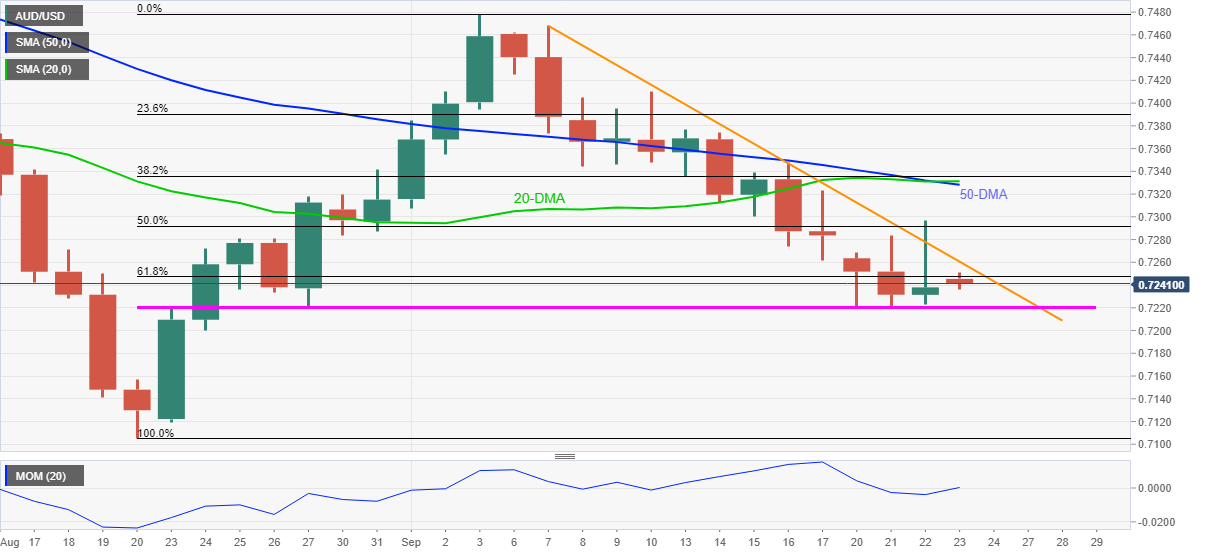
Trend: Further weakness expected
Author
Anil Panchal
FXStreet
Anil Panchal has nearly 15 years of experience in tracking financial markets. With a keen interest in macroeconomics, Anil aptly tracks global news/updates and stays well-informed about the global financial moves and their implications.