|

AUD/USD edges higher as traders eye Aussie’s CPI, US GDP

  • AUD/USD makes modest recovery, up 0.05%, as markets eye upcoming Australian CPI and US GDP data releases.
  • US Durable Goods Orders contract more than expected; Home Prices surge, fueling mixed sentiment on Wall Street.
  • Reserve Bank of New Zealand's policy decision and Federal Reserve officials' remarks to influence AUD/USD direction.

The Australian Dollar pared some of its losses against the US Dollar on Tuesday and finished the session with minimal gains of 0.05%. As the Asian session begins, the AUD/USD trades at 0.6542, at the time of writing, down by 0.02% as investors brace for the release of crucial data.

AUD/USD sees slight gains as investors await key Australian and US economic indicators

Price action in Wall Street was muted as investors prepared for the release of a tranche of US data. On Tuesday, the US economic docket revealed that January’s Durable Goods Orders shrank -6.1% MoM, exceeding estimates and the previous month’s data of -4.5% and -0.3% contraction. Besides, US housing data revealed that Home Prices in December advanced 6.1% YoY, above forecasts, and November’s data.

Moving into Wednesday’s data, the Australian Bureau of Statistics (ABS) will feature inflation figures for January. According to the consensus, the Consumer Price Index (CPI) is expected to have risen 3.6% YoY. A monetary policy decision in New Zealand could underpin the Aussie Dollar (AUD) in the event of a hawkish hold by the Reserve Bank of New Zealand (RBNZ).

On the US front, the US Bureau of Economic Analysis (BEA) will announce the second estimate of the Gross Domestic Product (GDP) for the last quarter of 2023. The consensus expects GDP to stand at 3.3% QoQ. AUD/USD traders would also gather direction from three Federal Reserve officials crossing the newswires.

AUD/USD Price Analysis: Technical outlook

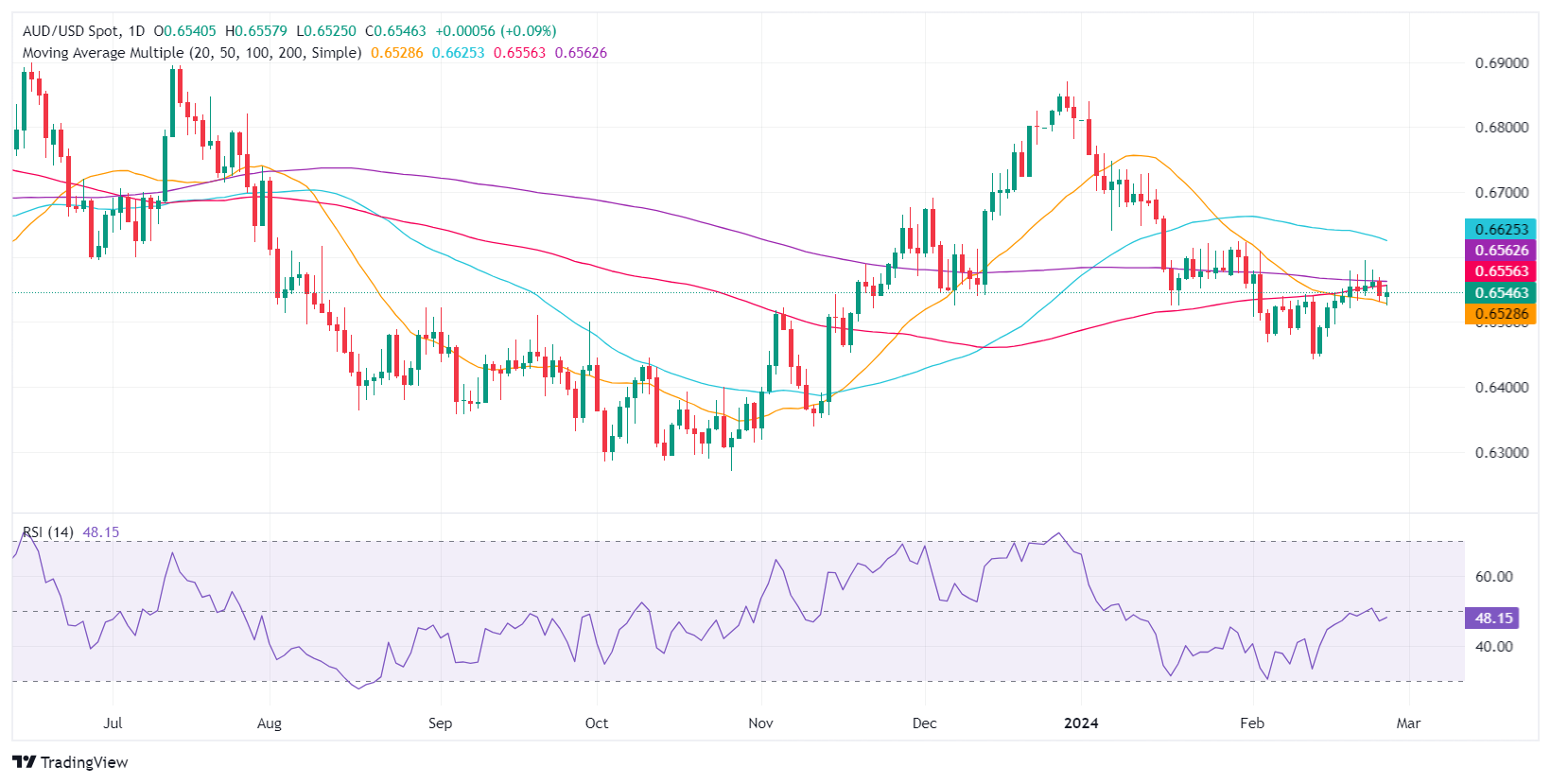
The AUD/USD remains neutral to downward bias, even though the exchange rate hovers around key technical levels, like the 100, 200, and 50-day moving averages (DMAs). Further confirmation is provided by the Relative Strength Index (RSI) punching below the 50-midline turning bearish, while the latest cycle high remains well below the current year-to-date (YTD) high at 0.6624.

For a bearish continuation, the AUD/USD must dive below the February 27 low of 0.6524, and the 0.6500 figure. Once those levels are cleared, look for a test of the YTD low of 0.6442. On the flip side, if buyers push the exchange rate above the 100 and 200-DMAs at around 0.6559, that could pave the way to challenge 0.6600.
AUD/USD

Overview
Today last price0.6545
Today Daily Change0.0004
Today Daily Change %0.06
Today daily open0.6541
 
Trends
Daily SMA200.6531
Daily SMA500.663
Daily SMA1000.6555
Daily SMA2000.6563
 
Levels
Previous Daily High0.6569
Previous Daily Low0.6531
Previous Weekly High0.6595
Previous Weekly Low0.6522
Previous Monthly High0.6839
Previous Monthly Low0.6525
Daily Fibonacci 38.2%0.6545
Daily Fibonacci 61.8%0.6554
Daily Pivot Point S10.6525
Daily Pivot Point S20.6509
Daily Pivot Point S30.6487
Daily Pivot Point R10.6563
Daily Pivot Point R20.6585
Daily Pivot Point R30.66

Author

Christian Borjon Valencia

Markets analyst, news editor, and trading instructor with over 14 years of experience across FX, commodities, US equity indices, and global macro markets.


More from Christian Borjon Valencia
Share:

Editor's Picks

AUD/USD sits at three-week highs above 0.7000 on hawkish RBA-speak

AUD/USD holds a positive bias for the fourth straight day, trading above 0.7000 in the Asian session on Wednesday and at three-week highs. RBA Deputy Governor Andrew Hauser's hawkish remarks and inflation concerns underpin the pair. However, the upside appears capped as the US Dollar attracts some buyers amid looming US-Iran uncertainty.

USD/JPY remains confined in a familiar range below 158.50

USD/JPY sees some dip-buying in the Asian session on Wednesday, though it remains confined within a multi-week range near 158.50 as the uncertainty over the timing of the next BoJ rate hike keeps Japanese Yen bulls on the defensive. Meanwhile, hawkish Fed expectations, bolstered by inflation risks stemming from volatile oil prices, underpin the US Dollar. However, looming intervention fears could limit JPY losses and cap the currency pair.

Gold appears slightly bid above $4,100

Gold prices manage to reverse three consecutive daily declines, trading just above the $4,100 per troy ounce on Wednesday. The yellow metal’s recovery comes amid a humble advance in the US Dollar, mixed US Treasury yields across the board and a widespread cautious tone from the US-Iran front.

Bitcoin eyes a break above $85,000 as institutional demand returns

Bitcoin edges higher above $83,000, extending its rebound from the 50-day EMA near $80,786. US-listed BTC spot ETFs recorded over $23 million in net inflows on Tuesday, following Monday's $526 million, signaling a return of institutional demand.

What November 3 means for the Fed's rate path and the US Dollar

The USD faces a decisive period ahead of the November 3 midterm elections. While markets anticipate another interest rate increase from the Fed in December, the battle for control of Congress could reshape fiscal policy expectations and, indirectly, the path of US monetary policy in 2027.

The US Dollar fell. Gold didn't rally. That tells you everything
Gold (XAU/USD) is struggling to capitalize on a weaker US Dollar (USD), after repeatedly failing to establish itself above the $4,200 level. The precious metal remains confined to a relatively narrow trading range despite a combination of developments that would normally support higher prices.














