AUD/USD dips amid Trump’s tariff rhetoric
- AUD/USD falls with Trump's tariff threats and robust US labor data fueling gains in the US Dollar.
- US initial jobless claims drop significantly, underscoring the labor market's strength.
- Australian inflation data shows slight increase but fails to boost the Aussie as traders awaited FOMC minutes.

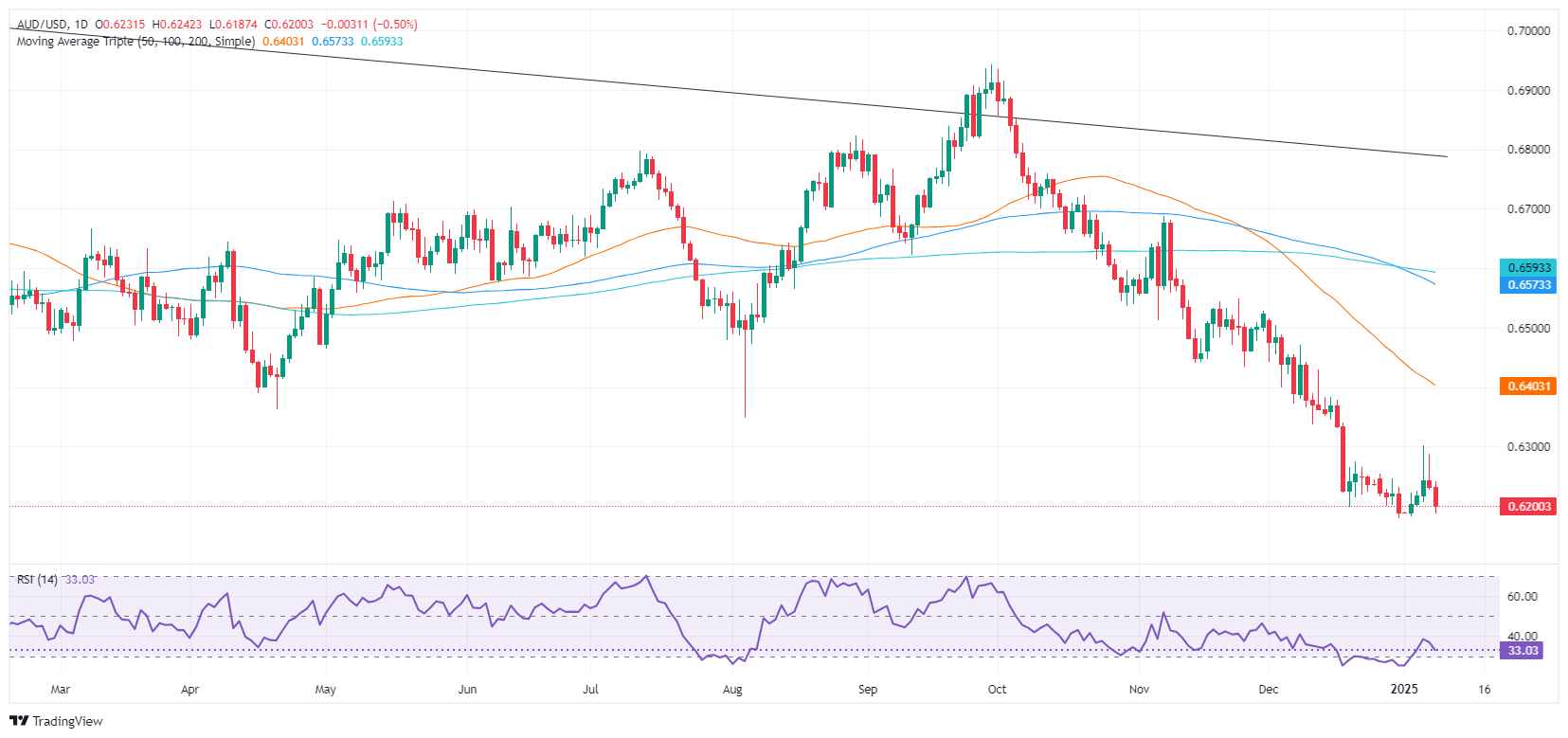
The Australian dollar posted losses of over 0.40% against the US Dollar, and the latter remains supported by US President-elect Donald Trump’s tariff threats. At the time of writing, the AUD/USD trades at 0.6204 after bouncing off daily lows of 0.6187.
AUD/USD faces downward pressure as Trump's potential economic emergency declaration looms
Recently, US data showed that the labor market remains strong, as Initial Jobless Claims for the week ending January 4 dropped from 211K to 201K, according to the US Department of Labor. The figures were below the consensus of 218K.
Earlier, Automatic Data Processing (ADP) revealed that private companies hired 122K people, below the 140K foreseen by economists.
Nonetheless, the main driver continues to be Donald Trump, as CNN revealed that he is considering a national economic emergency declaration to impose new tariffs, sources said.
In the central bank space, Federal Reserve Governor Christopher Waller commented that he doesn’t expect tariffs to produce persistent inflation, adding that the labor market is not behaving like an economy is overheating. He supports further cuts in 2025, but it will depend on the progress of inflation.
On the Australian side, inflation figures were released yet failed to increase appetite for the Aussie Dollar. Australian Weighted CPI for November, rose 2.3% YoY, above expectations and October’s readings of 2.2% and 2.1% each. The CPI Annual Trimmed Mean for the same period cooled slightly, from 3.5% to 3.2% YoY.
Ahead in the day, traders eye the release of the Federal Open Market Committee (FOMC) December meeting minutes, which are expected to show the committee's reasons for lowering borrowing costs in 2025.
AUD/USD Price Forecast: Technical outlook
The AUD/USD downtrend remains intact, after carving successive series of lower highs and lower lows since October 2024. Although the pair bottomed out at around 0.6178, further downside is seen as the pair hovers near 0.6200. A breach of the latter will expose the October 2022 swing low of 0.6169, followed by April’s 2020 monthly low of 0.5991.
On the upside, 0.6250 would be the first resistance level before traders could challenge the current week's peak at 0.6301.
Australian Dollar PRICE Today
The table below shows the percentage change of Australian Dollar (AUD) against listed major currencies today. Australian Dollar was the strongest against the British Pound.
| USD | EUR | GBP | JPY | CAD | AUD | NZD | CHF | |
|---|---|---|---|---|---|---|---|---|
| USD | 0.49% | 1.20% | 0.32% | 0.26% | 0.50% | 0.68% | 0.18% | |
| EUR | -0.49% | 0.70% | -0.13% | -0.23% | 0.00% | 0.19% | -0.32% | |
| GBP | -1.20% | -0.70% | -0.84% | -0.93% | -0.69% | -0.51% | -1.01% | |
| JPY | -0.32% | 0.13% | 0.84% | -0.06% | 0.18% | 0.35% | -0.15% | |
| CAD | -0.26% | 0.23% | 0.93% | 0.06% | 0.24% | 0.42% | -0.09% | |
| AUD | -0.50% | -0.01% | 0.69% | -0.18% | -0.24% | 0.18% | -0.31% | |
| NZD | -0.68% | -0.19% | 0.51% | -0.35% | -0.42% | -0.18% | -0.51% | |
| CHF | -0.18% | 0.32% | 1.01% | 0.15% | 0.09% | 0.31% | 0.51% |
The heat map shows percentage changes of major currencies against each other. The base currency is picked from the left column, while the quote currency is picked from the top row. For example, if you pick the Australian Dollar from the left column and move along the horizontal line to the US Dollar, the percentage change displayed in the box will represent AUD (base)/USD (quote).
Author

Christian Borjon Valencia
FXStreet
Markets analyst, news editor, and trading instructor with over 14 years of experience across FX, commodities, US equity indices, and global macro markets.
















