AUD/USD bears stay in control below critical daily resistance, Wall Street investors hitting the bid
- AUD/USD bears move in after a significant 38% daily correction.
- The focus is on keeping below daily resistance and weekly downside targets.
- US inflation keeps investors hitting the bid on Wall Street, weighing on high beta FX.

AUD/USD is back under pressure into the closing hours on Wall Street as risk sentiment deteriorates. Traders are moving back into the US dollar and selling equities in what has been a volatile trading session for North American markets. At 0.6935, AUD/USD is now printing in the red after falling from a high on the day of 0.7053 to a low of 0.6927.
Markets have digested the inflation data over the course of the trading day making for swings in risk sentiment and price action across the financial asset classes. It was a mixed report in that the Consumer Price Index climbed 8.3%, higher than the 8.1% estimate but below the 8.5% in the prior month.
Also, the index rose just 0.3% last month, the smallest gain since last August, the Labor Department said on Wednesday, versus the 1.2% MoM surge in the CPI in March, the most significant advance since September 2005. However, ''the fact that the CPI is driven by rents and services implies that price pressures are entrenched and may manifest in upward pressure on wages too,'' analysts at TD Securities argued.
Wall Street hitting the bid
As a consequence, we have seen both a bid and an offer in the US dollar and US yields and stocks. The high beta currencies, such as the Aussie, have been pulled along for the ride. In most recent trade, after an initial rally, the Dow Jones Industrial Average is falling some 0.9% giving up earlier gains to print fresh lows for the session. The S&P 500 slid 1.7% after increasing 0.5% earlier in the session to new session lows and the Nasdaq Composite has dropped 3.19%, currently extending intraday declines while the 2-year yield increased to 2.857% and is aligned closely with Federal Reserve's interest rate policy.
''The positive surprise in core prices will not be favourable for currencies not named the US dollar. We think the market is far too premature in reducing the Fed's optionality set for tightening. This should leave the USD resilient for now,'' analysts at TD Securities argued.
Expectations are completely priced in for another hike of at least 50 basis points at the central bank's June meeting, according to CME's FedWatch Tool. The US dollar index, DXY, is making its way back towards the session highs of 104.105 in a firm but slow bullish drift to currently trade at 103.99 which is weighing on the antipodeans as investors assess how aggressive the Fed will be.
For the week ahead, investors will get another look at inflation data on Thursday in the form of the Producer Price Index for April, with expectations of a monthly increase of 0.5% versus the 1.4% jump in March. On an annual basis, expectations are for a jump of 10.7% compared with the 11.2% surge the prior month.
AUD/USD technical analysis
As per the prior session's analysis, AUD/USD Price Analysis: Longer-term 'Shorts' eye a run to June 2020 lows, 0.6776, where the price was expected to make a bullish correction to the 38.2% ...
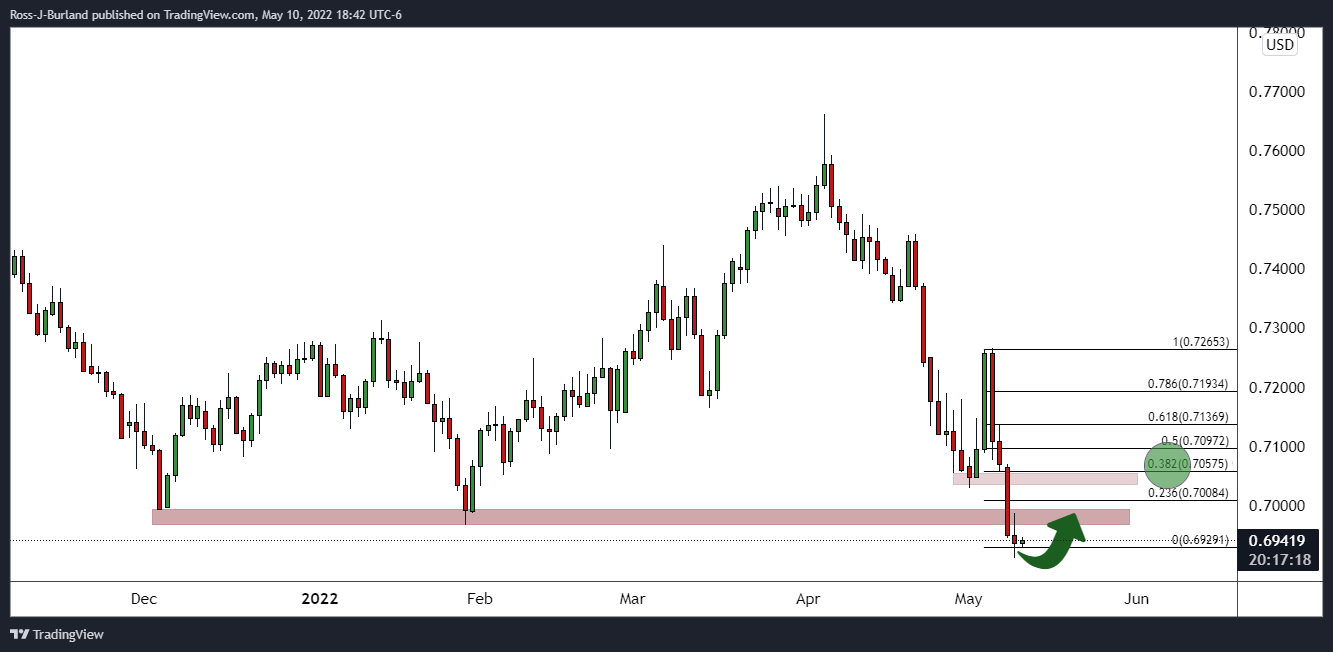
the bulls moved in on Wednesday and came in within a few pips shy of the target as follows:
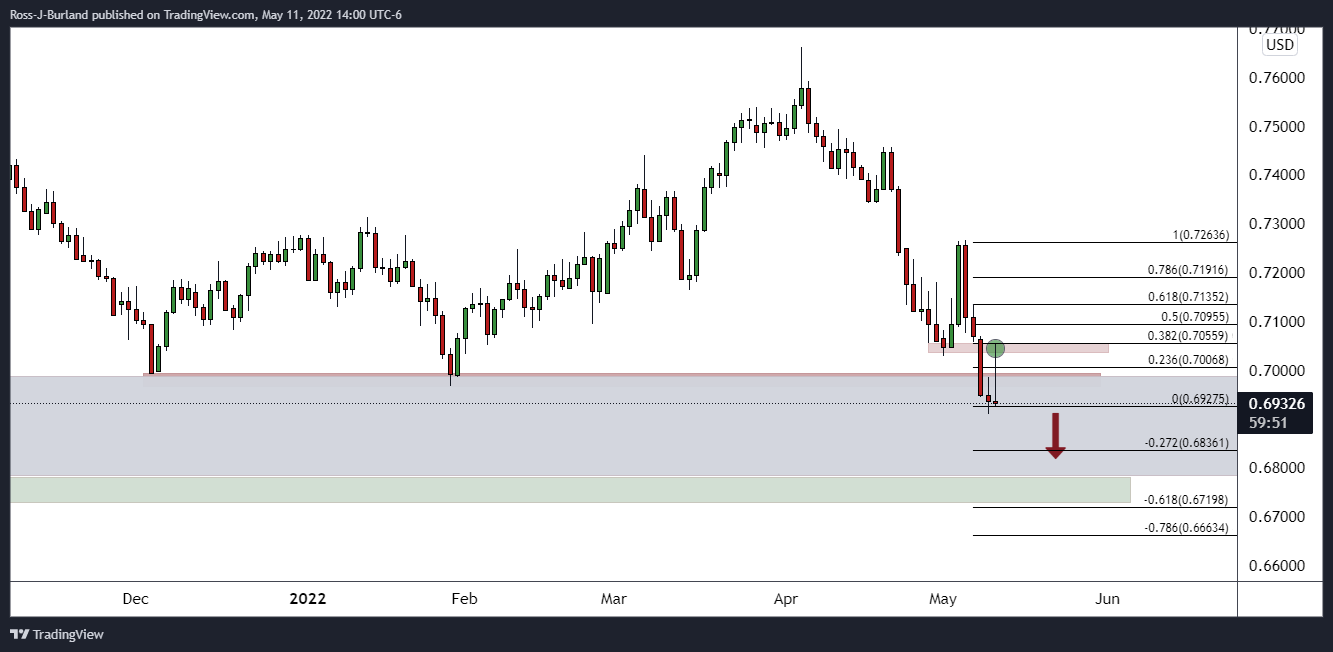
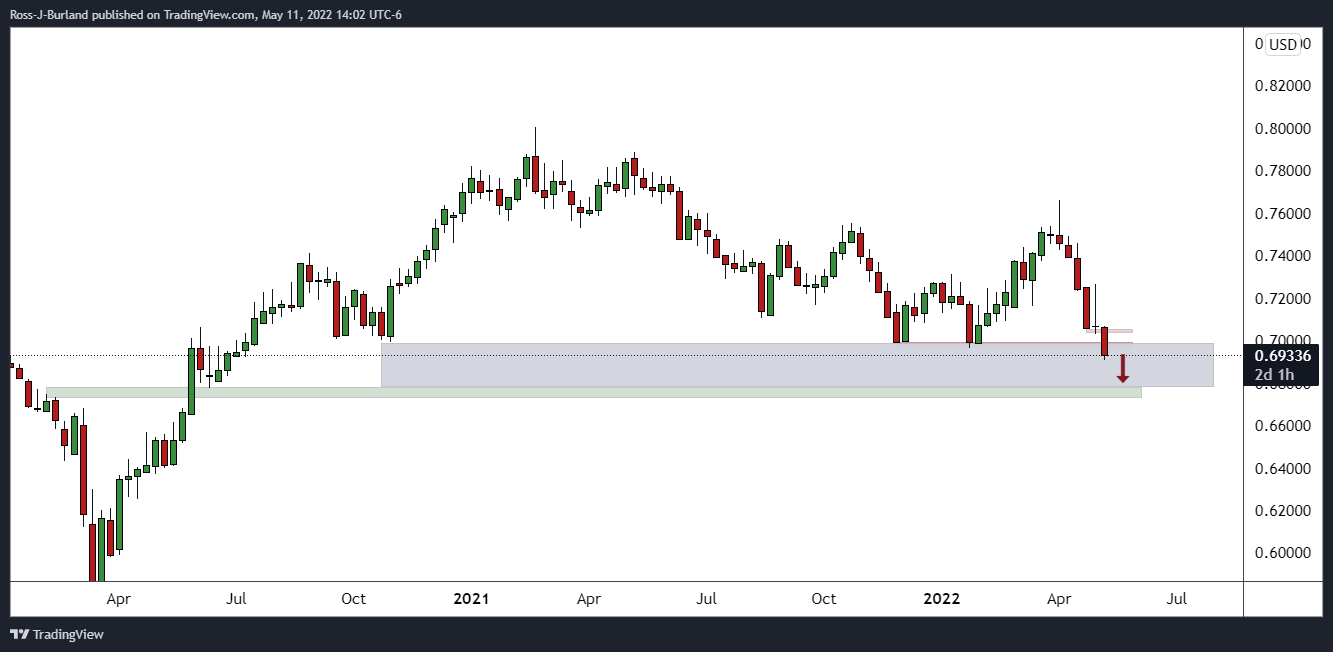
If the bears can now stay on top and keep the price below the resistance, 6990, then there will be prospects of an extension all the way to a weekly target as follows:
Author

Ross J Burland
FXStreet
Ross J Burland, born in England, UK, is a sportsman at heart. He played Rugby and Judo for his county, Kent and the South East of England Rugby team.