|

AUD/NZD sees the tide turn, awaiting key Australian and New Zealand data

  • Sellers take control of AUD/NZD, pushing the pair to 1.0860 and clearing the recent gains.
  • New Zealand is set to release June ANZ consumer and business surveys on Wednesday, with keen attention from the market.
  • CPI data from Australia due this Wednesday, continues to reveal Australia's direction.

The AUD/NZD sellers stepped in on Tuesday, wiping all the daily gains and pushing the cross to 1.0860. The Reserve Bank of Australia (RBA) and the Reserve Bank of New Zealand (RBNZ) moves are keenly awaited by investors, who await guidance.

In New Zealand, eyes are on the June ANZ consumer and business surveys to be released this Wednesday. The RBNZ plans its first rate cut for Q3 2025, which contradicts the market's expectations of a cut in November but incoming data will dictate the pace of the bets. In case New Zealand’s economy sees more signs of weakness the bank might consider sooner cuts.

In Australia, the Westpac Consumer Confidence data drew attention with a 1.7% rise to 83.6 in June from 82.2 in May- marking the first increase since February. The key data for the week would, however, come through with the release of the May Consumer Price Index (CPI) on Wednesday.

The swaps market now sees less than 25% odds of a rate cut by December 2024, which intensifies to around 65% in February 2025. Despite the headline expectation to climb by two ticks to a five-month peak at 3.8% year on year, the RBA remains patient, expecting a considerable period before inflation sustainably sits within the 2-3% target range. The outcome of inflation figures might see significant volatility in the Aussie’s price dynamics.

AUD/NZD technical analysis

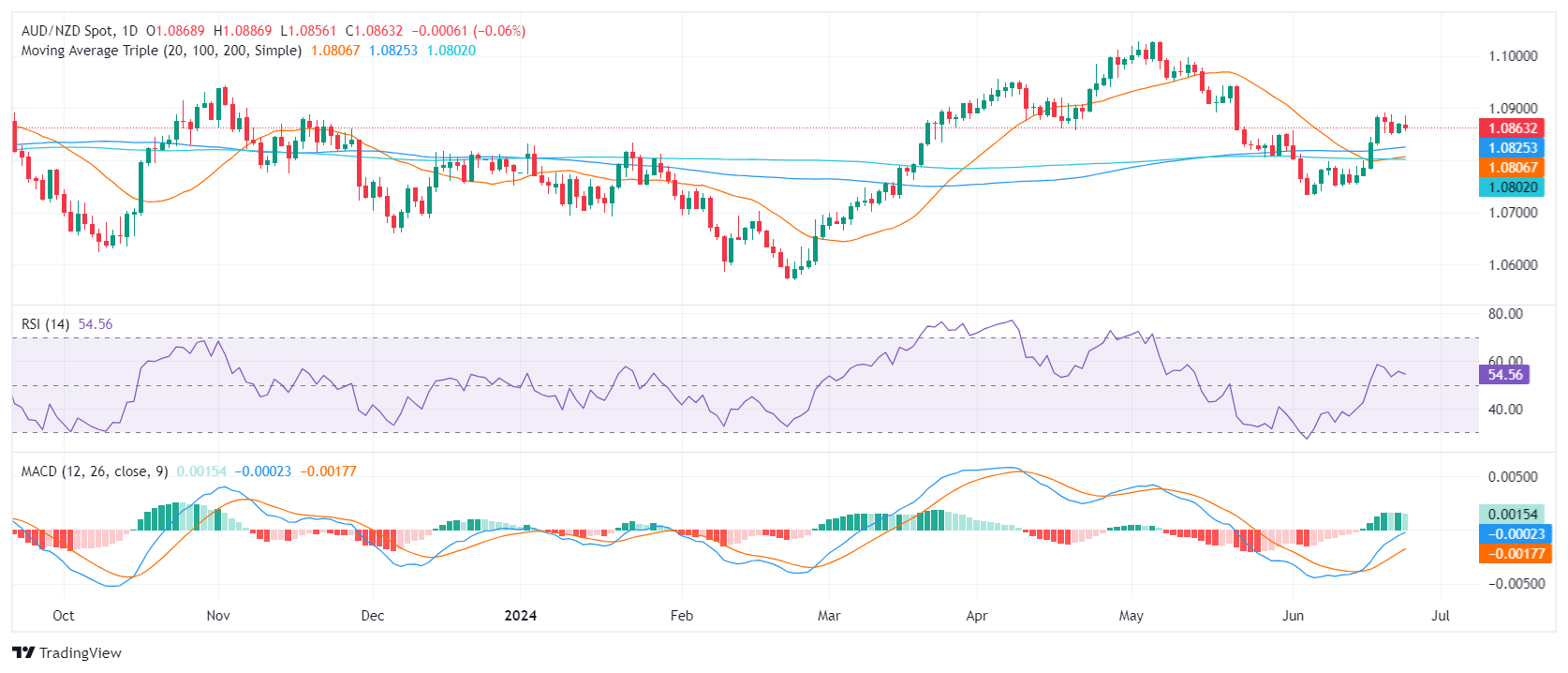
In the near term, the technical outlook for AUD/NZD appears positive, despite indicators flattening and hinting at a potential consolidation of the recent 0.80% gains achieved last week. This is supported by the cross maintaining its position above the 20, 100, and 200-day Simple Moving Averages (SMAs). Furthermore, the 20-day SMA completed a bullish crossover with the 100-day SMA which reinforces the positive outlook.

AUD/NZD daily chart
Author

Patricio Martín

Patricio is an economist from Argentina passionate about global finance and understanding the daily movements of the markets.


More from Patricio Martín
Share:

Editor's Picks

AUD/USD stays bid above 0.7100 on Australian trade data, Mideast optimism

AUD/USD clings to minor recovery gains above 0.7100 in the Asian session on Thursday as a new Israel-Lebanon ceasefire keeps a lid on the safe-haven US Dollar. Meanwhile, strong AustralianTrade Balane data also help the Aussie pair sustain the bounce from weekly lows.

USD/JPY hovers near the 160.00 intervention threshold on Mideast tensions

USD/JPY struggles to find acceptance above 160.00 and retreats from a one-month high in the Asian session on Thursday amid fears that authorities will step in again to prop up the Japanese Yen. Furthermore, a new Israel-Lebanon ceasefire caps the US Dollar and supports the currency pair. However, renewed US-Iran tensions keep the downside limited in the Greenback and the pair.

Gold rebounds from one-week low as Israel-Lebanon truce pressures safe-haven USD

Gold gains some positive traction on Thursday and climbs to the $4,475 area during the Asian session, reversing a major part of the previous day's slide to a one-week low. The Israel-Lebanon truce prompts some profit-taking around the US Dollar and supports the commodity. 


Ethereum: Long-term holders' capitulation drives ETH below $1,800

Ethereum has fallen below $1,800 on Wednesday, the first time since May 2025 following accelerated spot selling pressure and distributions from long-term holders. The Age Consumed metric, which tracks the movement of previously idle tokens or long-term holders' coins, spiked over the past two days as prices declined, indicating increased selling activity among this cohort.

Kevin Warsh takes the Fed helm: What it means for the US Dollar
The Federal Reserve moves away from the highly predictable "forward guidance" model of the Jerome Powell era to a new “Kevin Warsh environment”, characterized by less communication, more policy surprises, and an increased focus on the Fed's complex balance sheet.
Recession on paper: What really moves the Canadian Loonie now?

Statistics Canada handed the headline writers a gift and the analysts a headache. Real GDP shrank 0.1% on an annualized basis in the first quarter, and with the fourth quarter of 2025 revised down to a 1.0% contraction, that is two negative quarters in a row, the textbook definition of a technical recession and Canada's first since the pandemic.