AUD/NZD rides highs on weak NZ economic outlook and hawkish RBA
- Buyers steer AUD/NZD upwards, raising the pair near 1.0990 and then stabilizing at 1.0970.
- Firms in New Zealand expect a deterioration of the economic outlook according to the NZIER Survey of Business Opinion.
- RBA minutes from the June meeting confirmed a hawkish stance from the RBA.

The AUD/NZD buyers took the initiative on Tuesday. The steady stance by the Reserve Bank of Australia (RBA) seen in the latest minutes has raised market speculation for an interest rate hike in the August meeting, providing impetus to the pair's upward movement. The gloomy outlook in New Zealand is also pushing the pair upwards.
In New Zealand, the market is focused on the Q2 NZIER Survey of Business Opinion (QSBO) released this Tuesday. The survey showed that a great portion of the firm's survey expects a slowdown in the New Zealand economy over the coming year. Regarding the Reserve Bank of New Zealand, contrary to market expectations for a cut in November, the bank has its first rate cut planned for Q3 2025. However, if the economy shows more signs of weakening, the bank might consider earlier reductions.
Meanwhile, in Australia, the RBA's June meeting minutes underscored the bank's hawkish stance. Key reasons for maintaining the policy rate included uncertainty around consumption data and clear financial stress on many households and reaffirmed its intention of doing anything necessary to bring inflation down which boosted bets on a hike. The upcoming May Retail Sales data, due this Wednesday, is expected to further tilt the scale in favor of an RBA policy rate hike. In light of this and the stubbornly high inflation, markets now see nearly 40% odds of a rate hike on September 24, rising to nearly 50% for November 5.
AUD/NZD technical analysis
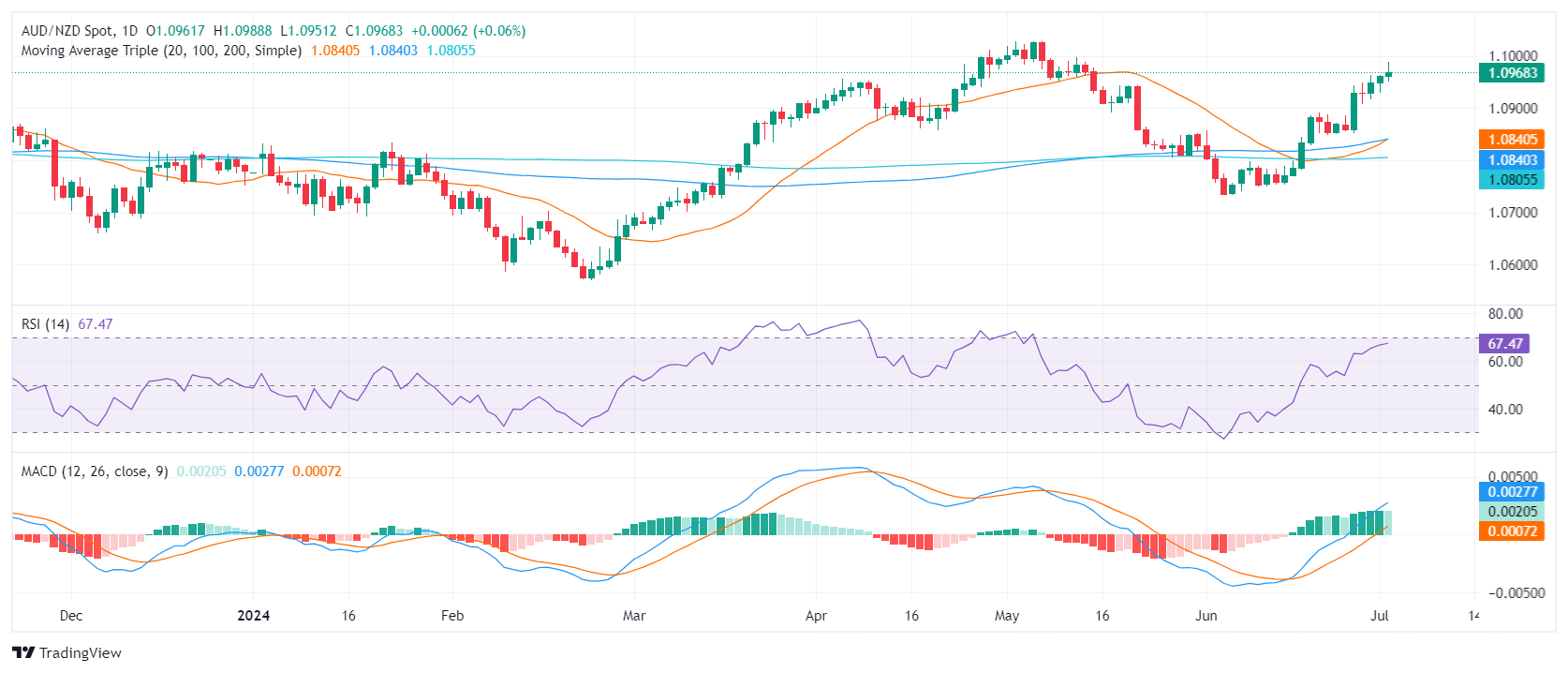
Short-term, the technical view of AUD/NZD remains bullish, but indicators nearing overbought conditions may indicate that a correction looms. The Relative Strength Index (RSI) is approaching 70 and the Moving Average Convergence Divergence (MACD) is printing rising green bars.
On the downside, supports are lining up at 1.0950, 1.0930, and 1.0900. The 1.1000 target is the next resistance for the purchasers. The risks of a potential correction seem to loom, but as long as the cross maintains its position above the 20, 100, and 200-day Simple Moving Averages (SMA) the outlook will remain positive.
AUD/NZD daily chart
Author

Patricio Martín
FXStreet
Patricio is an economist from Argentina passionate about global finance and understanding the daily movements of the markets.