|

AUD/NZD Price Analysis: The big day has arrived for this cross

  • AUD/NZD outlook into the RBNZ event is bullish on a 25BP hike.
  • Traders are fully pricing in a 25bp hike, although 50bp is the biggest risk. 

The RBNZ meets today and analysts are overwhelmingly expecting a 25bp hike rather than 50bp. This is where the risk is for the cross. A 50bp increase will see the kiwi fly considering the market has clipped it wings on the basis that a hike has been well telegraphed for a long time

This brings us to the charts:

AUD/NZD daily chart
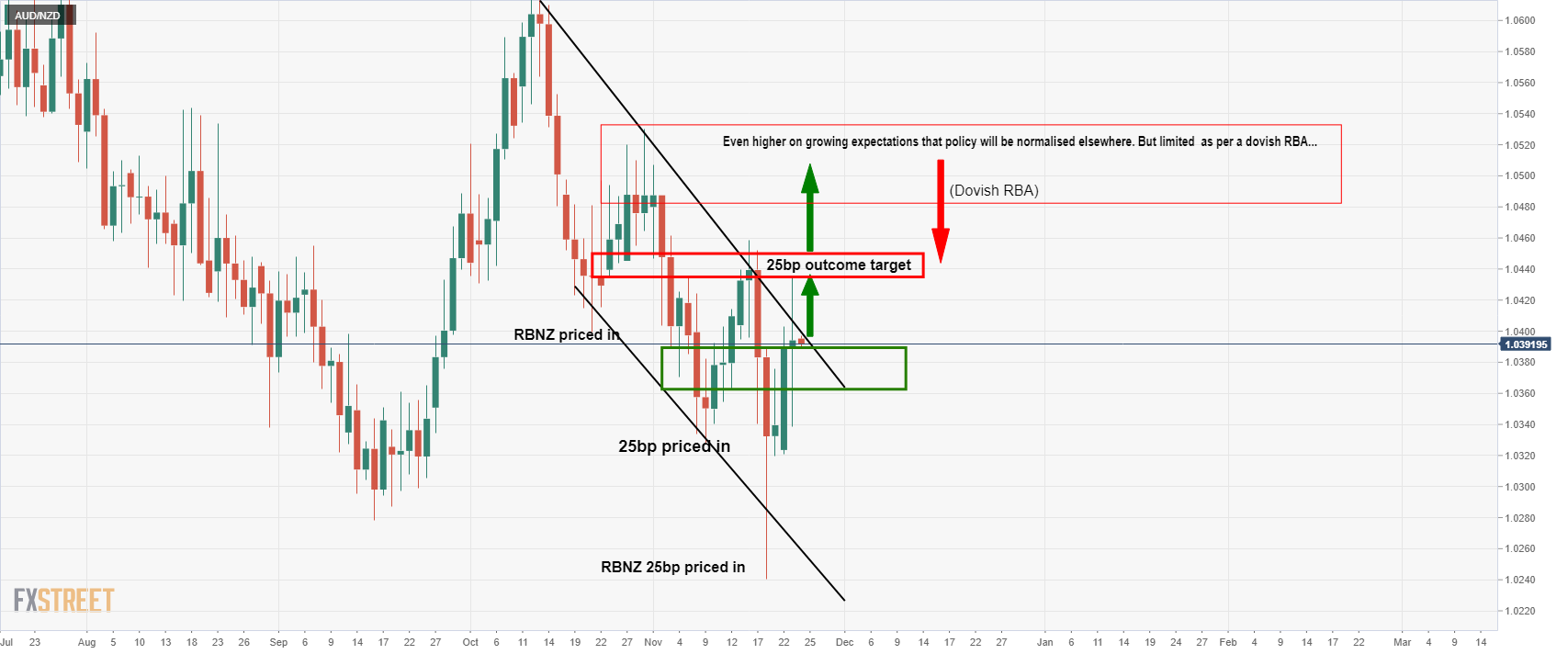
For the near term, this is the potential outlook for today's main event. Given the market will not be surprised that the RBNZ hikes, a move higher would not be unrealistic, especially as traders factor in the path of central banks in general. The RBNZ’s OCR track will be key in determining how far the kiwi could fall.

If there is a tendency towards an endpoint near 3% but dovish rhetoric, in so much that 25 bp OCR rate hikes will possibly be all we will get from the RBNZ between now and then, this leaves plenty of room for the RBA to catch up. Thus, there could be more value in the Aussie moving forward should a 2023 rate hike remain a possibility if inflation, wages and growth surprise to the upside.

In the event that there is a 50bp hike, there will be the toss-up between how detrimental this might be for the economy vs what this will mean to a market that is already long of NZD. The knee jerk will undoubtedly see a bid in the kiwi, especially as markets are nervous going into the meeting and waiting on the sidelines, waiting to pile in on such an outcome. 

AUD/NZD H1 chart
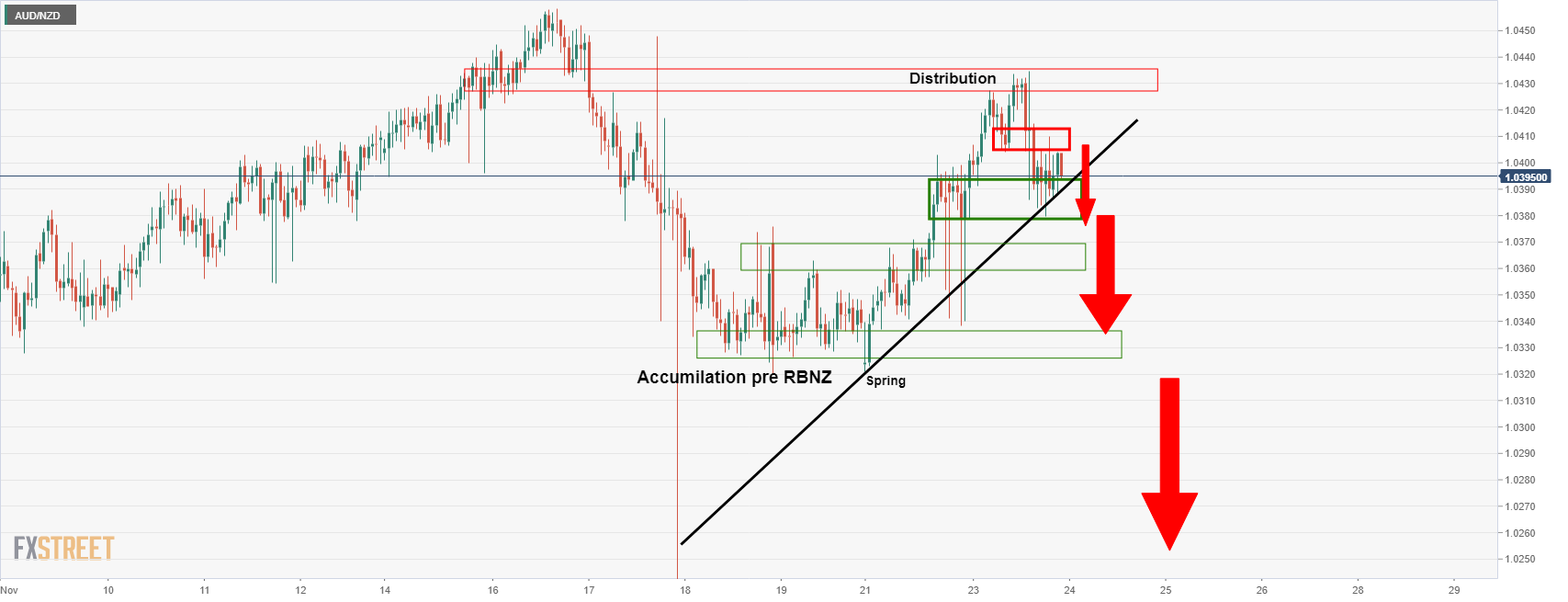
The price would be expected to extend distribution that has started to take place ahead of the meeting. A break of the dynamic support would open the risk of a knee-jerk run on 1.0380 and then 1.0320 stops.

Author

Ross J Burland

Ross J Burland, born in England, UK, is a sportsman at heart. He played Rugby and Judo for his county, Kent and the South East of England Rugby team.


More from Ross J Burland
Share:

Editor's Picks

AUD/USD keeps the red near 0.6950 after weak Aussie jobs data

AUD/USD holds losses near 0.6950 on disappointing Australian jobs data, extending the previous day's retracement slide from the monthly high and hitting a fresh weekly low during Thursday’s Asian session. Meanwhile, declining US bond yields drag the US Dollar away from the April 2025 high, touched after Wednesday's hot US CPI, helping limit losses for the currency pair.

USD/JPY slides back below 158.00 as USD reverses post-CPI gains

USD/JPY extends the previous day's pullback from a three-week high, attracting follow-through selling and sliding below 158.00 during Thursday's Asian session. Traders remain on high alert amid speculation that authorities will step in to prop up the Japanese Yen. The US Dollar, meanwhile, reverses Wednesday's hot CPI-led gains to April 2025 highs as US bond yields retreat on China bond-buying talk, further pressuring the pair.

Gold rebounds as global equity sell-off weigh on Treasury yields

Gold attracts fresh buying on Thursday as weakness across global equities, driven by mounting concerns over AI-related investments, triggers a sharp pullback in US Treasury yields and drags the US Dollar lower from fresh year-to-date highs. At the time of writing, XAU/USD trades around $4,155, up 1.21% on the day.

Bitcoin, XRP analyst sentiment jumps as Solana bulls hit 91%: CryptoQuant

Analyst sentiment on Bitcoin, Ethereum, Solana, BNB and XRP has flipped bullish since July, as the top five cryptocurrencies recovered faster and more strongly than during the 2022-2023 market phase, according to CryptoQuant.

Budget preview: Is Healey impressing the bond market?

There is less than 2 weeks to go before the Chancellor delivers his first budget. Unusually for the UK, the economic and financial backdrop to this budget is upbeat. UK bonds have been rallying, the FTSE 100 is the top performing major stock index this week, and the Pound is also stabilising versus the Dollar.

Has Bitcoin really escaped the macro forces it was built to fight?
Over 17 years ago, Satoshi Nakamoto designed Bitcoin (BTC) on the back of a global financial crisis as an alternative to the global monetary system outside the control of central banks, governments and traditional intermediaries. This raises a key question: has Bitcoin really become independent of the macroeconomic forces it was built to challenge?















