Advanced Micro Devices Stock Forecast: AMD stock surges over 12% on Fed rather than earnings
- Advanced Micro Devices closed up 12.6% on Wednesday.
- Fed Chair Jerome Powell aided the rally by saying rate hikes were working.
- NASDAQ closes 2% higher, AMD stock was the top performer in the S&P 500.
- Advanced Micro Devices offered poor revenue guidance for Q1.
Advanced Micro Devices (AMD) moved ahead sheepishly late Tuesday after CEO Lisa Su delivered a slight beat above Wall Street estimates for the fourth quarter. Once the Federal Reserve raised interest rates by 25 basis points as expected on Wednesday afternoon, however, the market unexpectedly shot higher, and AMD stock managed to close up an incredible 12.6%. Maybe AMD bulls were just waiting for the Fed's scheduled announcement and Fed Chair Jerome Powell's speech to be out of the way, but Q4 earnings and Q1 guidance were nowhere near good enough to engender Wednesday's AMD price action alone.
The market's price action following the Fed meeting almost entirely benefited the riskier end of the market – i.e. growth stocks like AMD. The growth and tech heavy NASDAQ roared 2% higher, while the value-heavy Dow remained essentially flat. AMD stock was the top performer in the entire S&P 500 for the session. Semiconductors as a whole did well. Nvidia (NVDA) and Applied Materials (AMAT) ranked as the sixth and seventh best performers in that index as well.
Advanced Micro Devices stock news: Hawkish Powell viewed as dovish
Jerome Powell obliged the market with a 25-basis-point raise of the federal funds rate as was almost unanimously expected. Why did the market take off so drastically then?
Basically, Powell said the Fed was not finished with raising rates and wanted to ensure that inflation kept dropping. Inflation has already been falling for half a year at this point though, and recent headlines involving receding consumer spending and large corporate layoffs seem to foreshadow a recession ahead. The arguement goes something like this (h/t Matt Levine): Since the Fed is steaming ahead with higher rates in the face of declining economic conditions, the central bank will be forced to cut rates to help a depleted economy in the second half of the year.
Powell has been resisting this type of thinking for some time, but the market refuses to relent. Higher rates will cause a quicker recession, this thesis says, which will lead to lower rates and higher prices for growth stocks like AMD.
After again stating that he does not expect to cut rates in 2023, Powell helped his adversaries when he added, "If we do see inflation coming down much more quickly, that will play into our policy setting, of course." Since most of the market does expect inflation to drop rapidly, they seized on this statement above more hawkish moments in the speech.
"The Fed is essentially speaking out of both sides of the mouth as they signaled further increases are appropriate, but also acknowledged they will consider the cumulative amount of tightening in future policy decisions,” said Charlie Ripley, senior investment strategist for Allianz Investment Management.
Advanced Micro Devices earnings news: Slight beat and poor guidance fail to deter bulls
AMD stock initially advanced modestly on a bare-bones Q4 beat late Tuesday. The stock rose just 1.5% afterhours following the earnings call.
CEO Lisa Su reported adjusted earnings per share (EPS) of $0.69 on revenue of $5.6 billion for Intel's (INTC) main competitor. Wall Street consensus had been $0.67 and $5.52 billion. The outlook for the current quarter, however, was more tepid. Management guided for a mid-point of $5.3 billion in revenue in Q1, while Wall Street consensus had been $5.5 billion. That guidance means management expects sales to drop 10% YoY – a poor outlook to say the least.
Weakness in Q4 and Q1 are mostly atributed to the ongoing reduction in the demand for consumer PCs and gaming use cases. The Embedded and Data Center segments, however, remain upbeat and healthy, and AMD appears to still be on track to continue stealing market share from rival Intel. The latter company reported its worst quarterly report and guidance in years, maybe decades, last week.
Investment firm Craig Hallum cut its rating from Buy to Hold on AMD stock after earnings. The price target was reiterated at $76, more than $8 below Wednesday's closing share price.
"We believe the company is positioned to continue executing well, and grow, but likely at a more marginalized pace," analyst Christian Schwab wrote in his client note.
Advanced Micro Devices stock forecast
AMD stock ploughed through the descending top trendline on Wednesday that has held since February 9, 2022. Bulls have been testing the trendline since January 23, but the gap up on Wednesday means the 51-week barrier is now broken. AMD stock is now in shouting distance of $88.22, a price level that has worked as both support and resistance on dozens of occasions since October 2020. Breaking that barrier would allow bulls to contemplate a stab at the range high from August 4 at $104.59.
It would not seem premature to say the bear market for AMD is coming to a close, but of course anything could still happen in the macro environment and upend this rally. Bears will note that AMD stock is firmly in the overbought region (above 70) on the Relative Strength Index (RSI). This typically leads to a measure of consolidation.
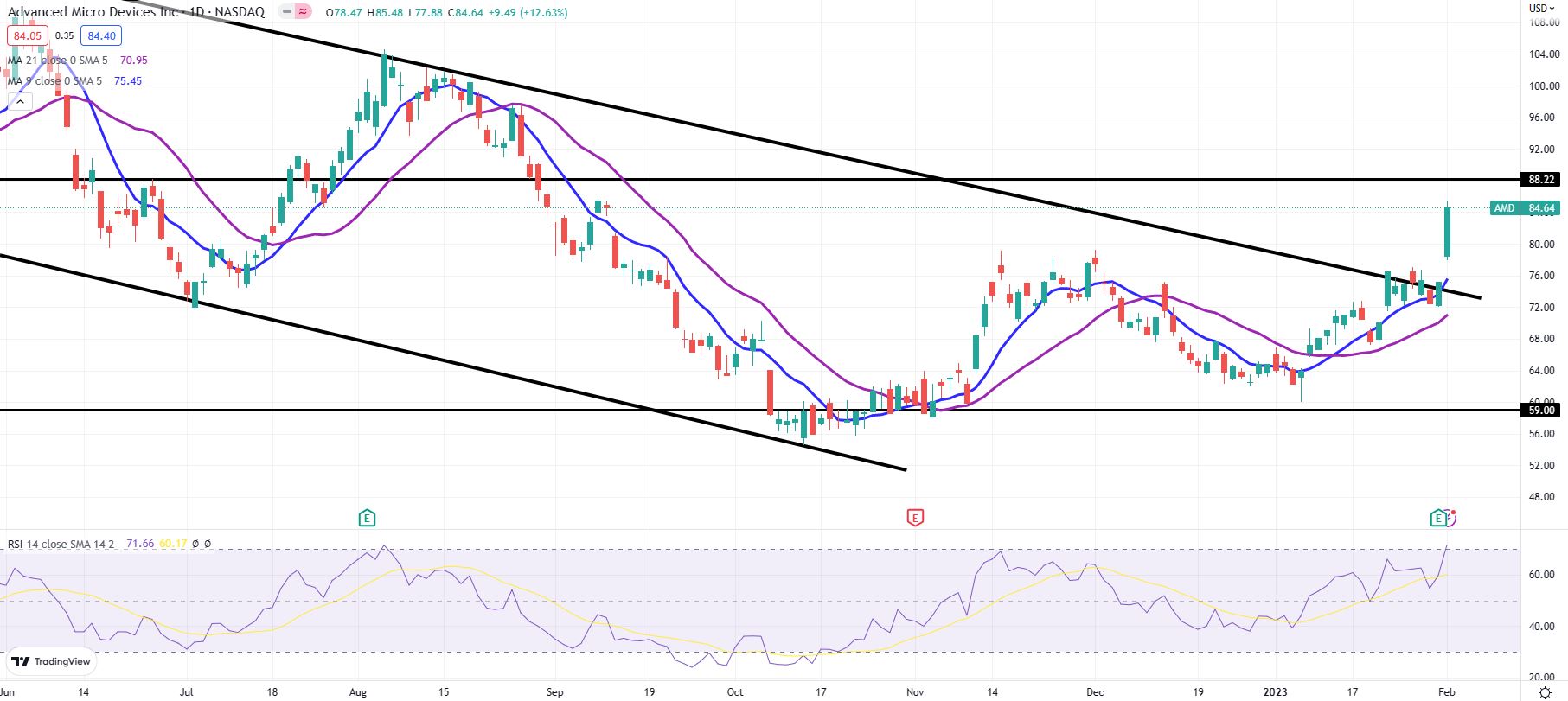
AMD daily chart
Author

Clay Webster
FXStreet
Clay Webster grew up in the US outside Buffalo, New York and Lancaster, Pennsylvania. He began investing after college following the 2008 financial crisis.