Advanced Micro Devices Stock Forecast: AMD poised to bounce 12% after break above key level
- AMD has retested a long-term resistance trendline and looks ready to rally.
- Traders should focus on the $119 level, which is nearly 12% higher than current price action.
- Citi analysts think AMD should benefit from higher notebooks sales in September.
- Investors wonder how quickly AMD’s MI300 accelerator chip will ramp up production and sales.

Advanced Micro Devices (AMD), the primary semiconductor competitor to Nvidia (NVDA), has seen its stock price set up for at least a 12% rally over the past week as shares have broken through a descending topline and then used it as support. The next target for bulls is $119, which at the current price near $106 would require an approximate 12% leap.
Equity futures are lower early Tuesday as Treasury yields gain for a second straight day. US Retail Sales for September arrived before the market open, showing that the US consumer is not giving up yet. Retails Sales rose 0.7% from August, more than twice the growth rate expected.
“Markets seem to be taking the geopolitical risk session by session at the moment, rather than having any strategic sense of where things are heading," said Deutsche Bank's Jim Reid in a client note. "It feels like we're in a very dangerous and delicate holding pattern for now.”
AMD stock news: Higher demand for Intel-based notebooks is good news for AMD
AMD investors have something to cheer about at the moment as Citi has issued a client note that expects better quarterly results from Intel (INTC) on account of increased demand for notebooks and laptops. During the second quarter, AMD’s Client segment that sources much of its revenue from selling its CPUs and APUs to PC brands and assemblers saw revenue plunge 55% YoY.
Citi analyst Chris Danely called September notebook demand data from Intel "well above expectations,” adding that notebook sales had jumped 7% over August rather than the 2% decline he was expecting. This is good news for AMD as Intel and AMD products are used together in many different PC notebooks at both the higher and lower end of the retail scale.
In a separate client note, Danely and other Citi analysts said that AMD and Intel are the most talked about companies in the semiconductor space right now. While hedge funds have grown interested in Intel’s turnaround story based on its return to foundry manufacturing, AMD has garnered more interest from traders wondering how fast its MI300 accelerator chip will ramp up.
Citi expects the MI300 to bring in $1 billion in revenue in 2024, but many investors the investment bank spoke with were more skeptical that the rollout would work out as fast as planned. Others were concerned that AMD’s Xilinx acquisition was not producing the returns originally anticipated when CEO Lisa Su decided to buy the maker of field-programmable gate arrays (FPGA) two years ago.
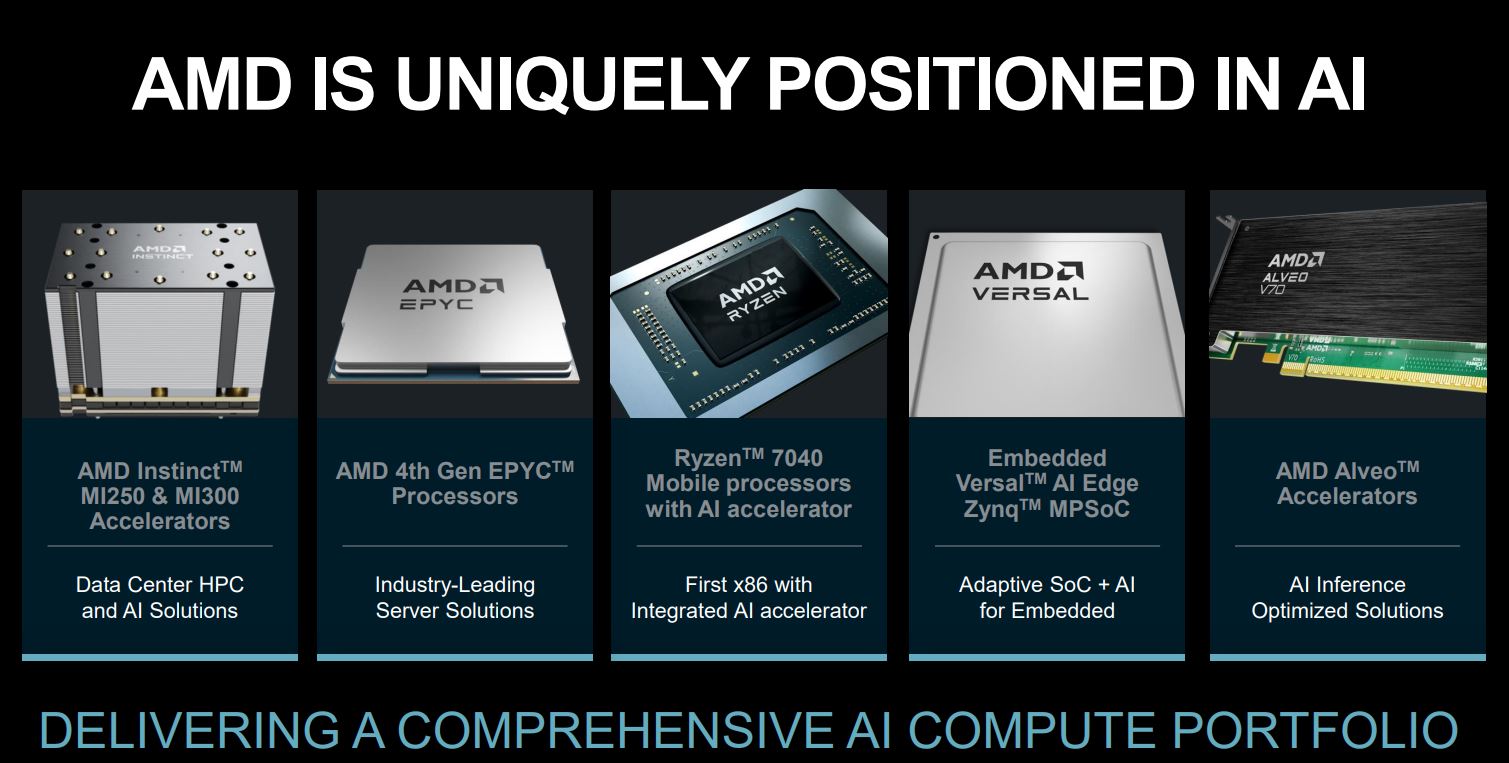
Updated product line unveiled in AMD’s Q2 2023 presentation
Semiconductor stocks FAQs
What is a semiconductor?
A semiconductor is a term for various types of computer chips. Officially called semiconductor devices, these computer chips rely on semiconductor materials like silicon and gallium arsenide to process the electrical current that produces the modern world of computing. They come in many shapes, sizes, enhancements and configurations such as diodes, transistors and integrated circuits to more complicated applications like DRAM memory, simple processors and even GPUs.
What types of semiconductor companies are there?
First, there are the pure chip designers, such as Nvidia, AMD, Broadcom and Qualcomm. These companies use sophisticated software to design and test chips. Second, there are the equipment manufacturers that provide the machines necessary to build computer chips. These include ASML and Lam Research. Then, there are foundries that manufacture the chips. These include Taiwan Semiconductor and GlobalFoundries. Last of all are the integrated device manufacturers who design their own chips and additionally manufacture themselves. These include Samsung and Intel.
What is Moore’s Law?
It is the observation that the number of transistors in an integrated circuit doubles every two years. The “law” is named after Gordon Moore, who founded Fairchild Semiconductor and later Intel. The doubling is possible due to the shrinking size of process nodes or parts in the computer chip. In 1971 the advanced commercial manufacturing had reached 10 microns in width. In 1987 semiconductor technology had advanced to 800 nanometers in width. By 1999, this process had moved to 180 nanometers. By 2007, the size had dropped to 32 nanometers, and this fell all the way to 3 nanometers in 2022, which is close to the size of human DNA.
How large is the semiconductor industry?
In 2022, the global semiconductor industry had revenues just under $600 billion. In total, the industry shipped 1.15 trillion semiconductor units in 2021. The leading nations involved in the semiconductor supply chain are Taiwan, the United States, China, the Netherlands, South Korea, Japan and Israel.
AMD stock forecast
Since May 30, a downward trending topline has been resistant to bullish attempts to return to the uptrending trajectory of 2023’s first five months. Besides a little blip in June, that topline has formed lower high after lower high.
After reaching the 200-day Simple Moving Average (SMA) in late September, the market is seeming to say: ‘enough is enough’. On October 10, AMD stock made a clear close above the trendline. AMD has since developed a retest last Friday, and made gains once again off that retest on Monday. This seems like a perfect setup for an attempt to rise back to the $119 to $133 supply zone.
Resistance at $109 experienced during the last few sessions will need to be overcome, but doing so will let bulls make a run for the $119 level, which hasn’t been reached since early August.
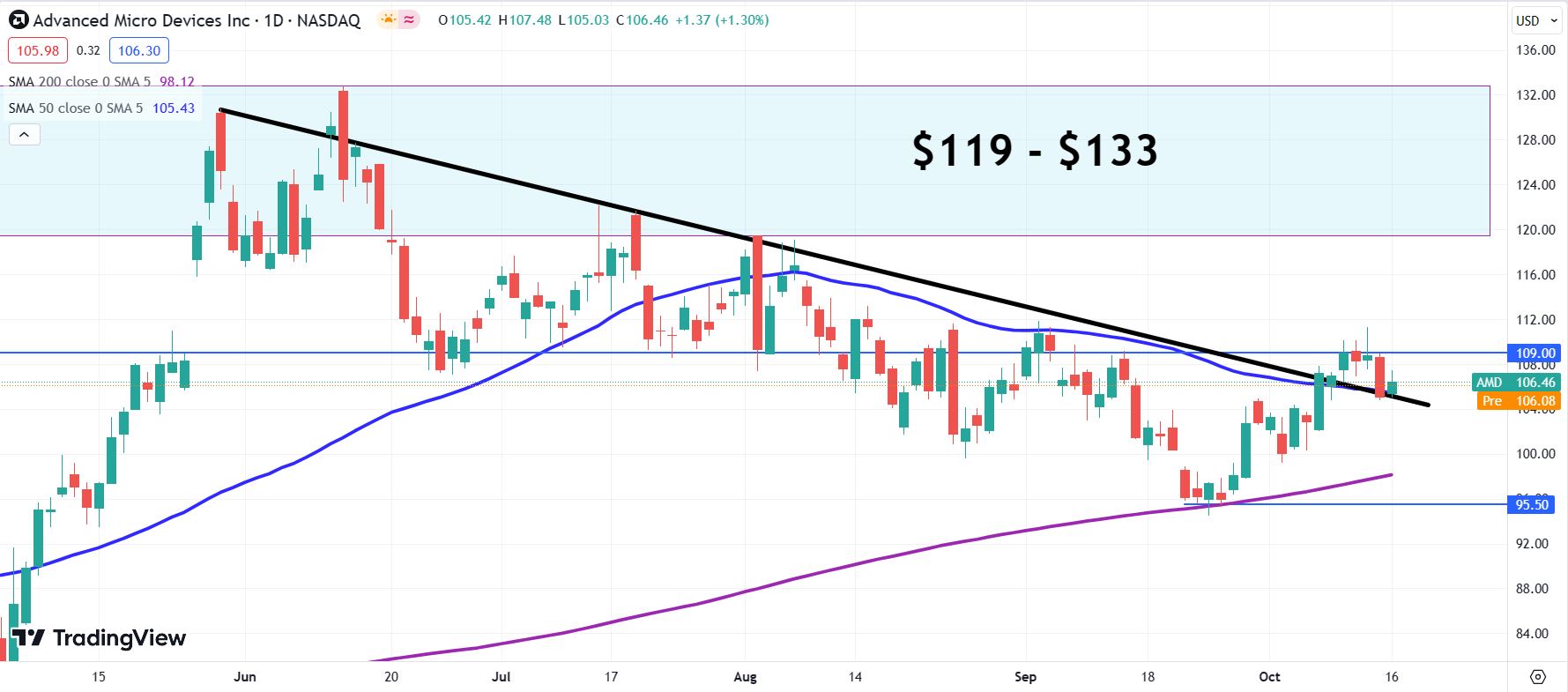
AMD daily chart
Author

Clay Webster
FXStreet
Clay Webster grew up in the US outside Buffalo, New York and Lancaster, Pennsylvania. He began investing after college following the 2008 financial crisis.