Advanced Micro Devices Earnings: AMD stock down 5.5% after guidance disappoints
- Advanced Micro Devices narrowly beats Q2 earnings estimates.
- AMD stock reacted down to the release worried by guidance revision.
- Adjusted EPS at $1.05 and $6.65B in revenue for chip manufacturer company.
UPDATE: AMD stock is trading off 5.5% at $93.85 in Wednesday's premarket after forward guidance from the semiconductor firm's Q2 earnings late Tuesday worried the market. Adjusted EPS of $1.05 and revenue of $6.55 billion came in narrowly ahead of consensus, but management's wide revenue forecast for Q3 had investors less excited. The guidance put revenue between $6.5 billion and $6.9 billion, which made the midpoint $6.7 billion. Analysts had been expecting $6.81 billion, but what is $110 million among friends? The client computing segment that includes PC processors grew 25% YoY to $2.2 billion, while the gaming segment advanced 32% YoY to $1.7 billion. The Xilinx acquisition also appears to be emboldening AMD's topline.
Advanced Micro Devices (AMD) stock is trading up 1.7% before lunch on Tuesday as optimism seems to be rising that, unlike competitor Intel (INTC), AMD can beat Wall Street's quarterly targets. AMD is set to release earnings after the close on Tuesday, and analyst consensus has the fabless chip designer producing Q2 adjusted earnings per share of $1.04 on revenue of $6.53 billion.
Also read: Nvidia Stock Deep Dive Analysis: NVDA price target at $205 with strong revenue growth
Advanced Micro Devices stock news
Despite Intel offering up an unexpectedly poor quarter last week, most analysts still expect AMD to outperform forecasts. Over the past 90 days, 28 of 29 EPS revisions for this quarter have been revised upward. That stands in stark contrast to much of AMD's competition, which guided lower in the back half of the year and suffered from the reduced trust from the analyst community for the entire sector. Much of the sentiment now regards last year's chip crunch quickly turning into an oversupplied environment. Intel management said that customers have been reducing inventory due to the uncertain nature of the economy.
AMD tends to be good at earnings releases, however. The firm has not missed consensus once in the past two years. Wall Street is expecting 70% revenue growth YoY and 65% for adjusted EPS. Most of that is not organic growth, however, but is instead related to AMD's acquisition of Xilinx, the company known for its programmable logic devices and FPGAs.
Based on Intel's Q2 report, Lynx Equity Strategies released a client note saying that AMD may have an easier time taking market share from Intel in the data center space. The investment firm raised its price target from $95 to $110 and also said that AMD's advantage in the server segment may last through 2024.
Susquehanna Group lowered its price target on AMD from $120 to $115, saying that it expected AMD to also report weakness in the PC segment like Intel.
Advanced Micro Devices stock forecast: Targeting $100 psychological resistance
AMD stock is trading near $98.70 at the time of writing. The $100 price level is both psychological in nature and worked as support on January 28 and March 8. In the case of a major beat, breaking through $100 would lead AMD toward resistance at $109, the last range high in early June. Above there the 200-day moving average currently rests around $113.
In the case of a miss, the 100-day moving average that was just broken through on Monday could also provide support for AMD share price, as it currently is located just under $95. Longer-term support is at $85.
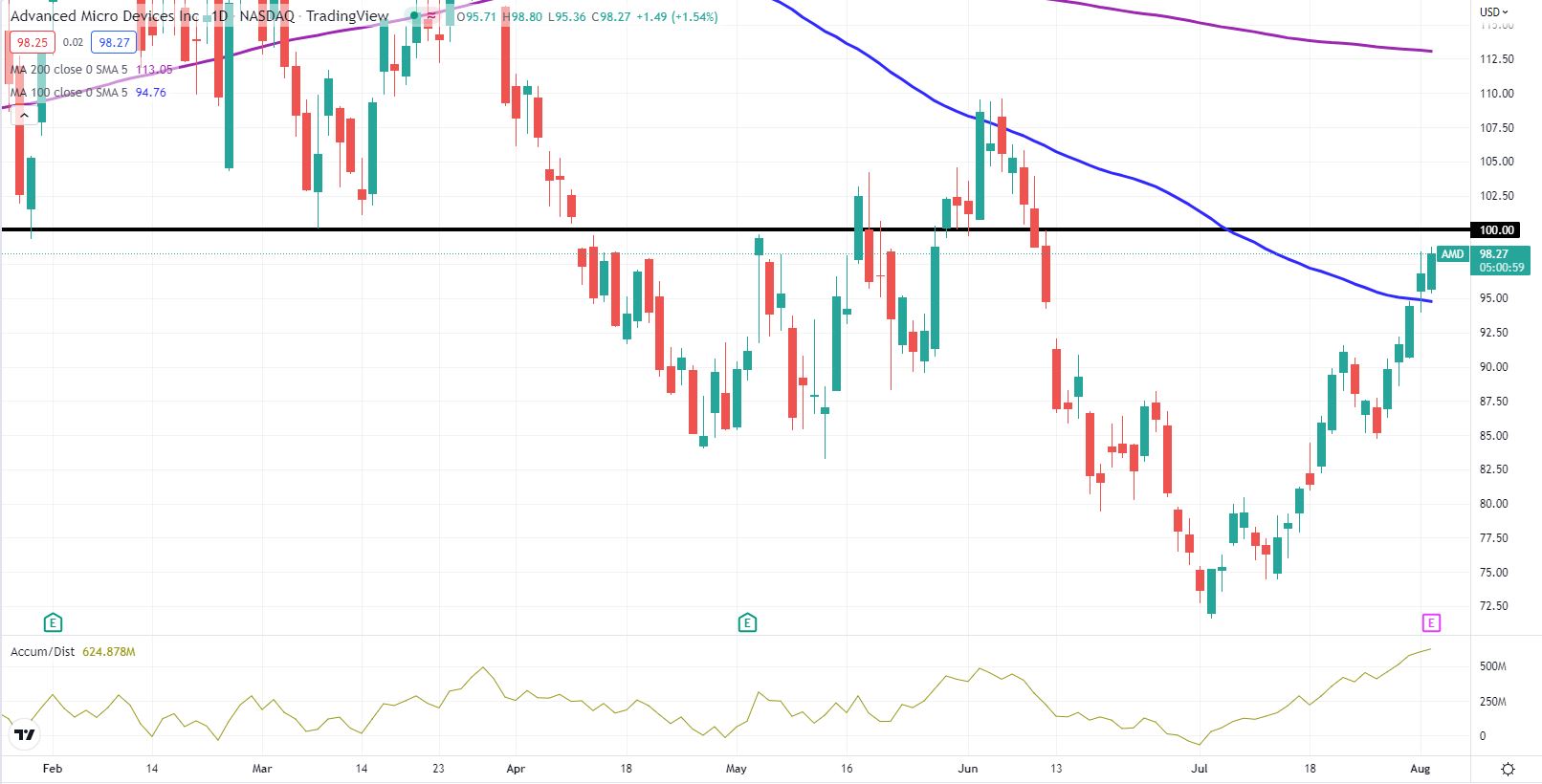
AMD daily chart
Author

Clay Webster
FXStreet
Clay Webster grew up in the US outside Buffalo, New York and Lancaster, Pennsylvania. He began investing after college following the 2008 financial crisis.