Why accumulating evidence boosts smart trading

In a minute, you'll uncover the key benefits of leveraging multiple evidence points in trading.
But first:
To provide you with some context - what better way than to incorporate a real-trading example as follows:
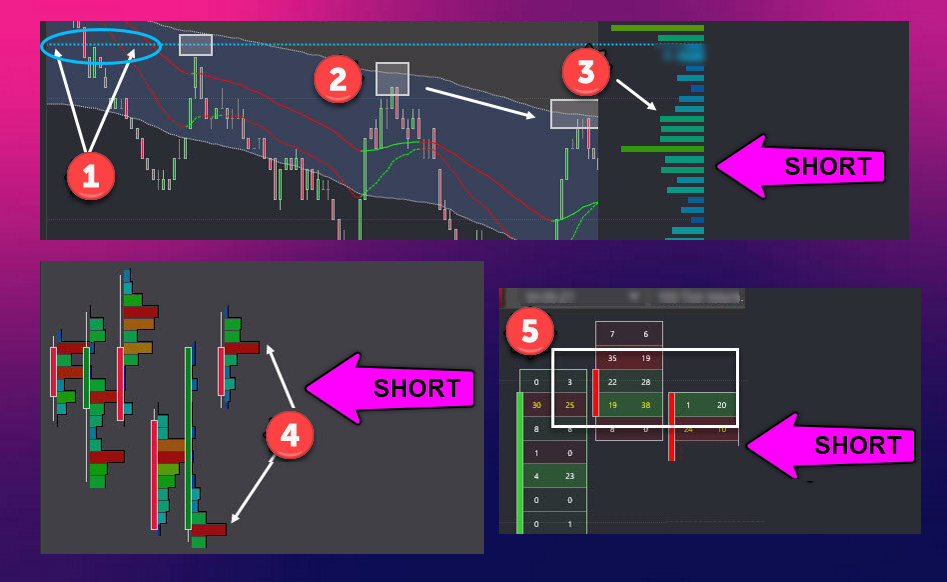
Below you can see the same short entry using three chart variations. The numbers one to five we'll come to shortly.
To lay the foundation:
Imagine a level you can't see on a naked chart - neither highs or lows or support or resistance.
But despite the price moving freely above and below this level for days now - what's unique about this level is most market participants are choosing to transact only above this level. Very few are making trades below it. Hold that thought...
Points of evidence
The numbers one to five represent our multiple evidence points to both qualify and time our short trade.
The first point of evidence (horizontal blue line) is the level we just covered.
But due to a recent shift in sentiment:
The price has stopped moving freely above and below this level.
In fact - this transition between where most participants do and don't do business is now anchoring price to the downside.
For our second point of evidence:
A systematic trading model is currently controlling price movement.
The model ensures price remains trading between the first and second standard deviations of VWAP anchored to the trading hours of a secondary market - the London Stock Exchange.
Evidence point three:
By isolating the activity of European region traders - right now - most of these traders won't transact at prices higher than the number three arrow is pointing to.
Evidence point number four:
Each intraday bar includes the volume traded at all the prices the bar encompasses.
Notice the difference between the last two bars and those that precede them?
Between the two arrows:
Little volume exists. In comparison - the preceding bars display more even volume distributions at all prices traded.
This 'hole' is likely to be filled - requiring the price to move downwards.
Our fifth evidence point shows price has moved up on on very thin volume (low liquidity).
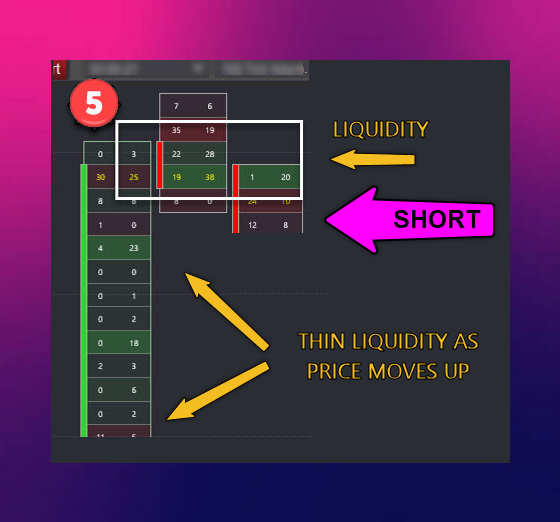
You can see row after row where the total number of contracts traded is close to zero. It's important to mention these low liquidity moves occur extremely quickly.
A market maker or an HFT created a melt-up in price on thin liquidity.
It's only near the highs do you see many contracts trade - likely FOMO buyers chasing the fast price increase because rapid movement attracts buyers like a moth drawn to a flame.
But see how these buyers are entering near the other evidence points including:
- The first deviation of VWAP anchored to London equities plus
- The transition from accepted to less accepted prices for Europe plus
- The big-picture price ceiling?
What happens next?
While the outcome followed the evidence resulting in a winning trade - the point here is not to highlight a winning trade.
Rather
We can see a group of traders who don't know what they don't know.
They wouldn't have entered a long trade if they had the necessary skills and expertise to trade successfully. Agree?
Their problem isn't a single losing trade - it's much bigger.
You see
If they don't know why their long trade was a poor decision, they're destined to repeat the same losing trade repeatedly. Right?
What do they do?
When you don't know what you don't know - most people look to their psychology as the problem.
But no amount of 'being more disciplined' or working on your trading psychology will fix this problem. Right?
Speaking of psychology
When you're trading decisions come from stacked evidence - there's no feeling anxious about entering a trade. Nor is there any anxiety about the outcome while in the trade.
That's because stacked evidence - when used correctly - provides you with a set of crystal clear set of instructions to follow.
So clear - they remove ambiguity or shades of grey about the decision to make - right now.
But that's not all
When you use multiple points of evidence as a strategy you're applying a unique approach to trading - which is how you unlock uncrowded trades.
Uncrowded trades are what the majority miss because the opportunity is unknown to them.
People who are successful are approaching markets in unique ways to unlock uncrowded trades. This is well documented through the Market Wizard series and is often referenced by Dr Brett Steenbarger based on his work with many of the world's brightest, most talented traders.
Look
Do the same as many other traders and you give up edge because what could have been effective is diluted by so many traders doing the same thing. Make sense?
On the flip side
Uncrowded trades retain an edge - getting in early on moves before the crowd picks up on it - so there’s more for you.
I can’t over-emphasise enough how important uncrowded trades are for success.
And finally
One of the most common trading problems people experience is over-trading. It's a major contributor to eroding account performance.
But as you've seen:
Stacked evidence clearly distinguishes between price movement that's not safe to trade and what's a genuine trading opportunity... putting an end to over-trading.
In summary
When you have the knowledge and expertise to apply evidence multiples, you're protecting yourself against the perils of trading while simultaneously identifying and timing high-probability opportunities.
Author

Adam Fiske
Boss Trading
Adam is an industry-trained trader with 19 years of professional trading experience.