"No, no! The adventures first, explanations take such a dreadful time." ― Lewis Carroll, Alice's Adventures in Wonderland & Through the Looking-Glass
"To hell with facts! We need stories!"
― Ken Kesey
As the literary geniuses above note, humans are a storytelling species. When given the choice between a complex explanation of a phenomenon and a simple, coherent narrative, we'll choose the latter every time.
Unfortunately for traders, it's been a rough couple of months for the dominant narratives, especially when it comes to the political sphere:
-
Going back to the US election, it was widely expected that a surprise victory by Donald Trump would be a disaster for investors ... until stocks surged.
-
Then traders reasoned Trump's intense early focus on growth neutral (arguably anti-growth) immigration and trade policies could hurt stocks by pushing back the promised fiscal stimulus...but stocks still rallied.
-
Most recently, last week's failure of the Republicans health care reform bill supposedly undermined the Republicans' "mandate"...instead US stocks have seemingly already started to recover after a 1% dip.
And these examples only cover the US! We could spill another couple thousand words on the failure of issues like Brexit, European political risk, and Chinese growth concerns to lead to reversals in global equity markets.
...So what gives?
At the risk of highlighting another overly simple narrative to explain the strong recent performance in US stocks, the fundamental pillars of support for US stocks (earnings) are as strong as they've been in years. According to the earnings mavens at Factset, "the estimated earnings growth rate for the S&P 500 is 9.1%. If 9.1% is the actual earnings growth rate for the quarter, it will mark the highest year-over-year earnings growth reported by the index since Q4 2011 (11.6%)."
The Factset report goes on to mention that analysts have made smaller cuts to earnings estimates than the recent average and that fewer S&P 500 companies than usual have issued negative EPS guidance. In other words, corporations are quietly more optimistic about their short-term business prospects, and this outlook is being reflected by the recent rise in US stocks:
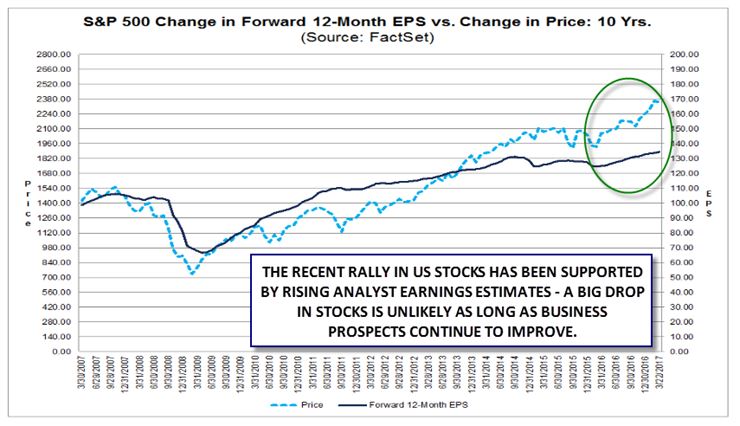
While valuations for US stocks are unambiguously stretched across a variety of measures, it's hard to see the case for a big reversal as long as corporate earnings continue to accelerate.
Perhaps traders are learning the lesson that the great authors we featured at the beginning of this report know all too well: Sometimes the simple, timeless stories are the best!
This research is for informational purposes and should not be construed as personal advice. Trading any financial market involves risk. Trading on leverage involves risk of losses greater than deposits.
Editors’ Picks
EUR/USD: Yes, the US economy is resilient – No, that won’t save the US Dollar Premium
Some impressive US data should have resulted in a much stronger USD. Well, it didn’t happen. The EUR/USD pair closed a third consecutive week little changed, a handful of pips above the 1.1800 mark.
Gold: Metals remain vulnerable to broad market mood Premium
Gold (XAU/USD) started the week on a bullish note and climbed above $5,000 before declining sharply and erasing its weekly gains on Thursday, only to recover heading into the weekend.
GBP/USD: Pound Sterling remains below 1.3700 ahead of UK inflation test Premium
The Pound Sterling (GBP) failed to resist at higher levels against the US Dollar (USD), but buyers held their ground amid a US data-busy blockbuster week.
Bitcoin: BTC bears aren’t done yet
Bitcoin (BTC) price slips below $67,000 at the time of writing on Friday, remaining under pressure and extending losses of nearly 5% so far this week.
US Dollar: Big in Japan Premium
The US Dollar (USD) resumed its yearly downtrend this week, slipping back to two-week troughs just to bounce back a tad in the second half of the week.
RECOMMENDED LESSONS
Making money in forex is easy if you know how the bankers trade!
I’m often mystified in my educational forex articles why so many traders struggle to make consistent money out of forex trading. The answer has more to do with what they don’t know than what they do know. After working in investment banks for 20 years many of which were as a Chief trader its second knowledge how to extract cash out of the market.
5 Forex News Events You Need To Know
In the fast moving world of currency markets where huge moves can seemingly come from nowhere, it is extremely important for new traders to learn about the various economic indicators and forex news events and releases that shape the markets. Indeed, quickly getting a handle on which data to look out for, what it means, and how to trade it can see new traders quickly become far more profitable and sets up the road to long term success.
Top 10 Chart Patterns Every Trader Should Know
Chart patterns are one of the most effective trading tools for a trader. They are pure price-action, and form on the basis of underlying buying and selling pressure. Chart patterns have a proven track-record, and traders use them to identify continuation or reversal signals, to open positions and identify price targets.
7 Ways to Avoid Forex Scams
The forex industry is recently seeing more and more scams. Here are 7 ways to avoid losing your money in such scams: Forex scams are becoming frequent. Michael Greenberg reports on luxurious expenses, including a submarine bought from the money taken from forex traders. Here’s another report of a forex fraud. So, how can we avoid falling in such forex scams?
What Are the 10 Fatal Mistakes Traders Make
Trading is exciting. Trading is hard. Trading is extremely hard. Some say that it takes more than 10,000 hours to master. Others believe that trading is the way to quick riches. They might be both wrong. What is important to know that no matter how experienced you are, mistakes will be part of the trading process.
The challenge: Timing the market and trader psychology
Successful trading often comes down to timing – entering and exiting trades at the right moments. Yet timing the market is notoriously difficult, largely because human psychology can derail even the best plans. Two powerful emotions in particular – fear and greed – tend to drive trading decisions off course.