Let it be stated upfront that there is no perfect way to analyze and forecast financial markets. No crystal balls.
Yet, let's be just as quick to add that in Elliott Wave International's review of market analysis methods, none approach the utility of the Elliott wave model.
The reason for the Elliott wave model's usefulness is easily explained: Elliott waves are reflections of the repetitive patterns of investor psychology, which is the real driver of prices, not news or events.
And, what could be more useful to an investor than a method which helps to identify a financial market's trend -- especially before it gets underway? Well, mastering the Elliott wave model helps you to do just that.
The Wall Street classic book, Elliott Wave Principle: Key to Market Behavior by Frost & Prechter, says:
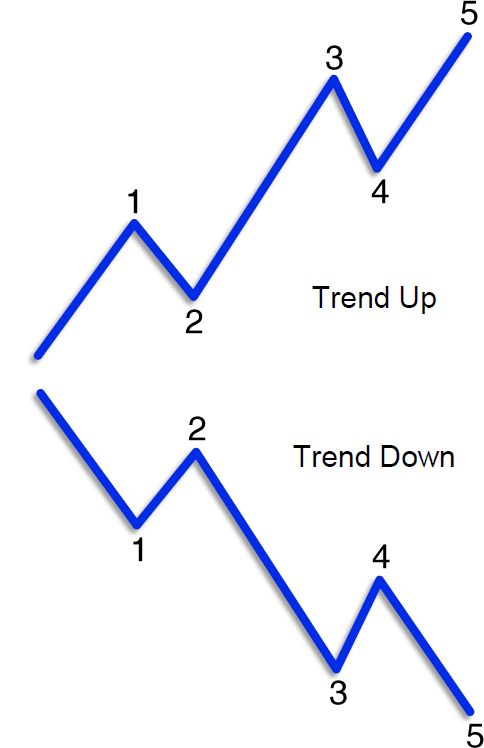
...action in the same direction as the one larger trend develops in five waves.
Here are illustrations:
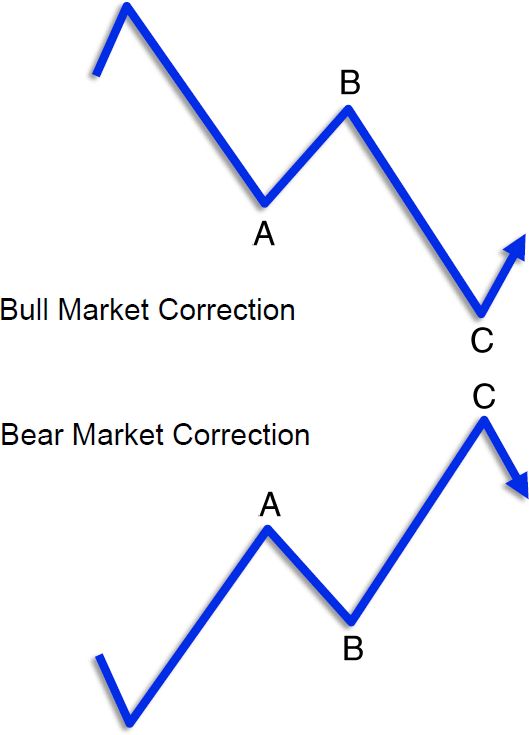
Let's now learn how the Elliott wave model identifies countertrend moves within the main trend by returning to Elliiott Wave Principle and additional illustrations:
... reaction against the one larger trend develops in three waves.
Lastly, let's learn how Elliott wave analysis signals the resumption of the main trend.
Elliott Wave International analyst Jeffrey Kennedy says:
A complete Elliott wave cycle consists of eight waves. Upon its completion, a similar cycle ensues....
Again, here are illustrations of the point:
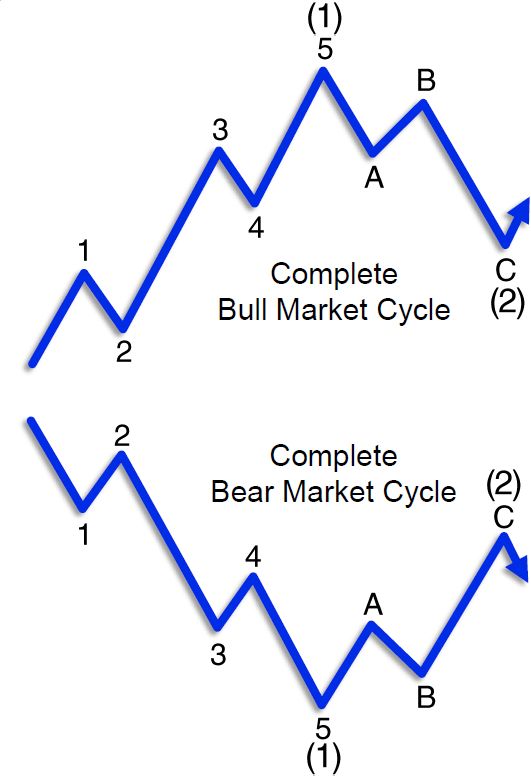
The reason that a market's basic form is five waves followed by three waves is that this is the most efficient method of achieving both fluctuation and progress in linear movement.
Think of it as a variation of nature's "two steps forward, one step back" model of achieving progress.
After all, humans are a part of the natural world, so it only follows that the financial markets, a product of human interaction, would carry the same imprint.
As you might imagine, there are many more details in applying the Elliott Wave Principle to financial markets, and it took an entire book to lay them all out.
The purpose of this article is to simply show you that the price patterns of financial markets unfold according to a repetitive, predictable structure. Familiarity with that structure can help you determine what's next.
Jump on once-in-a-lifetime opportunities and avoid dangerous pitfalls that no one else sees coming. We can help you prepare for opportunities and side step risks that will surprise most investors. You can get deeper insights in Elliott Wave International's new free report: 5 "Tells" that the Markets Are About to Reverse. The insights that you'll gain are especially applicable to the price patterns of key financial markets, including the stock market, now.
Get more financial insights like these -- 100% free.
Elliott Wave International does not provide investment advice. All rights reserved.
Editors’ Picks
AUD/USD: Some profit-taking should not be ruled out
AUD/USD has quickly faded Wednesday’s strong advance despite climbing to new multi-year highs around 0.7150 earlier on Thursday. The pair’s decline comes amid a marginal uptick in the US Dollar, while investors gear up for US CPI data and relevant Chinese releases on Friday.
EUR/USD faces next resistance near 1.1930
EUR/USD has surrendered its earlier intraday advance on Thursday and is now hovering uncomfortably around the 1.1860 region amid modest gains in the US Dolla. Moving forward, markets are exoected to closely follow Friday’s release of US CPI data.
Gold plunges on sudden US Dollar demand
Gold drops markedly on Thursday, challenging the $4,900 mark per troy ounce following a firm bounce in the US Dollar and amid a steep sell-off on Wall Street, with losses led by the tech and housing sectors.
Ripple collaborates with Aviva Investors to tokenize funds as XRP interest declines
Ripple (XRP) exhibits subtle recovery signs, trading slightly above $1.40 at the time of writing on Thursday, as crypto prices broadly edge higher. Despite the metered uptick, risk-off sentiment remains a concern across the crypto market, as retail and institutional interest dwindle.
A tale of two labour markets: Headline strength masks underlying weakness
Undoubtedly, yesterday’s delayed US January jobs report delivered a strong headline – one that surpassed most estimates. However, optimism quickly faded amid sobering benchmark revisions.
RECOMMENDED LESSONS
Making money in forex is easy if you know how the bankers trade!
I’m often mystified in my educational forex articles why so many traders struggle to make consistent money out of forex trading. The answer has more to do with what they don’t know than what they do know. After working in investment banks for 20 years many of which were as a Chief trader its second knowledge how to extract cash out of the market.
5 Forex News Events You Need To Know
In the fast moving world of currency markets where huge moves can seemingly come from nowhere, it is extremely important for new traders to learn about the various economic indicators and forex news events and releases that shape the markets. Indeed, quickly getting a handle on which data to look out for, what it means, and how to trade it can see new traders quickly become far more profitable and sets up the road to long term success.
Top 10 Chart Patterns Every Trader Should Know
Chart patterns are one of the most effective trading tools for a trader. They are pure price-action, and form on the basis of underlying buying and selling pressure. Chart patterns have a proven track-record, and traders use them to identify continuation or reversal signals, to open positions and identify price targets.
7 Ways to Avoid Forex Scams
The forex industry is recently seeing more and more scams. Here are 7 ways to avoid losing your money in such scams: Forex scams are becoming frequent. Michael Greenberg reports on luxurious expenses, including a submarine bought from the money taken from forex traders. Here’s another report of a forex fraud. So, how can we avoid falling in such forex scams?
What Are the 10 Fatal Mistakes Traders Make
Trading is exciting. Trading is hard. Trading is extremely hard. Some say that it takes more than 10,000 hours to master. Others believe that trading is the way to quick riches. They might be both wrong. What is important to know that no matter how experienced you are, mistakes will be part of the trading process.
The challenge: Timing the market and trader psychology
Successful trading often comes down to timing – entering and exiting trades at the right moments. Yet timing the market is notoriously difficult, largely because human psychology can derail even the best plans. Two powerful emotions in particular – fear and greed – tend to drive trading decisions off course.