US Dollar Weekly Forecast: Investors’ attention remains on the Fed
- The US Dollar closed the week with marked losses.
- The Japanese election results kept the buck under heavy pressure.
- The FOMC Minutes will unveil details of the latest hold by the Fed.
The week that was
The US Dollar (USD) resumed its yearly downtrend this week, slipping back to two-week troughs just to bounce back a tad in the second half of the week.
That said, the US Dollar Index (DXY) sold off with quite a dreadful start to the week, stabilising somewhat at the lower end of the weekly range in the subsequent days, all following investors' assessments of the Japanese election on Sunday.
Indeed, market participants seem to have parked the speculation of what a Warsh-led Federal Reserve (Fed) might look like, shifting their focus to the implications of a potentially renewed strength in the Japanese Yen (JPY), including its duration and extension.
In addition, the poor performance of the index mirrored that of US Treasury yields, which accelerated their decline to multi-month lows across various time frames.
So far, markets see the Federal Reserve on hold at its March 18 event, pencilling in nearly 70 basis points of easing this year.
Fed stays on hold as confidence edges higher
The Federal Reserve did exactly what markets expected in January, leaving the Fed Funds Target Range (FFTR) unchanged at 3.50% to 3.75%. The decision itself was no surprise. What stood out slightly more was the tone. Policymakers sounded a touch more confident on growth and quietly dropped earlier language about rising downside risks to the labour market.
During the press conference, Chair Jerome Powell maintained a steady and measured tone. He said the current policy stance still looks appropriate, pointing to signs that the labour market is stabilising and service inflation continues to ease. As for the recent uptick in headline inflation, Powell largely attributed it to tariffs on goods, suggesting those pressures should peak around the middle of the year.
Importantly, he repeated that decisions will be taken meeting by meeting, with no preset path. Further rate hikes are not the base case, and in his view, risks to both sides of the Fed’s dual mandate have moderated. In other words, the Fed is comfortable where it is and in no rush to move.
Lower rates or longer hold? The debate inside the Fed
Fresh comments from Fed officials revealed an interesting detail that wasn't obvious at first. One governor openly said that rates should already be lower. Several regional presidents, on the other hand, chose to wait, saying that the risks of inflation have not completely gone away. What is the main point? Confidence is growing, but caution is still the main feeling.
FOMC Governor Stephen Miran (permanent voter) was the clearest voice on the dovish side. He argued that policy rates are currently higher than necessary and should already be lower. In Miran’s view, policy is still running tighter than the data really justify. He seems to think the Fed is leaning more restrictive than necessary at this stage of the cycle. He also played down fears that trade tariffs will meaningfully rekindle inflation. According to Miran, their impact has been far less damaging than many initially expected. He added that a large share of the cost has been absorbed by foreign producers rather than US consumers, propping up his broader point that inflation risks stemming from trade policy may be overstated.
Dallas Fed President Lorie Logan (voter) said she was “cautiously optimistic” that the current 3.50%–3.75% policy range can guide inflation back toward 2% while preserving labour market stability. She noted that after last year’s three rate cuts, downside risks to employment have “meaningfully dissipated”. However, she warned that those same cuts have added some upside risk to inflation. For Logan, the next few months of data will be critical in determining whether policy is sufficiently restrictive.
Cleveland Fed President Beth Hammack (voter) struck a patient tone, saying there is no urgency to adjust rates this year. With the economy on a “cautiously optimistic” footing, she suggested the Fed could remain on hold for “quite some time”. Her remarks reinforce the idea that, barring a material shift in inflation dynamics, policy stability is currently the base case.
Kansas City Fed President Jeffrey Schmid (2028 voter) took the firmest stance on maintaining tight policy. He argued it is too early to rely on productivity gains or artificial intelligence to sustainably lower inflation pressures. While acknowledging the potential for supply-driven growth, Schmid stressed that “we are not there yet” and that interest rates must remain sufficiently high to restrain demand and prevent inflation from re-accelerating.
All in all
The internal balance is clear: Miran is leaning dovish, openly calling for lower rates, while regional presidents favour patience and continued restraint. The broader Fed message remains one of cautious optimism, but not complacency. For markets, the hurdle for further easing still looks high unless incoming data clearly justify it.
Disinflation progresses; caution remains
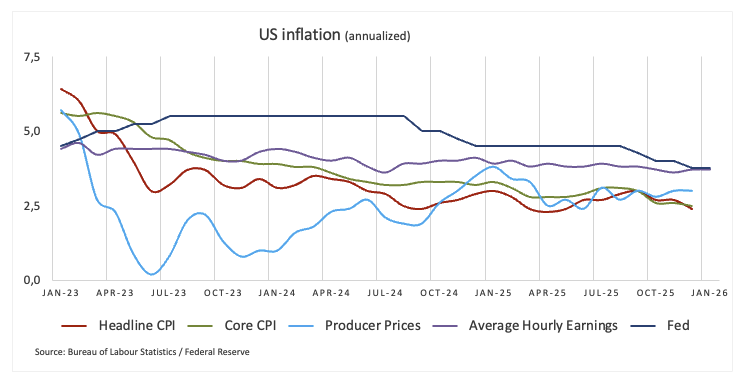
The latest US inflation print surprised slightly on the soft side. Headline CPI eased to 2.4% YoY in January, while core CPI, which strips out food and energy, also cooled to 2.5% over the past twelve months. In short, price pressures continue to move in the right direction.
For markets, that was enough to keep the disinflation narrative alive and nudge rate-cut expectations back into view over the medium term. But from the Fed’s perspective, the job isn’t finished. Policymakers continue to stress that inflation is still above the 2% target, and the full impact of US tariffs on consumer prices remains uncertain. So while investors may be leaning towards easing, the Fed is signalling there is still work to do.
‘Buy Japan’ kept the buck under pressure
The Yen has staged an impressive comeback this week, putting it on track for what could be its strongest weekly showing in more than a year. By Thursday, it was already applying steady pressure on the US Dollar, a sign that sentiment in FX markets may be shifting at the margin.
Since Prime Minister Sanae Takaichi’s Liberal Democratic Party secured a landslide victory in Sunday’s election, the Yen has rallied around 2.8% against the Dollar. If those gains hold into Friday’s close, it would mark the currency’s biggest weekly advance since November 2024, a sharp reversal that has not gone unnoticed by traders.
Dollar shorts trimmed, but bearish bias lingers
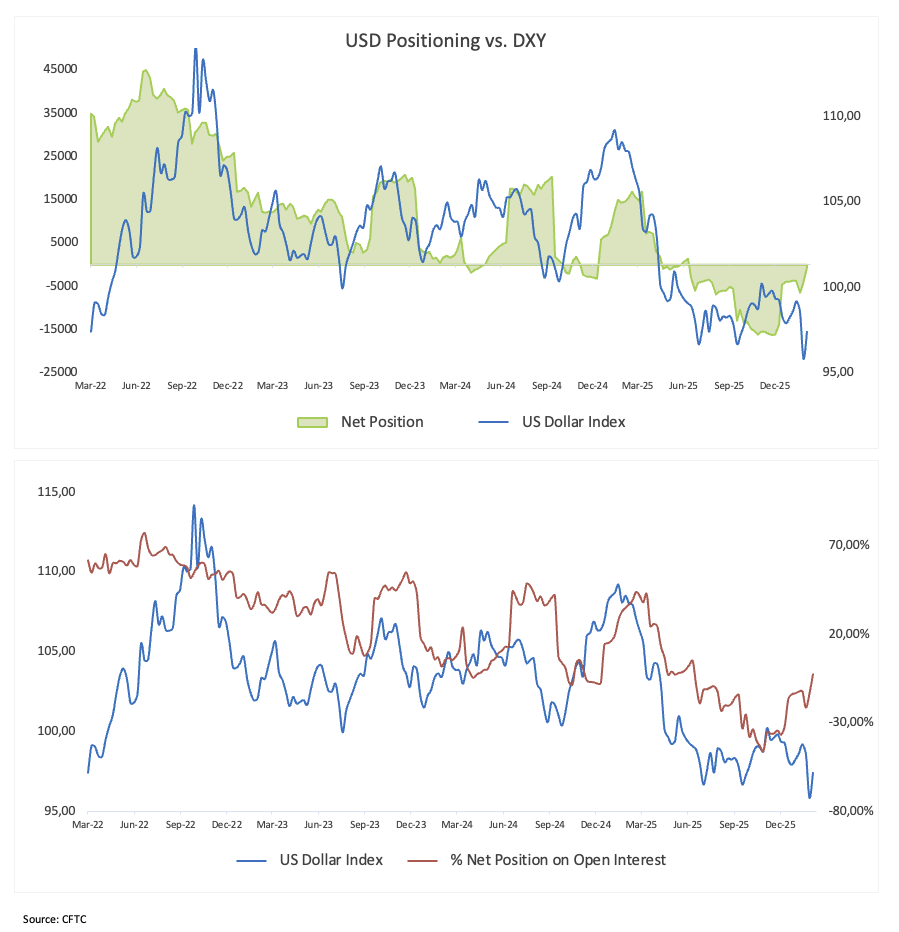
The latest positioning data from the Commodity Futures Trading Commission (CFTC) offer an interesting nuance beneath the surface. Non-commercial traders trimmed their net short US Dollar positions to the smallest since May 2025, down to roughly 850 contracts. In other words, the heavy bearish conviction that built up earlier in the year is starting to fade.
At the same time, open interest fell markedly to around 28.2K contracts, unwinding the previous increase. That drop suggests some participants are simply closing positions rather than aggressively flipping bullish. It feels less like a rush into fresh Dollar longs and more like a reduction of crowded shorts.
Taken together, the picture points to a market that has already priced in a good deal of negative news. The Dollar is still viewed with caution, but the positioning no longer looks stretched. That, in itself, reduces the risk of another sharp downside squeeze and hints that the next big move may need a fresh catalyst.
What’s next for the US Dollar
Attention now shifts back to the US data and the Fed. Next week’s flash Q4 GDP reading and the latest inflation figures measured by the Personal Consumption Expenditure (PCE) index will take centre stage. Both releases should help clarify whether the recent resilience in growth and the gradual cooling in prices are still intact.
At the same time, investors will comb through the Minutes from the January 28 FOMC meeting for additional insight into why policymakers opted to keep rates unchanged. Any nuance around the balance of risks, or hints about what could trigger the next move, will be closely scrutinised.
Technical landscape
The US Dollar Index (DXY) seems to have met an important resistance zone near the 98.00 mark, or monthly highs.
Once the index clears this region, it could attempt a test of the 98.20-98.60 band, where the temporary 55-day and 100-day SMAs and the more significant 200-day SMA all converge. Further up comes the 2026 ceiling at 99.49 (January 15).
On the flip side, the loss of the February floor at 96.49 (February 11) could put a test of the 2026 bottom at 95.56 (January 27) back into focus, prior to the February 2022 base at 95.13 and the 2022 valley at 94.62 (January 14).
Additionally, momentum indicators remain tilted toward extra weakness. That said, the Relative Strength Index (RSI) hovers around the 40 zone, while the Average Directional Index (ADX) above 29 indicates a still robust trend.
-1771007869786-1771007869787.png)
Bottom line
Even with this week’s pullback, led largely by Yen strength, it is worth remembering that a sizeable portion of the Dollar’s rebound in late January and early February was Fed-driven. Much of that move followed President Trump’s decision to appoint Kevin Warsh as Jerome Powell’s successor, a shift that markets interpreted as potentially less dovish than feared.
From here, the focus swings back to the data. Investors will be watching the US calendar closely, especially inflation prints and labour market figures. For the Fed, jobs remain the primary barometer. Policymakers are alert to any signs of a meaningful slowdown, but they are equally aware that inflation is not yet comfortably back at target.
Price pressures are still running above where the Fed would like them to be. If the disinflation trend begins to stall, markets could quickly scale back expectations for early or aggressive rate cuts. In that scenario, the Fed would likely lean into a more cautious stance, which over time could lend renewed support to the Dollar, regardless of the surrounding political noise.
Fed FAQs
Monetary policy in the US is shaped by the Federal Reserve (Fed). The Fed has two mandates: to achieve price stability and foster full employment. Its primary tool to achieve these goals is by adjusting interest rates. When prices are rising too quickly and inflation is above the Fed’s 2% target, it raises interest rates, increasing borrowing costs throughout the economy. This results in a stronger US Dollar (USD) as it makes the US a more attractive place for international investors to park their money. When inflation falls below 2% or the Unemployment Rate is too high, the Fed may lower interest rates to encourage borrowing, which weighs on the Greenback.
The Federal Reserve (Fed) holds eight policy meetings a year, where the Federal Open Market Committee (FOMC) assesses economic conditions and makes monetary policy decisions. The FOMC is attended by twelve Fed officials – the seven members of the Board of Governors, the president of the Federal Reserve Bank of New York, and four of the remaining eleven regional Reserve Bank presidents, who serve one-year terms on a rotating basis.
In extreme situations, the Federal Reserve may resort to a policy named Quantitative Easing (QE). QE is the process by which the Fed substantially increases the flow of credit in a stuck financial system. It is a non-standard policy measure used during crises or when inflation is extremely low. It was the Fed’s weapon of choice during the Great Financial Crisis in 2008. It involves the Fed printing more Dollars and using them to buy high grade bonds from financial institutions. QE usually weakens the US Dollar.
Quantitative tightening (QT) is the reverse process of QE, whereby the Federal Reserve stops buying bonds from financial institutions and does not reinvest the principal from the bonds it holds maturing, to purchase new bonds. It is usually positive for the value of the US Dollar.
Author

Pablo Piovano
FXStreet
Born and bred in Argentina, Pablo has been carrying on with his passion for FX markets and trading since his first college years.

















