EUR/USD Weekly Forecast: US economic resilience not enough to boost the US Dollar

Some impressive US data should have resulted in a much stronger USD. Well, it didn’t happen.
The EUR/USD pair closed a third consecutive week little changed, a handful of pips above the 1.1800 mark. Market players are still struggling to find a trend, even after hearing great news about the state of the US economy. At this point, it seems likely the pair will trade closer to 1.2000 than 1.1500, as the US Dollar is set to remain on the back foot.
Encouraging employment, easing inflation
The US released some relevant macroeconomic figures, but these led to only modest USD gains. On the one hand, the country published the January Nonfarm Payrolls report, which showed 130K new jobs were added in the month, almost doubling expectations. Moreover, the Unemployment Rate shrank to 4.3% from the previous 4.4%, also 0.1 points lower than anticipated.
Additionally, annual inflation in the US declined to 2.4% in January from 2.7% in December, lower than the 2.5% anticipated by market participants. On a monthly basis, the CPI advanced a modest 0.2% compared to the previous 0.3%. Core monthly inflation rose by 0.3%, while the annualized reading printed at 2.5%, both meeting expectations.
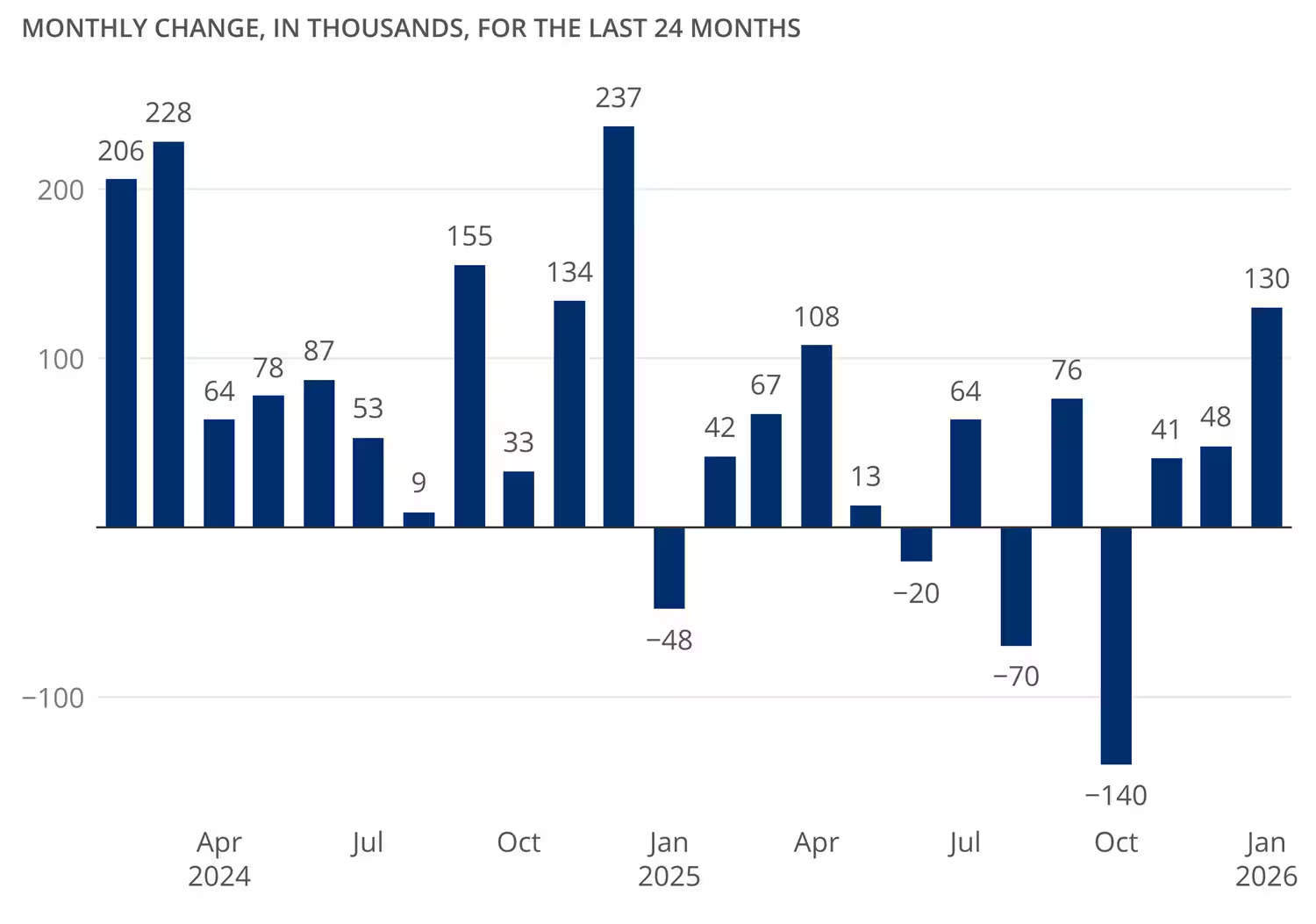
Why then, good American data failed to sustainably boost the Greenback? Well, it could be partially explained by the fact that the data was actually delayed by a short-lived US government shutdown, diminishing its relevance.
It could also be explained by the fact that these numbers leave the door open to an interest rate cut. But let’s make it clear: no one anticipates Chair Jerome Powell to deliver an interest rate cut before leaving in May. The odds of lower rates are delayed until June and July, when Kevin Warsh takes over as chair.
Warsh is coming with significant pressure: US President Donald Trump chose him in hopes that he would take rates well below the current range of 3.50% - 3.75%. This will prove to be an impossible task if there is a too weak labor market and persistent inflationary pressures.
If anything, what we learned these days is that the US economy is resilient, and that rates will eventually be lowered. And that’s what counts for financial markets and keeps leaving the US Dollar in a trend limbo.
The European song remains the same
Saying that the Euro (EUR) remains unattractive is no news. Little relevant data, and a European Central Bank (ECB) standing in a “good place,” with no aims to modify its monetary policy, spooks speculative interest. The odds of some surprises coming from the Old Continent are too low to make the common currency interesting.
Data-wise, a revision of the Q4 Gross Domestic Product (GDP) confirmed quarterly growth at 0.3%, and the annualized economic progress at 1.4%. Again, no surprises there. The EU economy is stable and will remain the same, with slow but steady growth expected in the foreseeable future.
Data in the docket
The upcoming days are meant to be lighter in terms of macroeconomic data. Germany will release the final estimate of the January Harmonized Index of Consumer Prices (HICP) on Tuesday, and the February ZEW Survey on Economic Sentiment in the same day. The US will offer an update on Durable Goods Orders on Wednesday.
Friday will be a bit more interesting as S&P Global, alongside local banks, will publish the flash estimates for the February Purchasing Managers’ Indexes (PMIs) for most major economies. Ahead of the weekly close, the US will release the December Personal Consumption Expenditures (PCE) Price Index, the Federal Reserve (Fed)'s favorite inflation gauge. More relevant, the US will also publish the preliminary estimate of the Q4 GDP.
EUR/USD technical outlook
The long-term technical picture indicates that buyers retain control.
In the weekly chart, EUR/USD trades well above the 20-week Simple Moving Average (SMA), which is slowly resuming its advance and currently stands at 1.1683, providing dynamic support. The shorter SMA stands far above the 100- and 200-week SMAs, which also head north. The same chart shows that, while lacking clear directional strength, technical indicators advance within positive levels, with the Relative Strength Index (RSI) indicator standing at 61, in line with the dominant yet dormant bullish trend. The weekly peak at 1.1928 provides resistance, particularly given that the pair has neared but retreated from this area several times in the last few days.
The daily chart shows that EUR/USD continues to attract buyers around the bullish 20-day SMA, which is rising above the longer-term SMAs. The short SMAs’ upturn alongside gradual advances in the longer SMAs suggest that buyers remain in control, while the 20-day SMA at 1.1837 provides near-term dynamic support. The same chart shows that the Momentum indicator declines after prior expansion, now crossing its midline into the negative territory and pointing to waning upside velocity. The RSI indicator also aims lower, yet it sits at 55, limiting the bearish potential of the pair.
Overall, the EUR/USD pair may remain under selling pressure in the coming days, but the broad picture favors a run towards the psychological 1.2000 mark.
(The technical analysis of this story was written with the help of an AI tool.)
Economic Indicator
Core Personal Consumption Expenditures - Price Index (YoY)
The Core Personal Consumption Expenditures (PCE), released by the US Bureau of Economic Analysis on a monthly basis, measures the changes in the prices of goods and services purchased by consumers in the United States (US). The PCE Price Index is also the Federal Reserve’s (Fed) preferred gauge of inflation. The YoY reading compares the prices of goods in the reference month to the same month a year earlier. The core reading excludes the so-called more volatile food and energy components to give a more accurate measurement of price pressures." Generally, a high reading is bullish for the US Dollar (USD), while a low reading is bearish.
Read more.Next release: Fri Feb 20, 2026 13:30
Frequency: Monthly
Consensus: 3%
Previous: 2.8%
Source: US Bureau of Economic Analysis
After publishing the GDP report, the US Bureau of Economic Analysis releases the Personal Consumption Expenditures (PCE) Price Index data alongside the monthly changes in Personal Spending and Personal Income. FOMC policymakers use the annual Core PCE Price Index, which excludes volatile food and energy prices, as their primary gauge of inflation. A stronger-than-expected reading could help the USD outperform its rivals as it would hint at a possible hawkish shift in the Fed’s forward guidance and vice versa.
Author

Valeria Bednarik
FXStreet
Valeria Bednarik was born and lives in Buenos Aires, Argentina. Her passion for math and numbers pushed her into studying economics in her younger years.