Gold Weekly Forecast: Bulls struggle to dominate ahead of next batch of US data
- Gold remains sensitive to tech-driven market volatility.
- Investors see a diminishing chance of a Fed interest rate cut in March.
- US data and risk sentiment could continue to drive Gold prices in the near term.

Gold (XAU/USD) started the week on a bullish note and climbed above $5,000 before declining sharply and erasing its weekly gains on Thursday, only to recover heading into the weekend. Investors await growth and business activity data from the US, while keeping an eye on the broad market mood.
Gold loses more than 3% in Thursday’s flash crash
The selling pressure surrounding the US Dollar (USD) helped XAU/USD to push higher on Monday. Heightened risks of the Bank of Japan (BoJ) intervening in foreign exchange markets after Japanese Prime Minister Sanae Takaichi’s landslide victory in the general election over the weekend caused the USD to weaken against its major currency peers. Additionally, Bloomberg reported that Chinese regulators have verbally advised financial institutions to curb holdings of US Treasuries, citing growing concerns about concentration risk and market volatility. This development further weighed on the USD.
On Tuesday, Gold corrected lower, but the losses remained limited as the US Treasury bond yields continued to decline in the second half of the day. The data published by the US Bureau of Labor Statistics (BLS) showed on Wednesday that Nonfarm Payrolls rose by 130K in January. This reading followed the 48K (revised down from 50K) increase recorded in December, and surpassed the market expectation of 70K by a wide margin. Moreover, the Unemployment Rate edged lower to 4.3% from 4.4%. The CME Group FedWatch Tool’s probability of a 25 basis-point (bps) Federal Reserve (Fed) interest rate cut in March declined below 10% after the upbeat unemployment data, compared to about 20% before the release. In turn, Gold struggled to build on its weekly gains but managed to hold comfortably above $5,000.
Following a quiet European session on Thursday, Gold came under heavy selling pressure during the American trading hours and lost more than 3% on a daily basis to close below $5,000. "Gold plunged as concerns about AI spurred a selloff across financial markets with algorithmic traders appearing to amplify the precious metal’s sudden drop," UOB Global Economics & Markets Research analysts explained. "Market talks also indicated some profit taking was done amidst the precious metal’s recent stellar rally,” they added. Silver (XAG/USD) lost over 11% on Thursday and Copper on the London Metal Exchange (LME) fell more than 2%.
On Friday, the BLS reported that annual inflation in the US, as measured by the change in the Consumer Price Index (CPI), declined to 2.4% in January from 2.7% in December. This print came in below the market expectation of 2.5% and made it difficult for the USD to preserve its strength. In turn, Gold gathered recovery momentum and retraced a portion of Thursday’s slump.
Gold traders await key US data
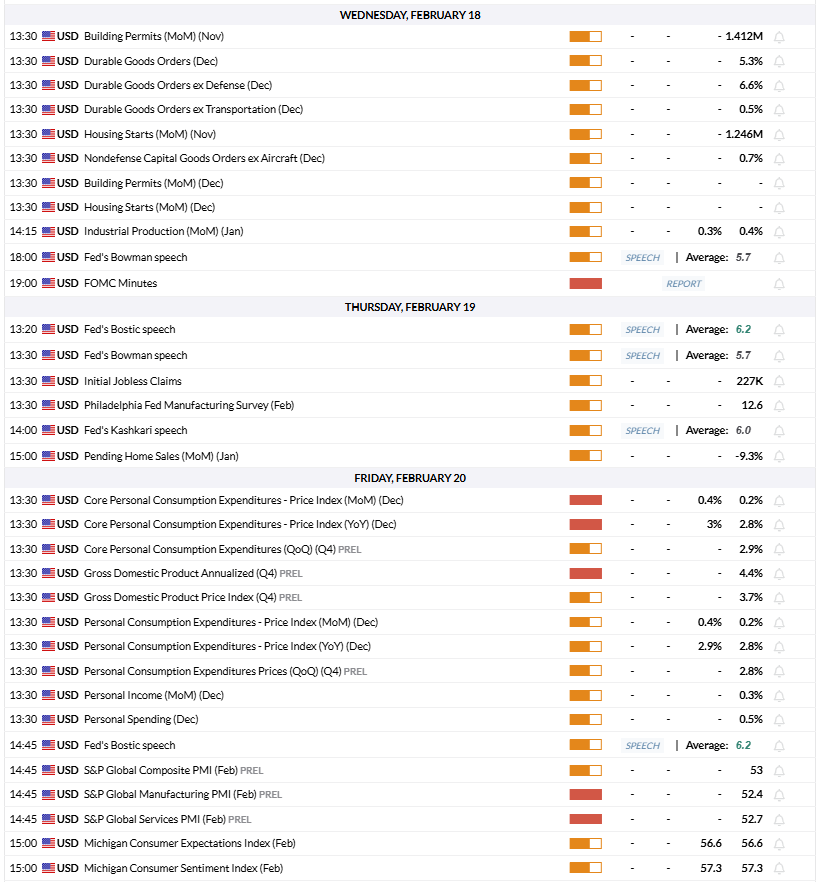
The US economic calendar will feature Durable Goods Orders for December on Wednesday, which is unlikely to trigger a noticeable market reaction. That same day, the Fed will publish the minutes of the January policy meeting. The market positioning suggests the USD doesn’t have much room left on the upside, even if the publication points to policymakers preferring a policy hold next month. On the other hand, the USD could come under short-lived selling pressure and help XAU/USD hold its ground if commentary in the document hints that officials are open to cutting the rate again in March.
On Friday, the US Bureau of Economic Analysis (BEA) will release its first estimate of the fourth-quarter Gross Domestic Product (GDP) growth. Commerzbank analysts expect the US economic growth momentum to persist in the last quarter of 2025 and explain:
“Based on monthly economic indicators, growth is expected to be similarly strong as in the second quarter (3.8% quarter-on-quarter, annualised) and the third quarter (4.4%). Our forecast for the fourth quarter is 3.7%. The drivers were private consumption, non-residential investment, and an improvement in the trade balance.”
A Q4 GDP reading between 3% and 4%, or better, could allow the USD to keep its footing. A significant negative print below 3% could cause the USD to come under pressure heading into the weekend and help XAU/USD edge higher.
Friday’s economic docket will also feature S&P Global’s preliminary February Manufacturing and Services Purchasing Managers’ Index (PMI) data. An unexpected drop below 50 in either of the headline PMIs could hurt the USD.
Investors will continue to keep a close eye on global equity indexes, specifically on the performance of tech stocks. Given the strengthening positive correlation between precious metals and tech stocks, Gold could benefit from bullish action in the tech-heavy Nasdaq Composite Index. Conversely, Gold could turn south and suffer large losses if investors witness another bout of selloff in tech stocks.
Gold technical analysis
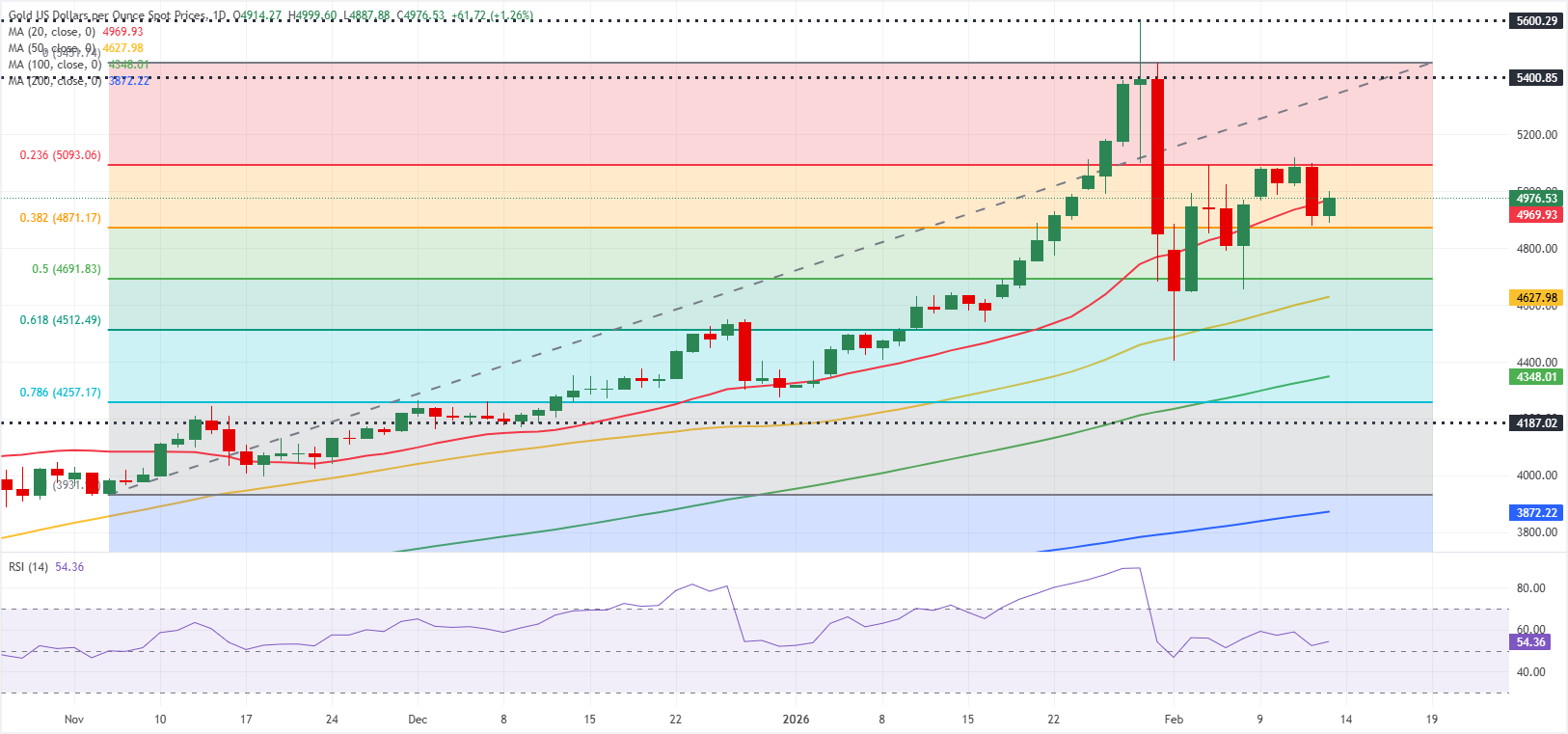
The Relative Strength Index (RSI) on the daily chart holds above 50 despite Thursday’s decline, highlighting a lack of bearish pressure in the short term. Additionally, Gold managed to recover toward the 20-day Simple Moving Average (SMA) on Friday after closing below this level on Thursday, reflecting sellers’ hesitancy.
On the upside, $5,090-$5,100 (Fibonacci 23.6% retracement of the November-February uptrend, round level) aligns as the first resistance area before $5,200 (round level) and $5,400 (round level, static level).
In case Gold drops below $4,870 (Fibonacci 38.2% retracement) and confirms that level as resistance, technical sellers could take action. In this scenario, $4,700 - $4,690 (round level, Fibonacci 50% retracement) and $4,630 (50-day SMA) could be seen as the next supports.
Gold FAQs
Gold has played a key role in human’s history as it has been widely used as a store of value and medium of exchange. Currently, apart from its shine and usage for jewelry, the precious metal is widely seen as a safe-haven asset, meaning that it is considered a good investment during turbulent times. Gold is also widely seen as a hedge against inflation and against depreciating currencies as it doesn’t rely on any specific issuer or government.
Central banks are the biggest Gold holders. In their aim to support their currencies in turbulent times, central banks tend to diversify their reserves and buy Gold to improve the perceived strength of the economy and the currency. High Gold reserves can be a source of trust for a country’s solvency. Central banks added 1,136 tonnes of Gold worth around $70 billion to their reserves in 2022, according to data from the World Gold Council. This is the highest yearly purchase since records began. Central banks from emerging economies such as China, India and Turkey are quickly increasing their Gold reserves.
Gold has an inverse correlation with the US Dollar and US Treasuries, which are both major reserve and safe-haven assets. When the Dollar depreciates, Gold tends to rise, enabling investors and central banks to diversify their assets in turbulent times. Gold is also inversely correlated with risk assets. A rally in the stock market tends to weaken Gold price, while sell-offs in riskier markets tend to favor the precious metal.
The price can move due to a wide range of factors. Geopolitical instability or fears of a deep recession can quickly make Gold price escalate due to its safe-haven status. As a yield-less asset, Gold tends to rise with lower interest rates, while higher cost of money usually weighs down on the yellow metal. Still, most moves depend on how the US Dollar (USD) behaves as the asset is priced in dollars (XAU/USD). A strong Dollar tends to keep the price of Gold controlled, whereas a weaker Dollar is likely to push Gold prices up.
Author

Eren Sengezer
FXStreet
As an economist at heart, Eren Sengezer specializes in the assessment of the short-term and long-term impacts of macroeconomic data, central bank policies and political developments on financial assets.

















