 Rick Wright
Online Trading Academy
Hello traders! This week’s newsletter will discuss how to increase the reward to risk ratio on your forex trades while decreasing your total number of trades by only trading near the edges on the chart!
What Does it Mean to Trade on the Edges of a Chart?
Now, first of all we must define what I mean by the edges. Every time frame, and therefore every trading style, can be broken down into three trends: up, down and sideways. When a market is consolidating, or basing, the edges are very obvious. In this chart, I’ve marked 3 obvious sideways trends (each area can be called a base) with short blue lines where price paused for a few candles before beginning a new trend. In all 3 cases, the trend was to the downside, coincidentally. I’ve also marked a much larger and longer base with the two pink lines. For clarity’s sake, all zones are roughly marked instead of using our more specific supply and demand zones.
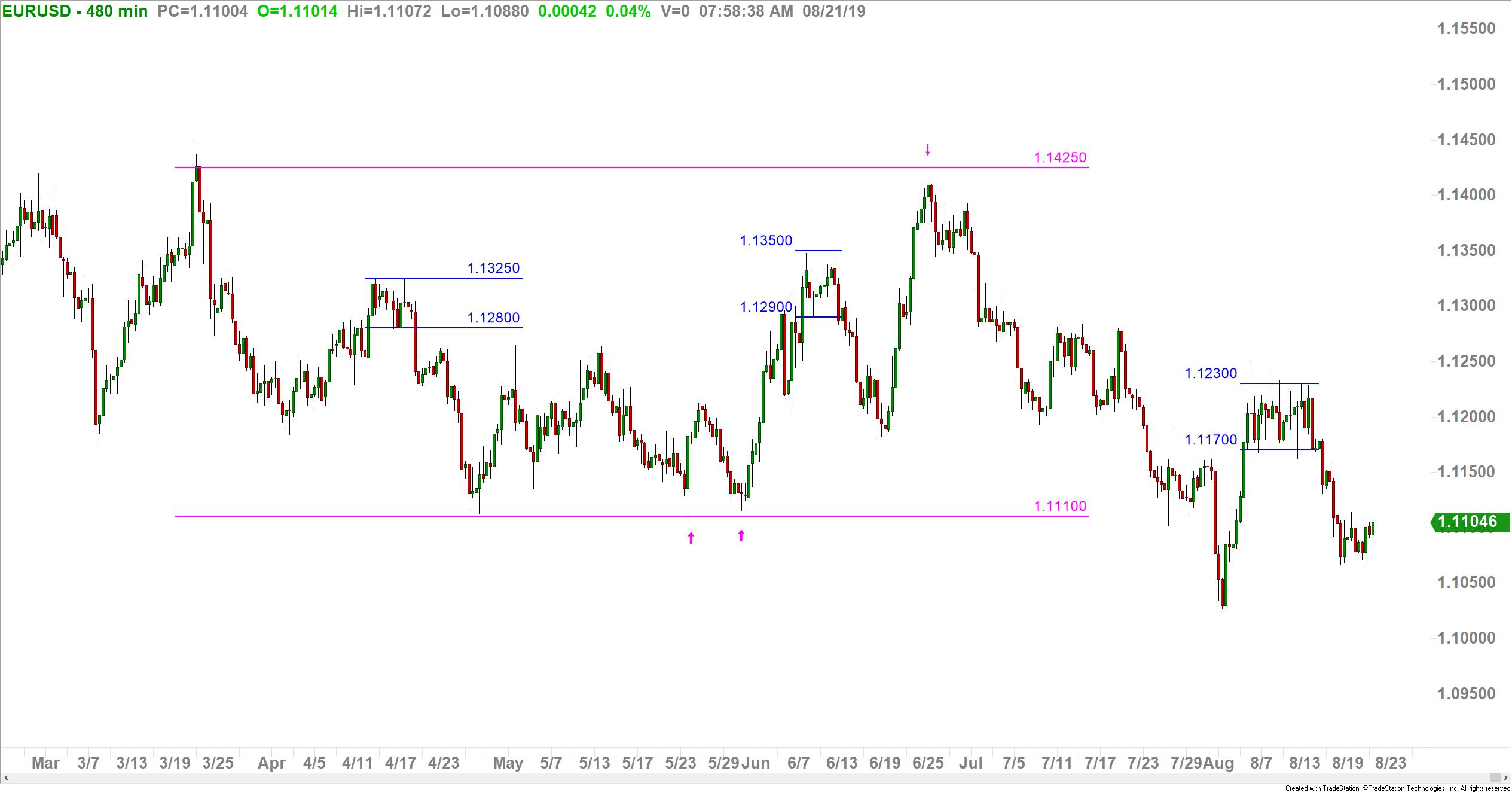
Depending on your trading style, meaning, how long you plan on spending in a trade, you could have played the smaller zones (marked in blue) back and forth, long and short, until price broke out of the zone. These smaller forex trades aren’t displayed on the chart, but they could have earned you in the neighborhood of 20-40 pips per side.
For the larger pink zone, trading on the long side at the 2 lower arrows should have earned you about 60 pips. On the short side, at the top downward pointing pink arrow, the short should have earned around 2-300 hundred pips.
So now the question is, where are the edges in a trending market?
Using the same EURUSD pair but going out to a larger, weekly timeframe shows a pretty clear downtrend for the past several months. In a downtrend, we prefer to stick with the dominant direction, so short forex trades for our conservative traders! The four blue arrows show where the trader should be looking for short trades in supply zones. Again, each trade would be worth anywhere from 100-300 pips. The more conservative trader will be able to use the bottom edge in a downtrend for profit targets, then patiently wait to re-enter on the short side.
Our more aggressive traders may look to go long, against the trend by playing retracements. Going against the trend is harder, and generally means going for smaller profit targets.

In an uptrend, to trade the edges the conservative trader will look to go long in that uptrend, near the lower edge in a demand zone. On this 60-minute EURGBP chart, this trader had at least 3 possible long entries, worth anywhere from 50-100 pips.
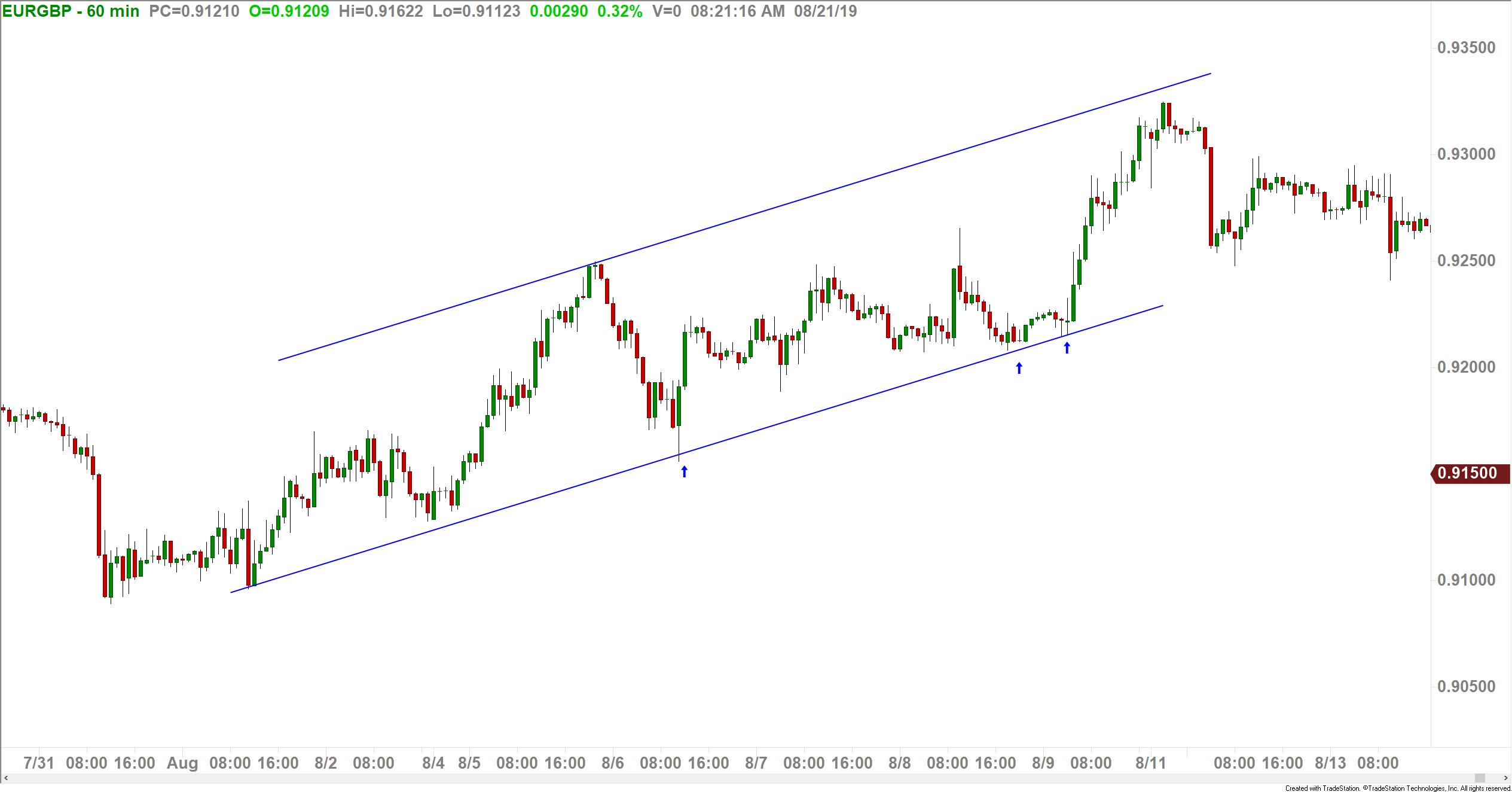
So how do we define the edges? Personally, I’m just using the obvious swing lows and swing highs. Because of our decentralized market when trading spot forex, I don’t need to be as specific as trading a centralized market like futures or stocks. This is why my trendlines, as they are called, don’t line up perfectly as some others would have you draw.
Another important thing to remember is that our task as traders is to keep our losses small and let our winners run! When trading the edges, your losses should remain very small in relation to the winning trades. In addition, you should be taking fewer trades, because you won’t be forcing trades in the middle, away from the edges. Our recommended reward to risk ratio is 3:1, meaning I’ll risk $1 for every $3 of potential reward. However, when adopting this technique, I believe your reward to risk ratio should rise dramatically, to 5:1 or even 10:1 ratios.
Read the original article here - Let’s Stick to the Edges of the Chart
This content is intended to provide educational information only. This information should not be construed as individual or customized legal, tax, financial or investment services. As each individual's situation is unique, a qualified professional should be consulted before making legal, tax, financial and investment decisions. The educational information provided in this article does not comprise any course or a part of any course that may be used as an educational credit for any certification purpose and will not prepare any User to be accredited for any licenses in any industry and will not prepare any User to get a job. Reproduced by permission from OTAcademy.com click here for Terms of Use: https://www.otacademy.com/about/terms
Editors’ Picks

EUR/USD flirts with daily highs, retargets 1.1900
EUR/USD regains upside traction, returning to the 1.1880 zone and refocusing its attention to the key 1.1900 barrier. The pair’s slight gains comes against the backdrop of a humble decline in the US Dollar as investors continue to assess the latest US CPI readings and the potential Fed’s rate path.

GBP/USD remains well bid around 1.3650
GBP/USD maintains its upside momentum in place, hovering around daily highs near 1.3650 and setting aside part of the recent three-day drop. Cable’s improved sentiment comes on the back of the Greenback’s irresolute price action, while recent hawkish comments from the BoE’s Pill also collaborate with the uptick.

USD/JPY edges up above 153.50 with all eyes on US CPI figures
USD/JPY appreciates above 153.00 but remains on track for a 2.4% weekly loss. Trading volumes remain subdued on Friday, ahead of the IS CPI release. The Yen remains supported by hopes of a stable government and calls for further BoJ tightening.
Editors’ Picks

EUR/USD: Yes, the US economy is resilient – No, that won’t save the US Dollar Premium
Some impressive US data should have resulted in a much stronger USD. Well, it didn’t happen. The EUR/USD pair closed a third consecutive week little changed, a handful of pips above the 1.1800 mark.

Gold: Metals remain vulnerable to broad market mood Premium
Gold (XAU/USD) started the week on a bullish note and climbed above $5,000 before declining sharply and erasing its weekly gains on Thursday, only to recover heading into the weekend.

GBP/USD: Pound Sterling remains below 1.3700 ahead of UK inflation test Premium
The Pound Sterling (GBP) failed to resist at higher levels against the US Dollar (USD), but buyers held their ground amid a US data-busy blockbuster week.

Bitcoin: BTC bears aren’t done yet
Bitcoin (BTC) price slips below $67,000 at the time of writing on Friday, remaining under pressure and extending losses of nearly 5% so far this week.
US Dollar: Big in Japan Premium
The US Dollar (USD) resumed its yearly downtrend this week, slipping back to two-week troughs just to bounce back a tad in the second half of the week.
RECOMMENDED LESSONS
Making money in forex is easy if you know how the bankers trade!

I’m often mystified in my educational forex articles why so many traders struggle to make consistent money out of forex trading. The answer has more to do with what they don’t know than what they do know. After working in investment banks for 20 years many of which were as a Chief trader its second knowledge how to extract cash out of the market.
5 Forex News Events You Need To Know

In the fast moving world of currency markets where huge moves can seemingly come from nowhere, it is extremely important for new traders to learn about the various economic indicators and forex news events and releases that shape the markets. Indeed, quickly getting a handle on which data to look out for, what it means, and how to trade it can see new traders quickly become far more profitable and sets up the road to long term success.
Top 10 Chart Patterns Every Trader Should Know

Chart patterns are one of the most effective trading tools for a trader. They are pure price-action, and form on the basis of underlying buying and selling pressure. Chart patterns have a proven track-record, and traders use them to identify continuation or reversal signals, to open positions and identify price targets.
7 Ways to Avoid Forex Scams

The forex industry is recently seeing more and more scams. Here are 7 ways to avoid losing your money in such scams: Forex scams are becoming frequent. Michael Greenberg reports on luxurious expenses, including a submarine bought from the money taken from forex traders. Here’s another report of a forex fraud. So, how can we avoid falling in such forex scams?
What Are the 10 Fatal Mistakes Traders Make
Trading is exciting. Trading is hard. Trading is extremely hard. Some say that it takes more than 10,000 hours to master. Others believe that trading is the way to quick riches. They might be both wrong. What is important to know that no matter how experienced you are, mistakes will be part of the trading process.
The challenge: Timing the market and trader psychology

Successful trading often comes down to timing – entering and exiting trades at the right moments. Yet timing the market is notoriously difficult, largely because human psychology can derail even the best plans. Two powerful emotions in particular – fear and greed – tend to drive trading decisions off course.