Hello traders! In last week's Lessons From the Pros newsletter, we discussed how learning to trade is like learning to drive a car - Learning to Trade is Like Learning to Drive. This week we will continue the driving theme while we look at charts to help us determine high probability/low risk trades.

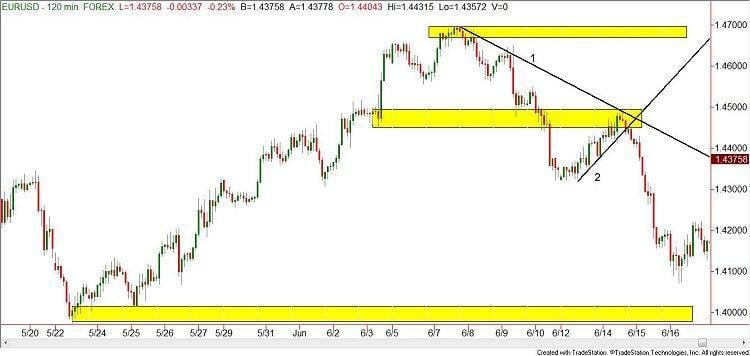
When you pull up to an intersection, very often we have a couple of choices to make be it to turn left, right, or go straight. In trading, our choices are buy, sell or wait. In the following EURUSD chart, we have an intersection of a previous demand/supply zone and a pair of trendlines. When we come to this intersection, what is the higher probability trade, long or short?
Chart

While we are in this yellow shaded supply and demand zone near the intersection of the two trendlines, we have a choice to make. Go left or right? Long or short? Or should we wait? When I teach one of our Online Trading Academy classes, this question comes up every trading day. If your answer to the buy sell or wait question is "wait," you have to ask yourself the next question. "Wait for what?" In this example, we are waiting to see which trendline is going to win at this intersection/decision point in our trading road. The general rule of thumb is that the trendline that has been valid the longest is the trendline that will win. Looking to the left on our supply demand zone area, there isn't a very compelling or high quality level we would have drawn here. Using the two trendlines and the intersection of all three can give us a trade. In this case, selling in the minor supply zone because of the longer term downward sloping trendline (#1) would have been the proper trade.

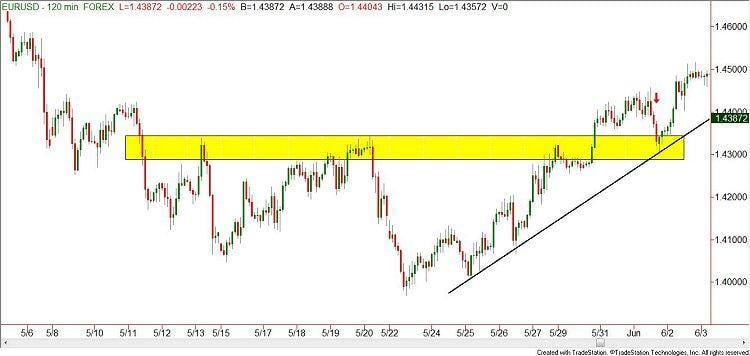
In the following EURUSD chart, we only have an intersection of a trendline and a supply demand zone. As the price action falls quickly into the yellow demand zone near the red arrow, there isn't really a clear downward trendline that we can draw into that zone.
However, the longer term upward sloping trendline is very obvious. Coming into this intersection, we only have two choices, buy or wait. (You could make the case for planning a short trade, but not until the yellow demand zone had been broken or even broken and then re-tested.) Why on earth would you sell IN the yellow demand zone? No reason at this intersection. If price drops through the demand zone, there would be a potential sell. But at this time, the better choice is to hit the buy button. If your answer to the question buy, sell or wait was to wait, what on earth are you waiting for? A traffic cop to point at you and tell you to go? I hope you don't need that!
Chart

Let's explore this topic a bit more. Leaving our driving analogies for a moment, what kind of trades are these - reversal or trend – following? Most people will answer trend - following. Guess what? Every trade is BOTH. On these two charts they are obvious trend followers, but when you zoom in on a smaller time frame –for example a 10 minute chart-you will notice very often a reversal trade.
What are we looking for in a reversal trade? Usually, some type of reversal pattern like a double top/bottom, head and shoulders, etc. The plan of action is then to do the following: In a larger time frame chart, look for an intersection of a trendline (or two!) and a supply demand zone. Look for a smaller time frame reversal pattern in the intersection. This should give you the direction to trade with a higher probability of being right.

Practice this technique like you practiced driving, and make sure you look both ways before turning!

Learn to Trade Now


This content is intended to provide educational information only. This information should not be construed as individual or customized legal, tax, financial or investment services. As each individual's situation is unique, a qualified professional should be consulted before making legal, tax, financial and investment decisions. The educational information provided in this article does not comprise any course or a part of any course that may be used as an educational credit for any certification purpose and will not prepare any User to be accredited for any licenses in any industry and will not prepare any User to get a job. Reproduced by permission from OTAcademy.com click here for Terms of Use: https://www.otacademy.com/about/terms

Editors’ Picks

EUR/USD edges higher to mid-1.1600s; looks to US PCE Price Index for fresh impetus

EUR/USD edges higher to mid-1.1600s; looks to US PCE Price Index for fresh impetus

The EUR/USD pair attracts some dip-buyers during the Asian session on Friday and recovers a part of the previous day's retracement slide from the 1.1680 region, or the highest level since October 17. Spot prices currently trade around mid-1.1600s and remain on track to register gains for the second straight week.

GBP/USD: Constructive view prevails above 1.3300 ahead of US PCE inflation data

GBP/USD: Constructive view prevails above 1.3300 ahead of US PCE inflation data

The GBP/USD pair trades on a flat note near 1.3330 during the Asian trading hours on Friday. Traders prefer to wait on the sidelines ahead of the key US inflation report later on Friday. The US delayed Personal Consumption Expenditures Price Index report for September could offer some hints about the US interest rate path.

USD/JPY stays pressured near 155.00 on Fed-BoJ policy divergence

USD/JPY stays pressured near 155.00 on Fed-BoJ policy divergence

USD/JPY remains weak near 155.00 in the Asian session on Friday. The pair faces headwinds from expectations of the Fed-BoJ monetary policy divergence, which outweighs the fall in Japanese Household Spending in October. All eyes are on the delayed US Personal Consumption Expenditures Price Index data for September later on Friday. 


Editors’ Picks

EUR/USD edges higher to mid-1.1600s; looks to US PCE Price Index for fresh impetus

EUR/USD edges higher to mid-1.1600s; looks to US PCE Price Index for fresh impetus

The EUR/USD pair attracts some dip-buyers during the Asian session on Friday and recovers a part of the previous day's retracement slide from the 1.1680 region, or the highest level since October 17. Spot prices currently trade around mid-1.1600s and remain on track to register gains for the second straight week.

GBP/USD: Constructive view prevails above 1.3300 ahead of US PCE inflation data

GBP/USD: Constructive view prevails above 1.3300 ahead of US PCE inflation data

The GBP/USD pair trades on a flat note near 1.3330 during the Asian trading hours on Friday. Traders prefer to wait on the sidelines ahead of the key US inflation report later on Friday. The US delayed Personal Consumption Expenditures Price Index report for September could offer some hints about the US interest rate path.

Gold edges higher amid dovish Fed expectations; traders await US PCE inflation data

Gold edges higher amid dovish Fed expectations; traders await US PCE inflation data

Gold struggles to capitalize on the overnight bounce from the $4,175 area, or the vicinity of the weekly trough, and oscillates in a narrow trading range during the Asian session on Friday. Traders now seem reluctant and opt to move to the sidelines ahead of the September Personal Consumption Expenditures Price Index, or the Federal Reserve's preferred inflation gauge. 

Pi Network: Bearish streak nears critical support trendline

Pi Network: Bearish streak nears critical support trendline

Pi Network edges lower on Friday for the third consecutive day, approaching a local support trendline. The on-chain data suggests an increase in supply pressure as Centralized Exchanges experience a surge in inflows. Technically, the pullback in PI risks further losses, as the Moving Average Convergence Divergence indicator is flashing a sell signal. 

Why the Fed may cut rates in December: Understanding the policy shift

Why the Fed may cut rates in December: Understanding the policy shift

The Fed has gone through a noticeable policy swing in recent months - from initiating a rate cut, to signaling a potential pause, and now shifting once again toward another cut in December. This has created understandable confusion among traders and investors trying to interpret the Fed’s reaction function.

RECOMMENDED LESSONS

5 Forex News Events You Need To Know

In the fast moving world of currency markets where huge moves can seemingly come from nowhere, it is extremely important for new traders to learn about the various economic indicators and forex news events and releases that shape the markets. Indeed, quickly getting a handle on which data to look out for, what it means, and how to trade it can see new traders quickly become far more profitable and sets up the road to long term success.

Top 10 Chart Patterns Every Trader Should Know

Chart patterns are one of the most effective trading tools for a trader. They are pure price-action, and form on the basis of underlying buying and selling pressure. Chart patterns have a proven track-record, and traders use them to identify continuation or reversal signals, to open positions and identify price targets.

7 Ways to Avoid Forex Scams

The forex industry is recently seeing more and more scams. Here are 7 ways to avoid losing your money in such scams: Forex scams are becoming frequent. Michael Greenberg reports on luxurious expenses, including a submarine bought from the money taken from forex traders. Here’s another report of a forex fraud. So, how can we avoid falling in such forex scams?

What Are the 10 Fatal Mistakes Traders Make

Trading is exciting. Trading is hard. Trading is extremely hard. Some say that it takes more than 10,000 hours to master. Others believe that trading is the way to quick riches. They might be both wrong. What is important to know that no matter how experienced you are, mistakes will be part of the trading process.

Strategy

Money Management

Psychology

Best Brokers of 2025