In “Inside Bars – Part One” last week we introduced this classic price pattern and discussed some basic uses of it, we now follow on from that piece by exploring some issues to take note of when trading the pattern as well as looking at a further way to trade the pattern…
Points To Consider
Key thing to remember, as with our breakout trading, is that the actual velocity of the breakout signal candle (the candle that closes outside of the Mother candle range) will vary and won’t always be trade-able, so some discretion is needed. If the breakout signal candle closes to far from the range perimeter then it compromises our risk:reward on the trade as price is less likely to run much further. I would much rather avoid a trades that appears less than favorable than take an unnecessary loser for fear of missing out. There is more than enough opportunity in the markets with chasing after sub-par trades so certainly bear that in mind.
Another way that we can look to maximize our chances of success is to look to trade with the trend. As you can see with the EURUSD example above, price was already moving lower before we established our inside bar setup and so with price moving in a downward trend, the highest probability trade would be a break down to the downside whereas if price was moving in a bullish trend and we got an inside bar setup, the highest probability outcome would be a breakout to the upside. Looking to capitalize on the direction of a prevailing trend is a recipe for long-term success and using a really simple yet solid setup such as the inside bar can be a fantastic way to catch entry points into fluid markets.
Trading The Fakeout
In part one we discussed one aspect of trading inside bars that needs to be carefully navigated for success and that was the Fake-out. We identified that if you simply look to trade a break of the Mother candle range without looking for a candle close then you leave yourself open to experience a fake-out whereby price actually reverses and trades back down into the range. However, once you start to become familiar with trading inside bars and understanding the market mechanics at play when they form then you can actually take advantage of the fakeout.
Where we see price trade through one side of the range to test order but reverse and trade back inside the range we can actually take a reversal trade in these circumstances anticipating a proper reversal.
How is this possible?
Remember the order flow dynamic we identified in part one. Order build up on either side of our trading range to keep price hemmed in. However, price starts to build momentum and trades through the range to test orders on a particular side but the momentum is not enough to break through these order and so price reverses. In these instances we can assume that the market has run out of steam and look to profit from the ensuing moves.
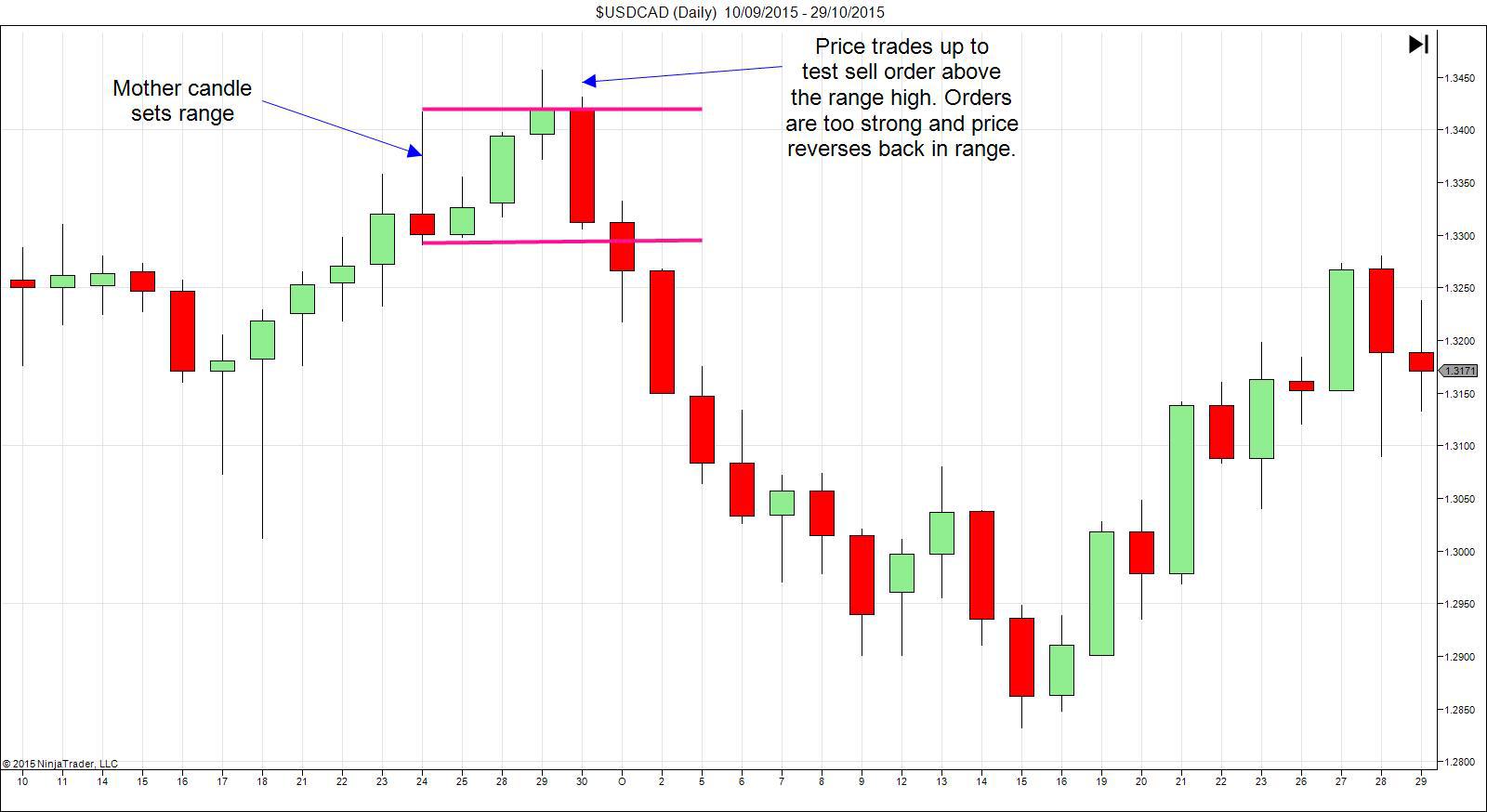
In the above example we can see we have a neat little range of inside bars formed. Price then runs up to pierce the high of the range and test sell orders sitting above the range. Sell order are too strong and buyers run out of steam so price reverses back into the range. We can sell price here anticipating that the weight of sell orders will indeed drive price lower. In these instances we can either target a move back to the other side of the range in a simple range-rotation play or we can hold and anticipate the materialisation of a full break-out through the opposite end of the range. Again as with our traditional inside bar trading, the more inside bars that form the better these trades tend to work out as the build up of orders tend to be much larger.
The beauty of using inside bars, whether trading a traditional breakout play or fading the fake-out is that it is an incredibly simplistic way to capitalise on underlying order flow and can work extremely well on all timeframes. For best results however, I suggest sticking to Daily, H4 & H1 setups as these tend to yield more solid results and where possible, look to trade in line with the overall market trend.
This market forecast is for general information only. It is not an investment advice or a solution to buy or sell securities.
Authors' opinions do not represent the ones of Orbex and its associates. Terms and Conditions and the Privacy Policy apply.
Trading foreign exchange on margin carries a high level of risk, and may not be suitable for all investors. Before deciding to trade foreign exchange, you should carefully consider your investment objectives, level of experience, and risk appetite. There is a possibility that you may sustain a loss of some or all of your investment and therefore you should not invest money that you cannot afford to lose. You should be aware of all the risks associated with foreign exchange trading, and seek advice from an independent financial advisor if you have any doubts.
Editors’ Picks
EUR/USD: US Dollar to remain pressured until uncertainty fog dissipates Premium
The EUR/USD pair lost additional ground in the first week of February, settling at around 1.1820. The reversal lost momentum after the pair peaked at 1.2082 in January, its highest since mid-2021.
Gold: Volatility persists in commodity space Premium
After losing more than 8% to end the previous week, Gold (XAU/USD) remained under heavy selling pressure on Monday and dropped toward $4,400. Although XAU/USD staged a decisive rebound afterward, it failed to stabilize above $5,000.
GBP/USD: Pound Sterling tests key support ahead of a big week Premium
The Pound Sterling (GBP) changed course against the US Dollar (USD), with GBP/USD giving up nearly 200 pips in a dramatic correction.
Bitcoin: The worst may be behind us
Bitcoin (BTC) price recovers slightly, trading at $65,000 at the time of writing on Friday, after reaching a low of $60,000 during the early Asian trading session. The Crypto King remained under pressure so far this week, posting three consecutive weeks of losses exceeding 30%.
Three scenarios for Japanese Yen ahead of snap election Premium
The latest polls point to a dominant win for the ruling bloc at the upcoming Japanese snap election. The larger Sanae Takaichi’s mandate, the more investors fear faster implementation of tax cuts and spending plans.
RECOMMENDED LESSONS
Making money in forex is easy if you know how the bankers trade!
I’m often mystified in my educational forex articles why so many traders struggle to make consistent money out of forex trading. The answer has more to do with what they don’t know than what they do know. After working in investment banks for 20 years many of which were as a Chief trader its second knowledge how to extract cash out of the market.
5 Forex News Events You Need To Know
In the fast moving world of currency markets where huge moves can seemingly come from nowhere, it is extremely important for new traders to learn about the various economic indicators and forex news events and releases that shape the markets. Indeed, quickly getting a handle on which data to look out for, what it means, and how to trade it can see new traders quickly become far more profitable and sets up the road to long term success.
Top 10 Chart Patterns Every Trader Should Know
Chart patterns are one of the most effective trading tools for a trader. They are pure price-action, and form on the basis of underlying buying and selling pressure. Chart patterns have a proven track-record, and traders use them to identify continuation or reversal signals, to open positions and identify price targets.
7 Ways to Avoid Forex Scams
The forex industry is recently seeing more and more scams. Here are 7 ways to avoid losing your money in such scams: Forex scams are becoming frequent. Michael Greenberg reports on luxurious expenses, including a submarine bought from the money taken from forex traders. Here’s another report of a forex fraud. So, how can we avoid falling in such forex scams?
What Are the 10 Fatal Mistakes Traders Make
Trading is exciting. Trading is hard. Trading is extremely hard. Some say that it takes more than 10,000 hours to master. Others believe that trading is the way to quick riches. They might be both wrong. What is important to know that no matter how experienced you are, mistakes will be part of the trading process.
The challenge: Timing the market and trader psychology
Successful trading often comes down to timing – entering and exiting trades at the right moments. Yet timing the market is notoriously difficult, largely because human psychology can derail even the best plans. Two powerful emotions in particular – fear and greed – tend to drive trading decisions off course.