Gold Weekly Forecast: Volatility to remain high as focus shifts to key US data
- Gold fluctuated in a wide range after starting the week under heavy pressure.
- CME raised margins on precious metals amid heightened volatility.
- US inflation and employment data could trigger a big reaction in Gold prices.

After losing more than 8% to end the previous week, Gold (XAU/USD) remained under heavy selling pressure on Monday and dropped toward $4,400. Although XAU/USD staged a decisive rebound afterward, it failed to stabilize above $5,000. The US economic calendar will feature Nonfarm Payrolls (NFP) and Consumer Price Index (CPI) data for January, which could influence the market pricing of the Federal Reserve’s (Fed) policy outlook and impact Gold’s performance.
Gold recovers following intense selloff
The commodity selloff triggered by US President Donald Trump’s announcement last Friday that he nominated Kevin Warsh, who served as a Federal Reserve Governor from 2006 to 2011, as the new chair of the Fed, continued at the beginning of the week. Gold touched its lowest level since early January near $4,400 early Monday before erasing a portion of its daily losses in the second half of the day.
Late Monday, the US Bureau of Labor Statistics (BLS) announced it would not release data due to the partial government shutdown. “The Job Openings and Labor Turnover Survey release for December 2025, Metropolitan Area Employment and Unemployment release for December 2025, and the Employment Situation release for January 2026 will be rescheduled upon the resumption of government funding,” Emily Liddel, associate commissioner for the BLS’ Office of Publications and Special Studies, explained. The US Dollar (USD) came under bearish pressure and helped XAU/USD gather bullish momentum. Additionally, dip-buying might have provided an additional boost to Gold, which rose more than 6% on a daily basis.
As the US House passed a package late Tuesday to end the partial government shutdown, Gold’s recovery lost momentum midweek. Meanwhile, the USD benefited from the poor performance of equity indexes and capped XAU/USD’s upside, despite mixed data releases. The Automatic Data Processing (ADP) reported that employment in the private sector rose 22K in January, missing the market expectation of 48K. On a positive note, the Institute for Supply Management's (ISM) Services Purchasing Managers' Index (PMI) held steady at 53.8, reflecting an ongoing expansion in the service sector's business activity at a healthy pace.
On Thursday, the USD continued to gather strength as the selloff in stock markets continued. Furthermore, the Bank of England’s (BoE) dovish tone and the European Central Bank’s (ECB) neutral stance helped the USD capture capital outflows out of Pound Sterling (GBP) and the Euro (EUR). The BoE maintained the bank rate at 3.75%, as expected, but four members of the Monetary Policy Committee voted for a rate cut. Meanwhile, ECB President Christine Lagarde reiterated that they don’t have an exchange rate target for the EUR, but acknowledged that a stronger EUR could bring inflation down more than expected.
After falling nearly 4% and retracing a large portion of its weekly rebound on Thursday, Gold regained its traction on Friday. The CME Group, once again, hiked margin requirements for Gold and Silver futures contracts late Thursday, helping prices rebound.
Gold traders await key US data
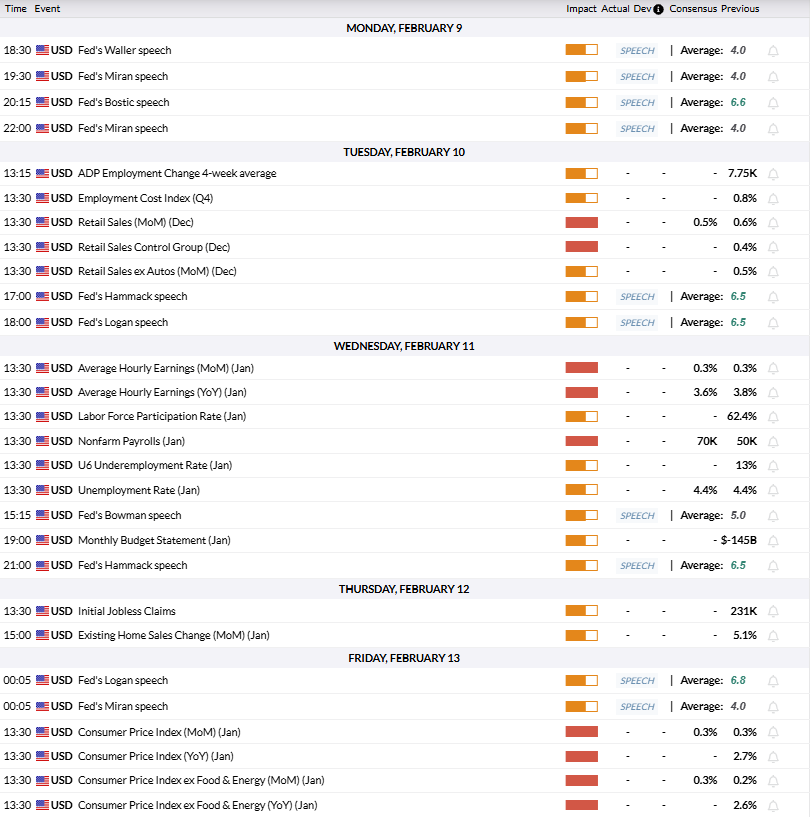
The US Bureau of Labor Statistics (BLS) will publish the January employment report on Wednesday. Investors expect Nonfarm Payrolls to rise 70K following the 50K increase recorded in December, and see the Unemployment Rate holding steady at 4.4%.
The CME FedWatch Tool shows that markets are pricing in about a 23% probability of a 25 basis points (bps) Fed rate cut in March. A significant negative surprise in the NFP print, at or below 25K, combined with an uptick in the Unemployment Rate, could cause markets to lean toward a Fed rate cut next month. In this scenario, Gold could push higher with the immediate reaction. Conversely, a better-than-forecast NFP print could support the USD and make it difficult for XAU/USD to keep its footing.
On Friday, the Consumer Price Index (CPI) data for January will be watched by investors. On a monthly basis, the core CPI is projected to rise 0.3%. The market reaction to the core inflation data is likely to be straightforward and remain short-lived, with a core CPI print of 0.4% or higher, boosting the USD and weighing on XAU/USD and vice versa.
In the meantime, market participants will pay close attention to the action in the commodity space as a whole. On Thursday, Silver (XAG/USD) lost nearly 20% on a daily basis, possibly intensifying the selling pressure on Gold. Even if the macroeconomic environment hints at a weaker USD, Gold could struggle to attract buyers unless volatility dissipates and commodities quiet down.
BNY’s Head of Markets Macro Strategy Bob Savage highlights the significant outflows, nearly $1 billion, from China’s Gold ETFs as a sign of how shaky the precious metal’s footing is despite the noteworthy rebound seen in price.
"The abrupt reversal followed Gold’s pullback from an all-time high and its steepest single-day decline since 2013 during Asian trading on Friday, validating concerns that the rally had become overstretched,” Savage explains, and adds: "Although bullion recovered more than 6% on Tuesday as dip buyers returned, the scale of ETF outflows highlights how fragile sentiment remains."
Finally, the outcome of the US-Iran talks and the general election in Japan could drive Gold prices at the weekly opening. If markets remain concerned about a US-Iran direct conflict, Gold could find demand as a safe haven. While the general election in Japan is unlikely to have a direct impact on Gold price, a significant weakening in the Japanese Yen (JPY) could trigger an intervention from the Bank of Japan (BoJ) and cause the USD to come under a flash selling pressure, allowing XAU/USD to push higher.
Gold technical analysis
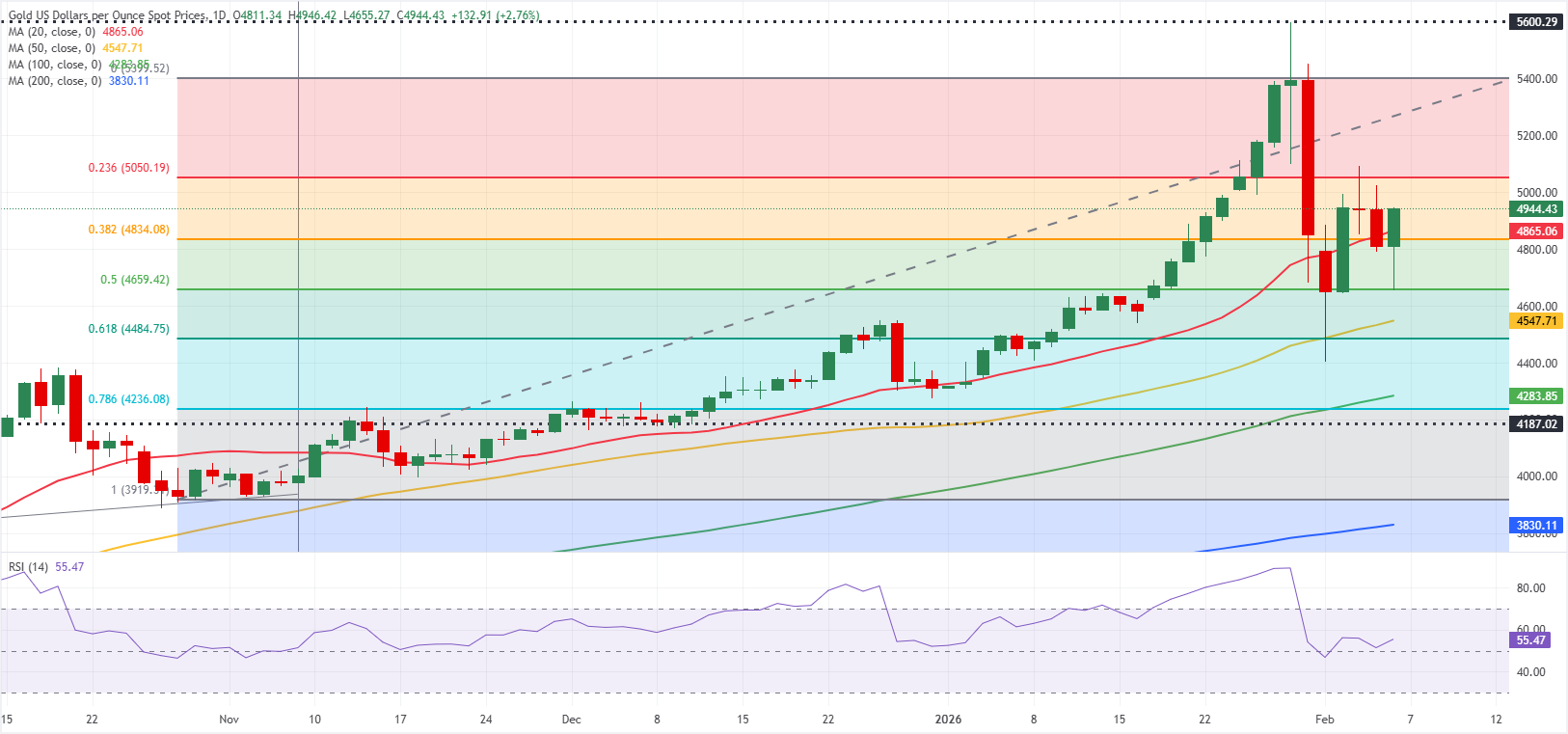
The Relative Strength Index on the daily chart seems to have stabilized above 50, reflecting a lack of bearish pressure in the near term. Additionally, Gold recovered above the 20-day Simple Moving Average (SMA) after closing below this level on Thursday.
On the upside, $5,000 (round level, psychological level) aligns as the first resistance level before $5,050 (Fibonacci 23.6% retracement of the November-February uptrend), $5,200 (static level) and $5,400 (static level, end-point of the uptrend).
Looking south, the first support level could be spotted at $4,830 (Fibonacci 38.2% retracement) before $4,660 (Fibonacci 50% retracement) and $4,550 (50-day SMA).
Gold FAQs
Gold has played a key role in human’s history as it has been widely used as a store of value and medium of exchange. Currently, apart from its shine and usage for jewelry, the precious metal is widely seen as a safe-haven asset, meaning that it is considered a good investment during turbulent times. Gold is also widely seen as a hedge against inflation and against depreciating currencies as it doesn’t rely on any specific issuer or government.
Central banks are the biggest Gold holders. In their aim to support their currencies in turbulent times, central banks tend to diversify their reserves and buy Gold to improve the perceived strength of the economy and the currency. High Gold reserves can be a source of trust for a country’s solvency. Central banks added 1,136 tonnes of Gold worth around $70 billion to their reserves in 2022, according to data from the World Gold Council. This is the highest yearly purchase since records began. Central banks from emerging economies such as China, India and Turkey are quickly increasing their Gold reserves.
Gold has an inverse correlation with the US Dollar and US Treasuries, which are both major reserve and safe-haven assets. When the Dollar depreciates, Gold tends to rise, enabling investors and central banks to diversify their assets in turbulent times. Gold is also inversely correlated with risk assets. A rally in the stock market tends to weaken Gold price, while sell-offs in riskier markets tend to favor the precious metal.
The price can move due to a wide range of factors. Geopolitical instability or fears of a deep recession can quickly make Gold price escalate due to its safe-haven status. As a yield-less asset, Gold tends to rise with lower interest rates, while higher cost of money usually weighs down on the yellow metal. Still, most moves depend on how the US Dollar (USD) behaves as the asset is priced in dollars (XAU/USD). A strong Dollar tends to keep the price of Gold controlled, whereas a weaker Dollar is likely to push Gold prices up.
Author

Eren Sengezer
FXStreet
As an economist at heart, Eren Sengezer specializes in the assessment of the short-term and long-term impacts of macroeconomic data, central bank policies and political developments on financial assets.

















