If you can spot a trend reversal you will become a very successful margin trader. That’s what’s it all about.
Let’s begin with what a reversal is. This is the point when the trend changes. You can see a price of Bitcoin, gold, or a currency pair going up with some smaller corrections. Until each local high and low is higher than the previous high and low, we are dealing with an uptrend.
The same is true the other way around. The price of an asset goes down you can see the trend if the local ups and downs are lower than the previous ones. The local rallies (increases in the price) are called retracements. You can also use them to enter the market at a better price.
You can imagine why making the difference between a retracement and a trend reversal is a key part of a successful trade. If you time it right, you will be able to make great gains.
On the other hand, if you notice a reversal and have an opposite position open, you want to close it as soon as possible. So identifying the trend reversal also helps you avoid a potential loss.
A pin bar is a common reversal pattern. It’s easy to spot and many margin traders find it very useful. You can spot the pin bar pattern using the Japanese candlestick chart view.
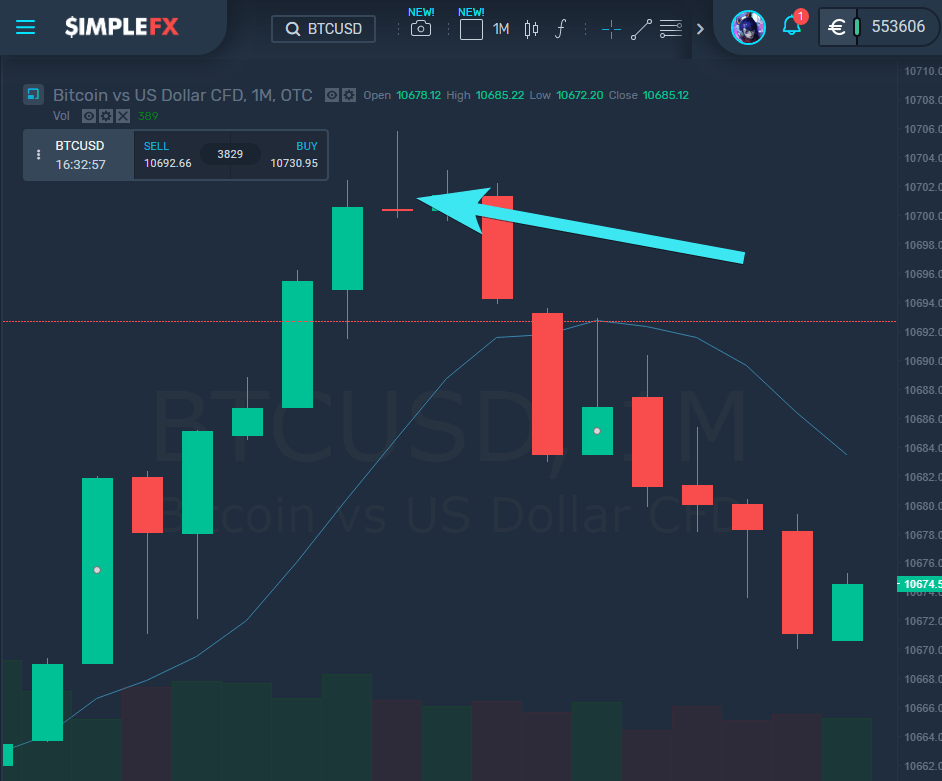
Above you can see an example of a red bearish pin bar that may signal a reversal from uptrend to downtrend.
The pin bar as a long wick and a short body. In the case of this red pin bar, the shape indicates that the price went up for a while, but then all the way down to the level indicated by the bottom of the candle’s body.
Here are some characteristics of a pin bar pattern to more likely signal a trend change:
-
Its wick has to be longer than the body
-
Its wick has to be longer than the wicks of previous candlesticks
-
Its body has to be on one side of the wicks
-
Its body has to be enclosed in the previous candlestick body.
You can also confirm the pattern with some other indicators, such as support and resistance or trend lines. You can also combine it with a moving average indicator.
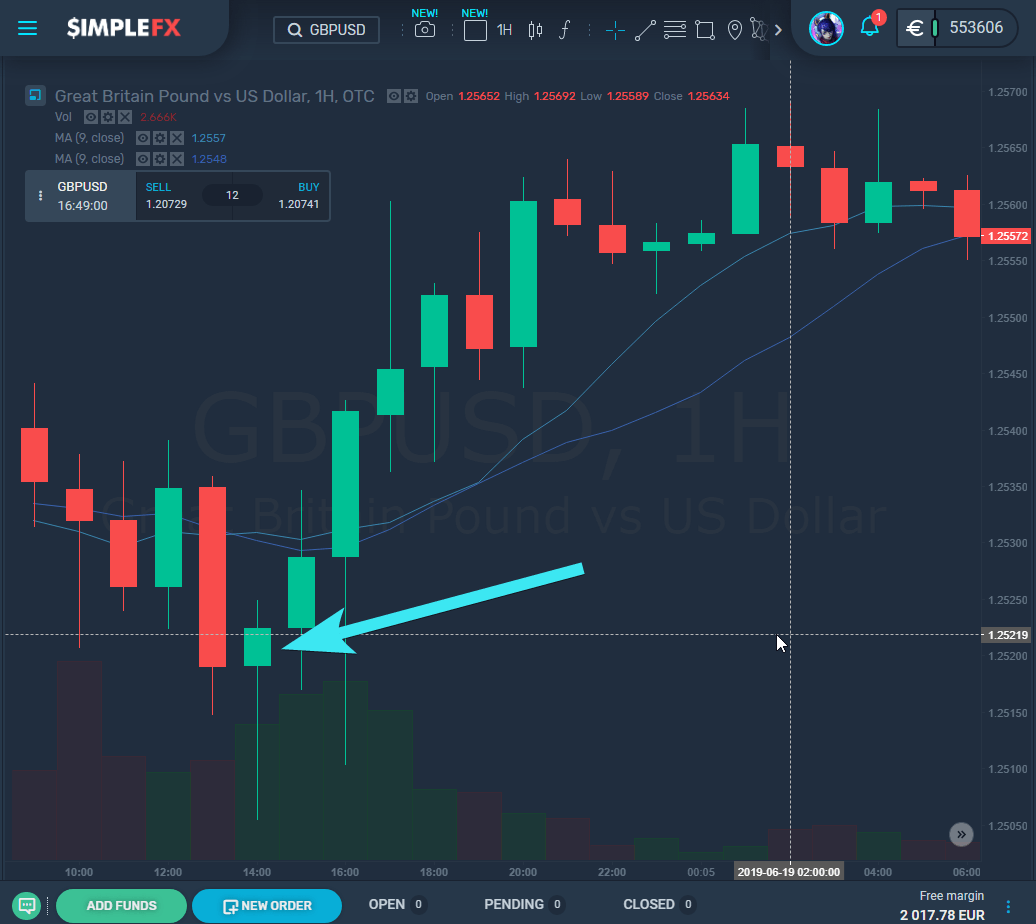
Now, let’s discuss when to make an entry then seeing a pin bar pattern. In the one-hour GBPUSD chart above you can see an example of a bullish green pin bar that signaled a reversal from a downtrend to an uptrend.
You can safely make the order at the close of the period (which is the upper edge of the body since it’s a green candlestick). This will hedge your position against the scenario when the pattern doesn’t work.
You can also consider trading at the tip of the nose (the upper wick) of such a bullish pin bar. You may also try trading at the break of the nose.
All these strategies have their trade-offs. The lower you try to buy the upward reversal, the higher the profit you may get, but then take more risks if the signal proves to be false.
You should also adjust your stop-loss points accordingly. If you put them too tight, you may be stopped out from your position even if you identify the trend swift correctly.
Remember, you should avoid entering too early or too late as you can lose the profit.
Use trading reversals to improve your strategy.
Trading in the products and services of SimpleFX may result in losses as well as profits. In particular trading in leveraged products, such as but not limited to, cryptocurrency, foreign exchange, derivatives and commodities can be very speculative. Losses and profits may fluctuate both violently and rapidly.
Editors’ Picks
EUR/USD: Yes, the US economy is resilient – No, that won’t save the US Dollar Premium
Some impressive US data should have resulted in a much stronger USD. Well, it didn’t happen. The EUR/USD pair closed a third consecutive week little changed, a handful of pips above the 1.1800 mark.
Gold: Metals remain vulnerable to broad market mood Premium
Gold (XAU/USD) started the week on a bullish note and climbed above $5,000 before declining sharply and erasing its weekly gains on Thursday, only to recover heading into the weekend.
GBP/USD: Pound Sterling remains below 1.3700 ahead of UK inflation test Premium
The Pound Sterling (GBP) failed to resist at higher levels against the US Dollar (USD), but buyers held their ground amid a US data-busy blockbuster week.
Bitcoin: BTC bears aren’t done yet
Bitcoin (BTC) price slips below $67,000 at the time of writing on Friday, remaining under pressure and extending losses of nearly 5% so far this week.
US Dollar: Big in Japan Premium
The US Dollar (USD) resumed its yearly downtrend this week, slipping back to two-week troughs just to bounce back a tad in the second half of the week.
RECOMMENDED LESSONS
Making money in forex is easy if you know how the bankers trade!
I’m often mystified in my educational forex articles why so many traders struggle to make consistent money out of forex trading. The answer has more to do with what they don’t know than what they do know. After working in investment banks for 20 years many of which were as a Chief trader its second knowledge how to extract cash out of the market.
5 Forex News Events You Need To Know
In the fast moving world of currency markets where huge moves can seemingly come from nowhere, it is extremely important for new traders to learn about the various economic indicators and forex news events and releases that shape the markets. Indeed, quickly getting a handle on which data to look out for, what it means, and how to trade it can see new traders quickly become far more profitable and sets up the road to long term success.
Top 10 Chart Patterns Every Trader Should Know
Chart patterns are one of the most effective trading tools for a trader. They are pure price-action, and form on the basis of underlying buying and selling pressure. Chart patterns have a proven track-record, and traders use them to identify continuation or reversal signals, to open positions and identify price targets.
7 Ways to Avoid Forex Scams
The forex industry is recently seeing more and more scams. Here are 7 ways to avoid losing your money in such scams: Forex scams are becoming frequent. Michael Greenberg reports on luxurious expenses, including a submarine bought from the money taken from forex traders. Here’s another report of a forex fraud. So, how can we avoid falling in such forex scams?
What Are the 10 Fatal Mistakes Traders Make
Trading is exciting. Trading is hard. Trading is extremely hard. Some say that it takes more than 10,000 hours to master. Others believe that trading is the way to quick riches. They might be both wrong. What is important to know that no matter how experienced you are, mistakes will be part of the trading process.
The challenge: Timing the market and trader psychology
Successful trading often comes down to timing – entering and exiting trades at the right moments. Yet timing the market is notoriously difficult, largely because human psychology can derail even the best plans. Two powerful emotions in particular – fear and greed – tend to drive trading decisions off course.