Forex vs Other markets: What is better for you?

Traders often ask - what’s the difference between Forex and other markets?
All people search for a better place to do business, and they question themselves - what if somewhere money is made easier? There are plenty of markets available for a trader today - Stock and bond market, futures and options, CFDs. Thousands of instruments are traded on a daily basis in financial markets. So, what’s the difference?
We would disappoint seekers of “easy” markets. There is nothing really easy in trading. Each market requires knowledge and experience, as well as discipline. Below we’ve made an overview for your convenience so that you could grasp differences between Forex and other markets.
Enjoy the read!
Forex vs Stock market
First, let’s compare Forex and Stock market. Almost every country has the stock market - it is a place where shares of companies are traded. You can find one in Thailand, Russia, Australia, but the largest stock market, is, of course, the New York Stock Exchange from the United States. Let’s outline major differences between Stock and Forex markets.
Liquidity
Forex is way more liquid than stock market - currencies are always in demand, unlike for many stocks, which sometimes are “thinly” traded (with limited supply/demand, gaps).
Large companies from the S&P500 index, like Apple, are very liquid. Yet, opportunities on very liquid, large-cap stocks might be limited.
Gaps
Currencies historically are more stable - gaps occur rarely on Forex charts, excluding sudden decisions from Central Banks or extraordinary political events. The situation is different for the stock market.
Prices of individual stocks are influenced by many factors from earnings reports to rumors.
Take a look at a chart of Alphabet (ex. Google, symbol: GOOG). Even though this company is one the largest in S&P500 index, we observe relatively large gaps, which sometimes exceed 10%. If you trade large volume at that time, you would be exposed to unexpected losses.

Trends
That’s true - stock market may generate more notable trends than any of the currencies.
Stability of currencies has a flip side - Forex prices change less than prices of individual stocks.
It doesn’t mean that Forex trader has limited opportunities in comparison to a stock trader. The leverage provided by the Forex broker can help achieve good results. For long-term investor who trades with no leverage, the stock market may be more interesting.
Long-term investing
Imagine that you are long-term investor which is ready to hold the position for years, employing the passive strategy. Historically, you would be right investing in Dow Jones and S&P500 index.
Below you see all time historical chart of Dow Jones stock index. It is growing, yet not without massive sell-offs and drawdowns.
Sometimes, you would need years, even decades to wait for the price to rebound and resume moving in the direction of a trend. But, passive long-term investors accumulate profit just following stock index. Not very much, not very quickly, but they do.
There is, however, one nuance. The situation is fair for US Stock market only. For other countries, it works differently. For example, the SET index of Thailand shows different dynamics than Dow Jones or S&P500. It is mostly sideways. The same is for the majority of other indexes.
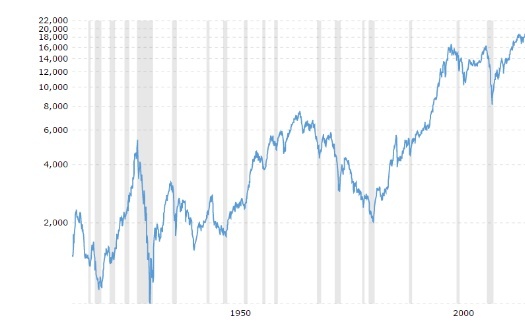
Historical performance of Dow Jones stock index
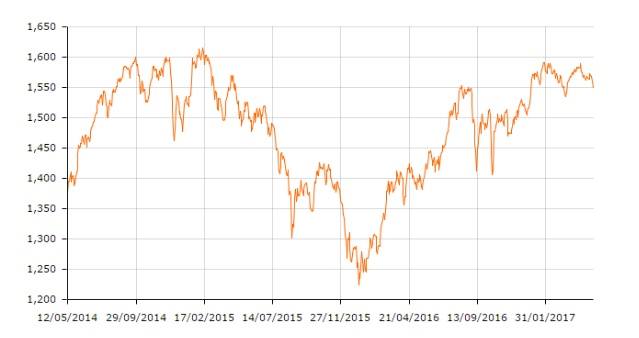
Performance of SET stock index (Thailand)
Leverage
Forex market allows a retail trader to employ leverage given by the Forex broker. Stockbrokers - those who provide real access to the stock market (not CFDs), can also give limited leverage to a trader, but mostly, only for day trading, and rarely more than 10:1. They also usually collect fees for that.
In the stock trading industry, there are proprietary trading firms which provide capital to traders, since trading with limited capital is barely possible on the stock market, at least for liquid stocks. Note that quote of Alphabet (GOOG) for the moment of writing this article is equal to $930 per share. How much capital would you need to trade GOOG or similar expensive stocks?
Many stock traders prefer to trade small cap, cheaper stocks. They produce larger gaps, less liquidity, and more risk for a trader.
On the contrary, Forex traders can start with almost any size of the capital.
Forex vs Commodities
Today, traders can also speculate on commodity markets, which are available on Chicago Mercantile Exchange - one the world’s oldest marketplaces. Commodities are traded via futures or options - derivative contracts.
Futures or options are leveraged products by definition - you don’t have to pay the full cost of a contract to speculate. Usually, you can employ around 10:1 leverage and even more for day trading. Leverage is the common feature between Forex and futures markets.
Available instruments
Futures markets are liquid enough for retail trader. The most popular trading instruments are E-mini S&P500, Crude oil, Euro, Gold. They acquire much non-professional liquidity - many retail speculators are participating it on a daily basis.
What about other trading instruments?
Thinly traded markets
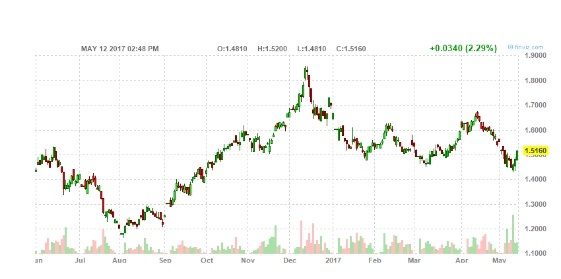
There are also grain futures (wheat, corn, soymeal e t.c.) and softs (cocoa, orange juice, green lumber e t.c.) Not all instruments are liquid enough - softs and grains make notable gaps from time to time.
Take a look at the chart of Ethanol futures (ZK) below. This contract is thinly traded, as well as other contracts of the kind (Canola, Lumber e t.c.). Speculating commodity markets requires much experience and understanding of underlying supply and demand from a trader.
At first sight, futures markets offer many ideas to trade, but for short-term traders range of liquid markets is quite narrow. Many CFD and Forex brokers now provide an opportunity to trade Gold and Crude Oil.
Margin requirements
One needs to have at least several thousand dollars to start trading futures and/or options. The margin requirement for holding the position of one contract overnight varies from $500 (E-micro S&P500 future) to $25000 (DAX index future). The contract is the basic trading unit in the future market and it can’t be split. For instance, you can’t trade futures with 0.1 lot.
The less capital you have, the fewer opportunities you have access to. Many traders narrow their focus to cheapest and affordable contracts like E-mini S&P500 futures and similar.
Forex traders have more flexibility when it comes to opening real money trading account and practicing. Ability to trade 0.1 or even 0.01 lot allows to put less capital at risk and mitigate downside.
Source of useful statistics
While not too many Forex traders are eager to transition to future markets due to reasons listed above, many of them are still using statistical data from the Chicago Mercantile Exchange.
Apart from the stock index and commodity futures, there are currency futures, which are liquid enough. Big market participants use them to hedge their spot positions, and if you have enough skill, you can analyze their footsteps.
Every day Chicago Mercantile Exchange publishes Daily Bulletin with complete information concerning volume and open interest for all tradable contracts. You can find it here.
Also, you can analyze so-called COT-reports, which are published on a weekly basis by the Commodity Futures Trading Commission. They provide more sophisticated information, yet some professional Forex traders use it for decision making.
Bottom line:
Retail speculators all over the world today have access to various markets and marketplaces. The most popular are stock and commodity (futures) markets. They are traded on centralized exchanges, while Forex market is decentralized.
Long-term investors historically gravitate to the stock market, while short-term traders mostly trade on Forex or futures/options markets.
Forex is more flexible for those traders, who have limited trading capital and want to grow it from trading. Statistics from futures markets can be used by Forex traders for the decision-making process.
There are no ”easy” markets. Each market requires knowledge, experience, discipline and financial resources from a trader.
Author

Stanislav Bernuhov
Common Sense Trading
I'm an individual trader since 2004 and a trading coach since 2010.