Binary Options Trading Strategy
How To Trade Binary Options:
In this article, I want to show you a simple binary options trading strategy.
In the previous article, I’ve shown you how binary options work.
If you haven’t read that article yet, please do this first so that you know the basics before we actually start trading binary options.
Because in this article, I will show you:
- How to configure your charts
- How to find the right market to trade
- How to find the best expiration to trade and…
- As promised: A Binary Options Trading Strategy
So let’s get started…
How To Configure Your Charts For Trading Binary Options
In the previous article, we talked about all the markets that you can trade:
- Indices like the S&P 500, DOW Jones, Nasdaq, etc.
- Currencies like EUR/USD, USD/JPY. AUD/USD, etc
- … and you can trade commodities like Gold, Silver ad Crude Oil as well.
And as you know, Binary Options can expire…
- in 5 min,
- in 20 min,
- hourly,
- at the end of the day
- … etc.
For this very simple trading strategy, I want to know which Binary Options expire in the next 20 min, so I’m selecting this here:
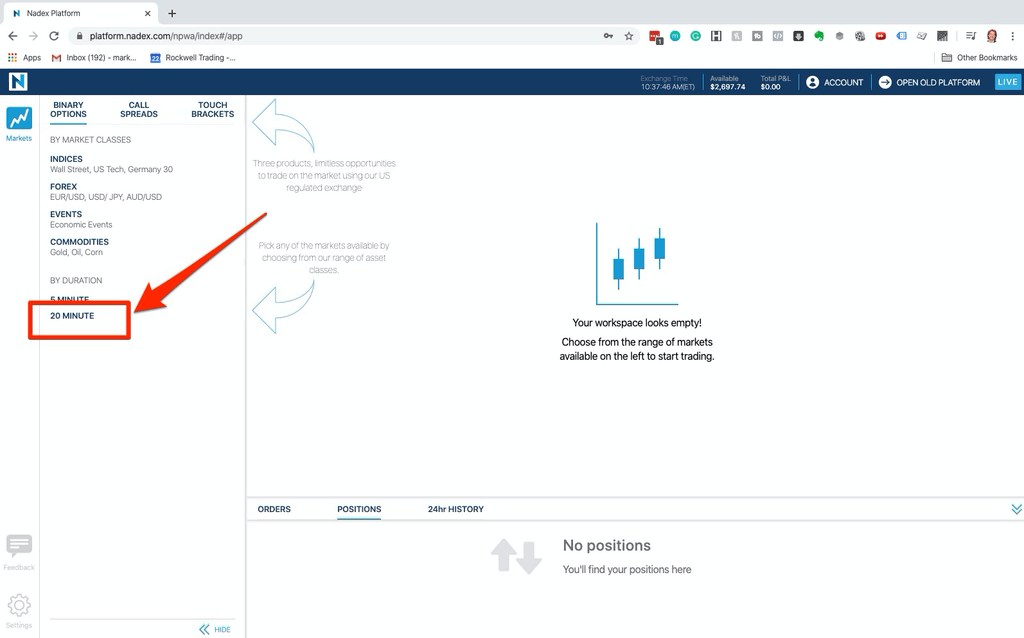
Right now, we see that only the indices are expiring in the next 20 min.
Depending on the time of day, you might also see currencies and commodities here.
But let’s get started with the indices:
- Simply click on one of the indices, e.g. US 500
- And then select any strike price.
This will bring up the chart and an order ticket. For now, we only need the chart.
This is what it looks like:
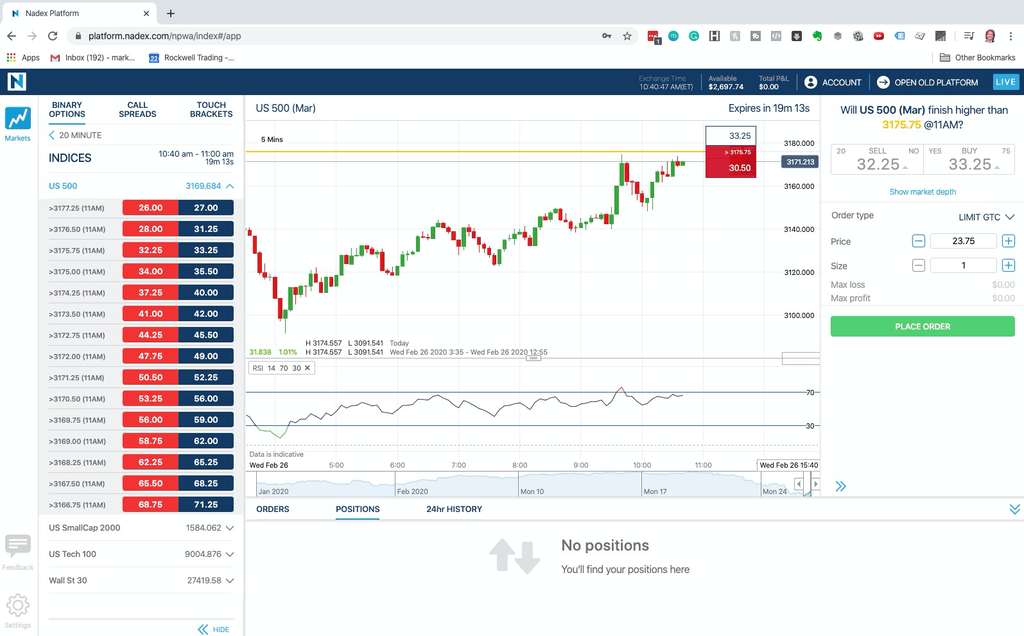
For this simple Binary Options trading strategy, I want to remove the RSI, and I want to add the Bollinger Bands as well as the Bollinger Bandwidth.
And I am changing the settings of these 2 indicators to 12 and 2:
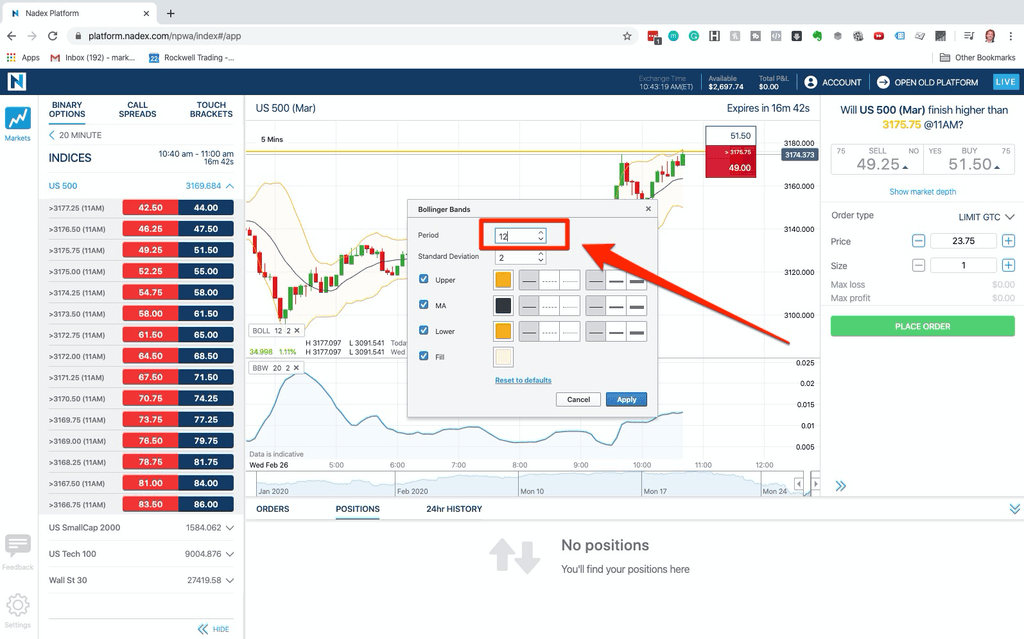
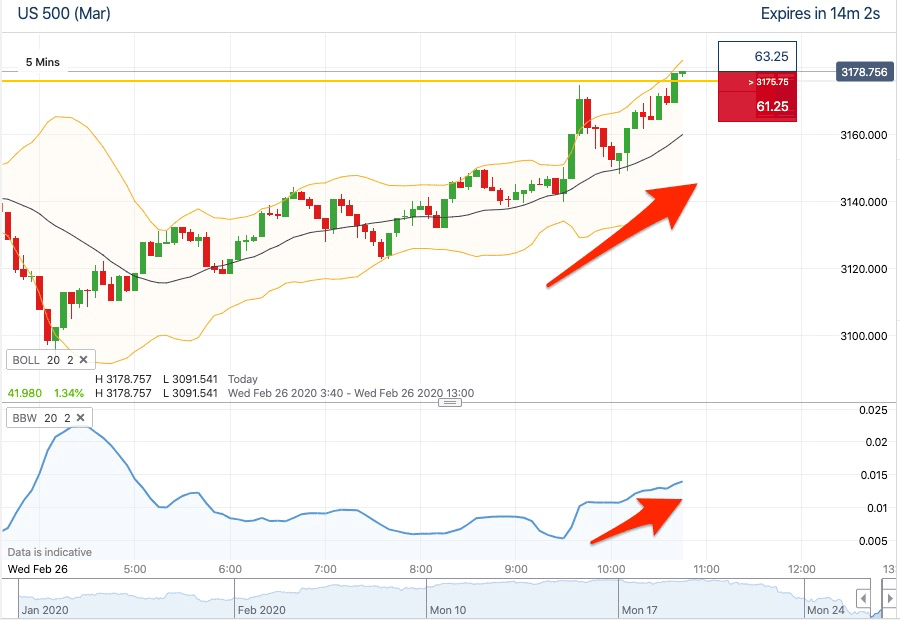
Here’s what I’ve found when using Bollinger Bands:
- If prices are moving higher and the Bollinger Bandwidth gets larger, prices usually stay ABOVE the Moving Average.
- And if prices are moving lower and the Bollinger Bandwidth gets larger, prices usually stay BELOW the Moving Average.
A Simple Binary Options Trading Strategy
Here’s how I use this for trading Binary Options:
- When I see prices moving HIGHER and the Bollinger Bandwidth gets larger, I BUY a binary option with a strike price at the Moving Average
- When I see prices moving LOWER and the Bollinger Bandwidth gets larger, I SELL a binary option with a strike price at the Moving Average
I like to use LIMIT orders and I want to see at least $10 in profits.
$10 might not sound a lot, but if you can do this every 15-20 minutes, it adds up.
And you could always buy more contracts:
If you would buy 10 contracts, you would make $100.
Keep in mind that there’s always the risk of losing money!
But you already know that, right?
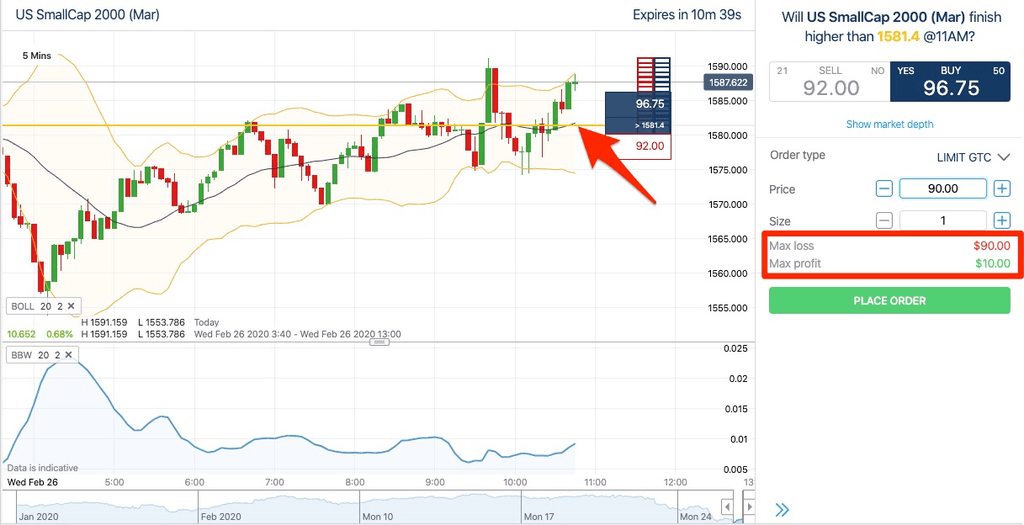
After placing the order, all you need to do it wait until expiration.
In this example:
- If prices close above 1581.4 in the next 6 min, you would make $10.
- And if prices close below 1581.4 in the next 6 min, you would lose $90.
If you need a refresher on how exactly Binary Options work, read the previous article.
Can Binary Options Make You Rich?
What you have just seen is a very simple strategy for trading Binary Options.
And there are a few restrictions when trading this strategy:
- You have to be in front of your computer during the day when the markets are open. And not everybody has time to do that.
- You have to wait for the right setup that I just explained.
- The strategy has a low risk/reward ratio.
I personally use a more advanced trading strategy for Binary Options that allows you to place the trades at night so that you don’t have to worry about it during the day.
I’ll show you this strategy in the next article.
Trading Futures, options on futures and retail off-exchange foreign currency transactions involves substantial risk of loss and is not suitable for all investors. You should carefully consider whether trading is suitable for you in light of your circumstances, knowledge, and financial resources. You may lose all or more of your initial investment. The lower the day trade margin, the higher the leverage and riskier the trade. Leverage can work for you as well as against you; it magnifies gains as well as losses. Past performance is not necessarily indicative of future results.
Editors’ Picks
EUR/USD runs past 1.1730 after tepid US macroeconomic figures
EUR/USD extends its gains and trades above 1.1730 in the American session on Thursday. The US Dollar resumed its decline, following much weaker-than-expected Initial Jobless Claims. Market players bet for additional rate cuts despite a mildly hawkish Fed.
GBP/USD ticks north beyond 1.3400 after US employment data
GBP/USD ticks beyond 1.3400 in the American session on Thursday, as the US Dollar is back on the losing side, following worse-than-anticipated US employment-related figures. The US Federal Reserve delivered a rate cut at its December meeting, in line with the market’s expectations.
Gold on its way to retest record highs
Broad US Dollar weakness helps the bright metal to extend weekly gains. The XAU/USD pair trades above $4,250, its highest for the week and not far from its record high in the $4,380 region. The Greenback came under selling pressure on Wednesday following the Federal Reserve's monetary policy announcement, further pressured on Thursday by softer-than-anticipated United States employment data.
Solana dips as hawkish Fed cuts dampen market sentiment
Solana price is trading below $130 on Thursday, after being rejected at the upper boundary of its falling wedge pattern. The broader market weakness following the Federal Reserve’s hawkish rate cut has added to downside momentum.
FOMC Summary: A split cut and a clear shift toward caution
The Federal Reserve (Fed) went ahead with a 25 basis points rate cut, taking the target range to 3.50–3.75%. But the tone around the decision mattered just as much as the move.
RECOMMENDED LESSONS
Making money in forex is easy if you know how the bankers trade!
I’m often mystified in my educational forex articles why so many traders struggle to make consistent money out of forex trading. The answer has more to do with what they don’t know than what they do know. After working in investment banks for 20 years many of which were as a Chief trader its second knowledge how to extract cash out of the market.
5 Forex News Events You Need To Know
In the fast moving world of currency markets where huge moves can seemingly come from nowhere, it is extremely important for new traders to learn about the various economic indicators and forex news events and releases that shape the markets. Indeed, quickly getting a handle on which data to look out for, what it means, and how to trade it can see new traders quickly become far more profitable and sets up the road to long term success.
Top 10 Chart Patterns Every Trader Should Know
Chart patterns are one of the most effective trading tools for a trader. They are pure price-action, and form on the basis of underlying buying and selling pressure. Chart patterns have a proven track-record, and traders use them to identify continuation or reversal signals, to open positions and identify price targets.
7 Ways to Avoid Forex Scams
The forex industry is recently seeing more and more scams. Here are 7 ways to avoid losing your money in such scams: Forex scams are becoming frequent. Michael Greenberg reports on luxurious expenses, including a submarine bought from the money taken from forex traders. Here’s another report of a forex fraud. So, how can we avoid falling in such forex scams?
What Are the 10 Fatal Mistakes Traders Make
Trading is exciting. Trading is hard. Trading is extremely hard. Some say that it takes more than 10,000 hours to master. Others believe that trading is the way to quick riches. They might be both wrong. What is important to know that no matter how experienced you are, mistakes will be part of the trading process.
The challenge: Timing the market and trader psychology
Successful trading often comes down to timing – entering and exiting trades at the right moments. Yet timing the market is notoriously difficult, largely because human psychology can derail even the best plans. Two powerful emotions in particular – fear and greed – tend to drive trading decisions off course.