 Sam Seiden
Independent Analyst
Do you think you have to be smart to make money trading the financial markets? Think again. While there are strong studies on the correlation between IQ and income levels that show the higher the IQ, the stronger the income, I would argue the supply and demand strategy that I write about so often flips that equation. Meaning, from my experience, the less you use your smart brain and instead keep things at the kindergarten level with some discipline, the more likely you will have success.
Let’s take the same approach with this article and keep things really simple.
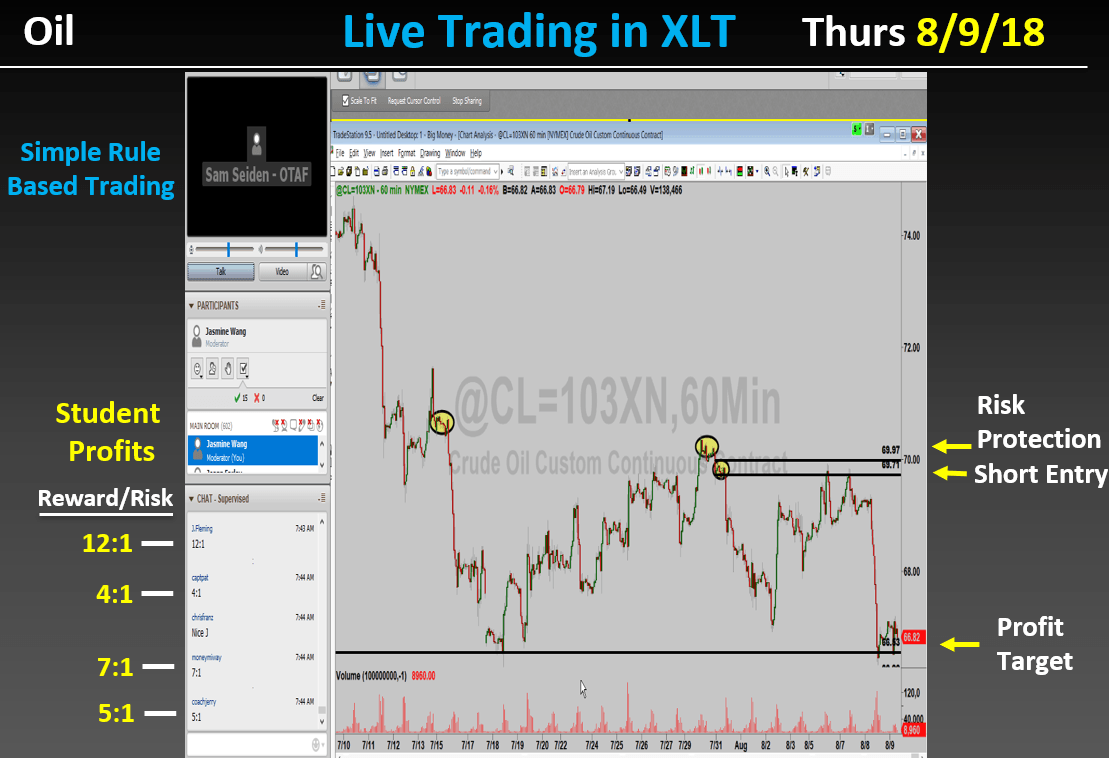
The chart above is a recent trade we took in one of my live trading sessions with members of the academy. It was in Crude Oil futures, one of the many markets we monitor and trade. The trading opportunity offered us a $3.00 gain for $0.30 of risk. Price rallied up to our predetermined supply zone (retail prices) where we sold short, and then it fell to our predetermined demand zone (wholesale prices) where we bought back for a profit.
As you can see on the left, many students reported reward to risk gains that were very ideal. So, what did we need to master to identify and take advantage of this opportunity? Let’s dive into that question…
Question: How much do we need to learn about the fundamentals of Crude Oil and that market?
-
Answer: Nothing at all.
Question: How much do we need to focus on the fundamentals and news around Crude Oil?
-
Answer: Not at all.
Question: Do we need to know or focus on whose supply and demand it is at our levels?
-
Answer: No, we don’t at all, it doesn’t matter.
Question: Do we need to be an expert in math or economics?
-
Answer: No, not at all.
Question: Does it matter if we really don’t understand what Crude Oil is and think Oil is something that grows on a tree and we eat it?
-
Answer: Doesn’t matter at all.
Question: Do we need to know how to quantify and identify real supply (retail) and demand (wholesale) on a price chart?
-
Answer: Yes, this is how you profit buying and selling anything in life, so you have to master this.
The big illusion is that you have to be a walking calculator or Ivy League economist to be a great trader or investor. The reality is, you don’t. How we make money trading the financial markets is exactly how you make money buying and selling anything.
Really think about how you buy and sometimes sell things in other parts of life. We always try and buy at wholesale prices and sell at retail prices just like any business or store does.
Really think about it for a minute. You probably know what a sale price on laundry detergent is, but do you know the chemical make up of it? Do you care? Do you know the factory it’s made at and who manages that factory? No, you’re focused on price. Whether it’s the detergent, a car, your home or your trading and investing markets, your thought process and strategy should not change. There is only one way to make money buying and selling anything in life. Don’t let the illusion of a complicated financial system fool you.
If you have any questions or comments, please let me know I am always happy to help if I can.
Read the original article here - Are You Too Smart to Make Money?
Note: All information on this page is subject to change. The use of this website constitutes acceptance of our user agreement. Please read our privacy policy and legal disclaimer. Opinions expressed at FXstreet.com are those of the individual authors and do not necessarily represent the opinion of FXstreet.com or its management. Risk Disclosure: Trading foreign exchange on margin carries a high level of risk, and may not be suitable for all investors. The high degree of leverage can work against you as well as for you. Before deciding to invest in foreign exchange you should carefully consider your investment objectives, level of experience, and risk appetite. The possibility exists that you could sustain a loss of some or all of your initial investment and therefore you should not invest money that you cannot afford to lose. You should be aware of all the risks associated with foreign exchange trading, and seek advice from an independent financial advisor if you have any doubts.
Editors’ Picks

EUR/USD flirts with daily highs, retargets 1.1900
EUR/USD regains upside traction, returning to the 1.1880 zone and refocusing its attention to the key 1.1900 barrier. The pair’s slight gains comes against the backdrop of a humble decline in the US Dollar as investors continue to assess the latest US CPI readings and the potential Fed’s rate path.

GBP/USD remains well bid around 1.3650
GBP/USD maintains its upside momentum in place, hovering around daily highs near 1.3650 and setting aside part of the recent three-day drop. Cable’s improved sentiment comes on the back of the Greenback’s irresolute price action, while recent hawkish comments from the BoE’s Pill also collaborate with the uptick.

USD/JPY edges up above 153.50 with all eyes on US CPI figures
USD/JPY appreciates above 153.00 but remains on track for a 2.4% weekly loss. Trading volumes remain subdued on Friday, ahead of the IS CPI release. The Yen remains supported by hopes of a stable government and calls for further BoJ tightening.
Editors’ Picks

EUR/USD: Yes, the US economy is resilient – No, that won’t save the US Dollar Premium
Some impressive US data should have resulted in a much stronger USD. Well, it didn’t happen. The EUR/USD pair closed a third consecutive week little changed, a handful of pips above the 1.1800 mark.

Gold: Metals remain vulnerable to broad market mood Premium
Gold (XAU/USD) started the week on a bullish note and climbed above $5,000 before declining sharply and erasing its weekly gains on Thursday, only to recover heading into the weekend.

GBP/USD: Pound Sterling remains below 1.3700 ahead of UK inflation test Premium
The Pound Sterling (GBP) failed to resist at higher levels against the US Dollar (USD), but buyers held their ground amid a US data-busy blockbuster week.
Bitcoin: BTC bears aren’t done yet
Bitcoin (BTC) price slips below $67,000 at the time of writing on Friday, remaining under pressure and extending losses of nearly 5% so far this week.

US Dollar: Big in Japan Premium
The US Dollar (USD) resumed its yearly downtrend this week, slipping back to two-week troughs just to bounce back a tad in the second half of the week.
RECOMMENDED LESSONS
Making money in forex is easy if you know how the bankers trade!

I’m often mystified in my educational forex articles why so many traders struggle to make consistent money out of forex trading. The answer has more to do with what they don’t know than what they do know. After working in investment banks for 20 years many of which were as a Chief trader its second knowledge how to extract cash out of the market.
5 Forex News Events You Need To Know

In the fast moving world of currency markets where huge moves can seemingly come from nowhere, it is extremely important for new traders to learn about the various economic indicators and forex news events and releases that shape the markets. Indeed, quickly getting a handle on which data to look out for, what it means, and how to trade it can see new traders quickly become far more profitable and sets up the road to long term success.
Top 10 Chart Patterns Every Trader Should Know

Chart patterns are one of the most effective trading tools for a trader. They are pure price-action, and form on the basis of underlying buying and selling pressure. Chart patterns have a proven track-record, and traders use them to identify continuation or reversal signals, to open positions and identify price targets.
7 Ways to Avoid Forex Scams

The forex industry is recently seeing more and more scams. Here are 7 ways to avoid losing your money in such scams: Forex scams are becoming frequent. Michael Greenberg reports on luxurious expenses, including a submarine bought from the money taken from forex traders. Here’s another report of a forex fraud. So, how can we avoid falling in such forex scams?
What Are the 10 Fatal Mistakes Traders Make
Trading is exciting. Trading is hard. Trading is extremely hard. Some say that it takes more than 10,000 hours to master. Others believe that trading is the way to quick riches. They might be both wrong. What is important to know that no matter how experienced you are, mistakes will be part of the trading process.
The challenge: Timing the market and trader psychology

Successful trading often comes down to timing – entering and exiting trades at the right moments. Yet timing the market is notoriously difficult, largely because human psychology can derail even the best plans. Two powerful emotions in particular – fear and greed – tend to drive trading decisions off course.