The question I get asked a lot when speaking or working with new traders is how active should I be as a trader? This question has been asked a lot by many around the globe, if you ask your broker he will say active, your trend adviser he will say less active. So who is right ? Several years algo I ran a group of 50+ ALGO day traders using our ATS trading software and where the opportunity to trade a lot was always there because our short term ALGOs gave 20+ plus trades per day. Looking back on it however, did we need to do that much trading (we routinely did 1% of total SPY volume 1-2mm shares per day).  My answer is – it depends on the person/trader.

Many years ago, I used to define profit potential as a function. Profit was defined as a function of skill and opportunity. The less skill you have means you require more opportunity. This is the scalper. The more skill you have, then the less opportunity you require, this is the longer term position trader. I have since amended that function to include mentality even for ALGO trading because ALGO need to be run, they don’t run themselves, and environment, which is defined by how much time a trade can or does spent connected to the trading.

Why is mentality important ? Simply put, some traders cant sit on their hands. They need to be involved in some action. This is as much about emotion as it is about market view. Other traders don’t want to watch the market short term and prefer to place their trades with their levels or what ever form of money management and then things unfold. The environment aspect is relatively straight forward. Many traders d not trade full time and work at other jobs. This means that they cannot be monitoring short term algos all day or they soon wont be working full time.

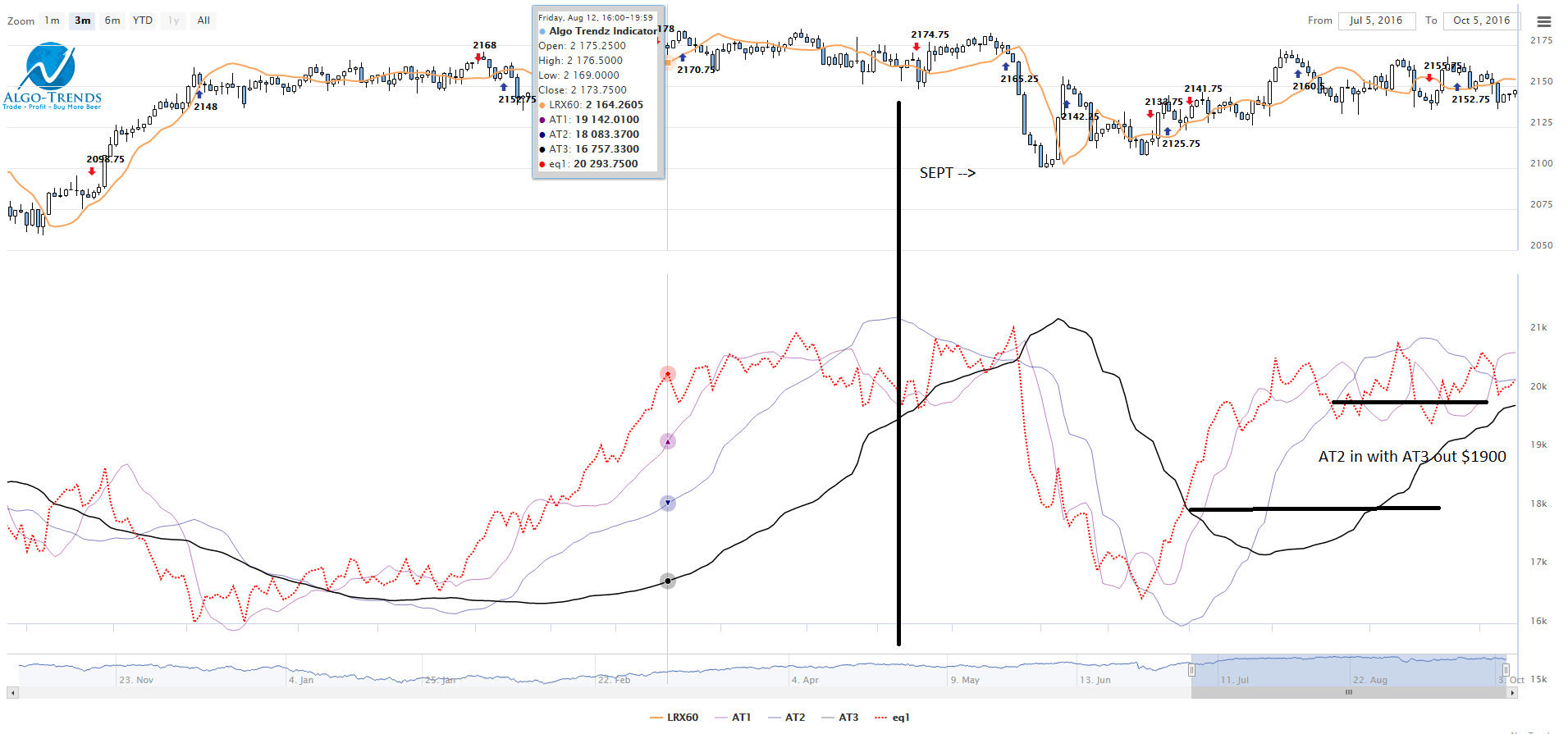
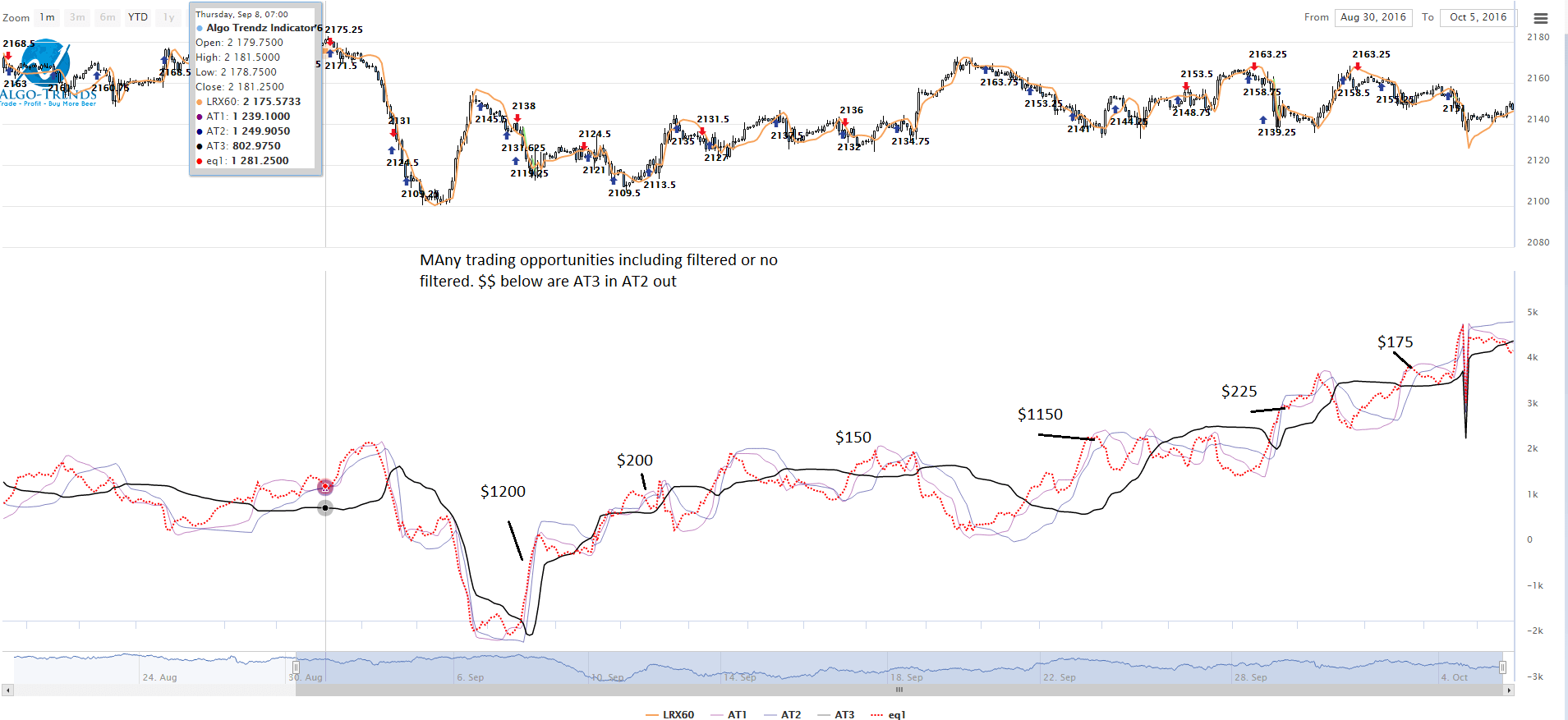
Below I have posted three of our ALGO programs from the Index Strategist. All three produces similar $2000 returns but did so in very different ways. The first chart shows a relatively active model that we use in the live trade. This model relies on shorter trades for better risk adjusted returns but has a fair amount of trading during the month. For the ADHD trade (like me) this is preferred but this is for full time traders who have the time to make sure things are running smoothly.
YTD

The second chart is a lightly less active model that requires more patience but is better suited to the trader who is watching many markets, perhaps have many ideas. This model has only one on and off session the whole month. This is more idea for the trader who has some patience and is not in front of their screen all the time. This level requires more faith in the process of the ALGO which is generated form understanding how the ALGO is designed.
YTD

The Last example is a very passive approach that is employed by the trader who has much more skill (or AGLO signal being right) but also places a great deal of value in letting the trade work because they just don’t have the time to monitor short term.

Bottom line is that every trader is different and each approach should factor in many inputs to select the best way to trade.


Editors’ Picks

EUR/USD flirts with daily highs, retargets 1.1900

EUR/USD flirts with daily highs, retargets 1.1900

EUR/USD regains upside traction, returning to the 1.1880 zone and refocusing its attention to the key 1.1900 barrier. The pair’s slight gains comes against the backdrop of a humble decline in the US Dollar as investors continue to assess the latest US CPI readings and the potential Fed’s rate path.

GBP/USD remains well bid around 1.3650

GBP/USD remains well bid around 1.3650

GBP/USD maintains its upside momentum in place, hovering around daily highs near 1.3650 and setting aside part of the recent three-day drop. Cable’s improved sentiment comes on the back of the Greenback’s  irresolute price action, while recent hawkish comments from the BoE’s Pill also collaborate with the uptick.

USD/JPY edges up above 153.50 with all eyes on US CPI figures

USD/JPY edges up above 153.50 with all eyes on US CPI figures

USD/JPY appreciates above 153.00 but remains on track for a 2.4% weekly loss. Trading volumes remain subdued on Friday, ahead of the IS CPI release. The Yen remains supported by hopes of a stable government and calls for further BoJ tightening.


Editors’ Picks

EUR/USD: Yes, the US economy is resilient – No, that won’t save the US Dollar

EUR/USD: Yes, the US economy is resilient – No, that won’t save the US Dollar Premium

Some impressive US data should have resulted in a much stronger USD. Well, it didn’t happen. The EUR/USD pair closed a third consecutive week little changed, a handful of pips above the 1.1800 mark. 

Gold: Metals remain vulnerable to broad market mood

Gold: Metals remain vulnerable to broad market mood Premium

Gold (XAU/USD) started the week on a bullish note and climbed above $5,000 before declining sharply and erasing its weekly gains on Thursday, only to recover heading into the weekend. 

GBP/USD: Pound Sterling remains below 1.3700 ahead of UK inflation test

GBP/USD: Pound Sterling remains below 1.3700 ahead of UK inflation test Premium

The Pound Sterling (GBP) failed to resist at higher levels against the US Dollar (USD), but buyers held their ground amid a US data-busy blockbuster week.

Bitcoin: BTC bears aren’t done yet

Bitcoin: BTC bears aren’t done yet

Bitcoin (BTC) price slips below $67,000 at the time of writing on Friday, remaining under pressure and extending losses of nearly 5% so far this week.

US Dollar: Big in Japan

US Dollar: Big in Japan Premium

The US Dollar (USD) resumed its yearly downtrend this week, slipping back to two-week troughs just to bounce back a tad in the second half of the week.

RECOMMENDED LESSONS

5 Forex News Events You Need To Know

In the fast moving world of currency markets where huge moves can seemingly come from nowhere, it is extremely important for new traders to learn about the various economic indicators and forex news events and releases that shape the markets. Indeed, quickly getting a handle on which data to look out for, what it means, and how to trade it can see new traders quickly become far more profitable and sets up the road to long term success.

Top 10 Chart Patterns Every Trader Should Know

Chart patterns are one of the most effective trading tools for a trader. They are pure price-action, and form on the basis of underlying buying and selling pressure. Chart patterns have a proven track-record, and traders use them to identify continuation or reversal signals, to open positions and identify price targets.

7 Ways to Avoid Forex Scams

The forex industry is recently seeing more and more scams. Here are 7 ways to avoid losing your money in such scams: Forex scams are becoming frequent. Michael Greenberg reports on luxurious expenses, including a submarine bought from the money taken from forex traders. Here’s another report of a forex fraud. So, how can we avoid falling in such forex scams?

What Are the 10 Fatal Mistakes Traders Make

Trading is exciting. Trading is hard. Trading is extremely hard. Some say that it takes more than 10,000 hours to master. Others believe that trading is the way to quick riches. They might be both wrong. What is important to know that no matter how experienced you are, mistakes will be part of the trading process.

Strategy

Money Management

Psychology

Best Brokers of 2025